How to Practice Speaking Korean When You Have Nobody to Talk To
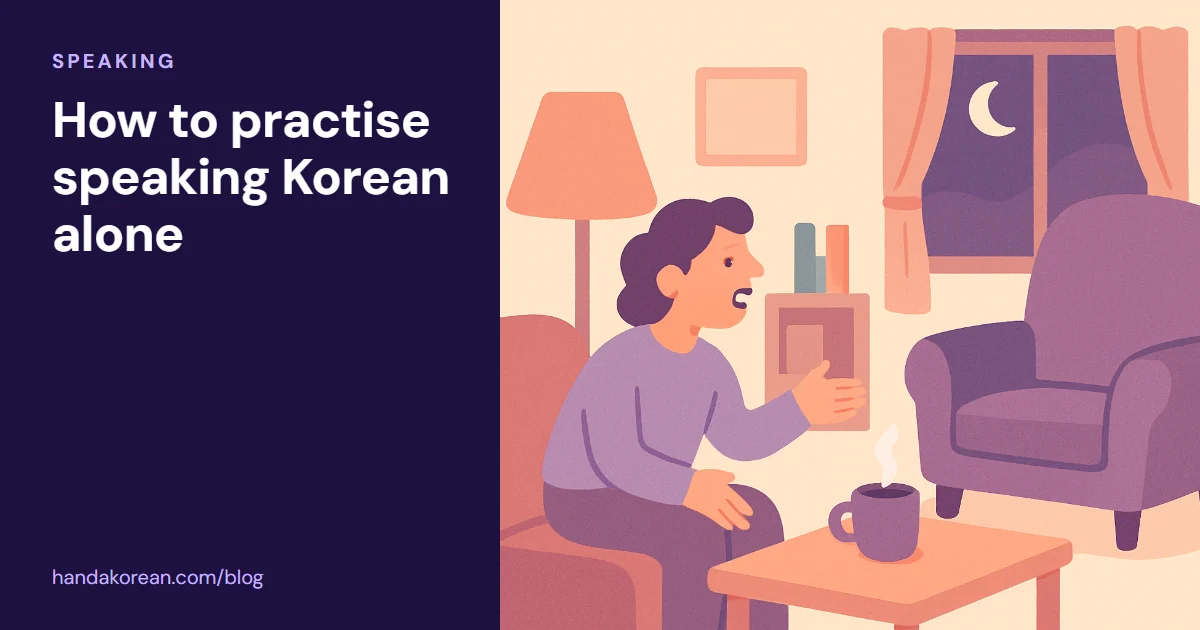
Most people learning Korean alone hit the same wall. Reading is fine. Listening is getting better. And then someone asks a question in Korean and nothing comes out.
This is not a vocabulary problem. It is a production problem — and production is the one skill that input alone never builds. You can watch four hundred hours of Korean television and still freeze, because watching trains recognition, and recognition is not the same muscle as retrieval.
Here is what actually works when there is nobody sitting across from you, roughly in the order you should reach for it.
1. Say everything out loud, including the reading
The cheapest change with the largest effect: stop reading silently.
When you study a sentence, say it. When you meet a new word, say it five times. When you do a textbook exercise, speak the answer before you write it. Your mouth has never made these shapes before — 으 and 어 do not exist in English, and the difference between ㄱ, ㅋ and ㄲ is not a difference English uses to tell words apart.
This feels trivial and it is not. Learners who read silently for a year build a Korean that lives entirely in their eyes.
2. Shadowing — copying audio in real time
Shadowing means playing a Korean recording and speaking along with it, a beat behind, copying the rhythm as closely as you can. Not translating. Not understanding every word. Copying.
What it trains is prosody: where Korean puts its stress, how sentences rise and fall, how fast the syllables actually come. This is the part of an accent that textbooks cannot teach you, because it is not written down anywhere.
Start with material slightly below your reading level. If you are struggling to decode the words, you have no attention left for the melody. Our level-matched listening guide covers how to pick audio that fits.
3. Pronunciation feedback, at the phoneme level
Shadowing tells you nothing about whether you are right. For that you need something that listens back.
Be careful what you accept as feedback, though. An app that tells you "78%" has told you nothing you can act on. The useful version identifies which sound you missed — that your ㅅ is landing too close to an English "s" before ㅣ, or that your final consonants are being released when they should be stopped. We wrote about why a single percentage score is useless and what to look for instead.
4. Conjugation drills, done as production
Korean conjugation is where most self-study speaking dies. You know 먹다 means "to eat." Someone asks what you ate. You need 먹었어요, and you need it in under a second, and instead you spend four seconds assembling it from parts.
Recognising 먹었어요 on a page is easy. Producing it under time pressure is a different skill, and flashcards do not train it — flashcards show you the answer. You need drills that make you build the form yourself, from the dictionary form, out loud, fast. This is the argument we make at length in Korean conjugation is a production problem.
5. Talk to yourself, on purpose
Narrate your day in Korean. Not perfectly — badly, and out loud.
오늘 뭐 했어요? 커피 마셨어요. 그리고 일했어요.
You will immediately discover the gap between what you can recognise and what you can say. You will want a word, not have it, and that wanting is the most efficient vocabulary lesson available — a word you reached for and missed sticks in a way a word from a list never does. This is why so much studied vocabulary refuses to stay in your head.
Keep a note open. Every time you get stuck, write the English. Look up five of them at the end of the day, not thirty.
6. Real conversation, with correction
Everything above is preparation. At some point you need the thing itself: someone asks you something you did not plan for, and you answer, and you are told when you are wrong.
The correction part matters more than people expect. A conversation partner who nods politely at your mistakes is pleasant and will slow you down for years, because you will fossilise your errors — repeat them until they feel correct. But the style of correction matters too. Being stopped mid-sentence every time destroys fluency; never being stopped destroys accuracy. There are four distinct ways to correct a mistake, and they are good for different things at different stages.
This is also the part that is hardest to arrange alone, which is why AI tutors have become the default answer — they are available at 11pm, they do not get bored of your level, and they will correct you every single turn without it being awkward. We compared the main options, including a direct comparison with Speak.
The order that actually works
If you do only one thing: speak out loud, every day, even badly. Ten minutes of bad speaking beats an hour of silent reading for this specific skill.
If you can do three:
- Shadow something at your level for five minutes.
- Drill conjugation out loud until the common forms are automatic.
- Have one real conversation where you get corrected.
The first two make the third one survivable. The third one is the only one that actually makes you a speaker.
Start today. Say one sentence in Korean out loud before you close this tab — 저는 한국어를 공부해요. That is the whole first step.
Practice this with an AI tutor
HanDa corrects every sentence you write or say — in real conversation, not flashcards.