HanDa vs Speak for Learning Korean
Last updated: September 2026.
Short answer: Speak is the better choice if you want a polished, well-produced lesson experience or expect to study more than one language. HanDa is the better choice if Korean is your only target and you want speech levels, TOPIK-mapped content and sound-by-sound pronunciation feedback. We make HanDa, so weigh this accordingly — the comparison below sticks to differences you can verify yourself in each app's store listing and help pages.
The core difference
Speak is a multi-language product. Korean is one of several courses, and its curriculum architecture has to work for every language it supports. That is a genuine strength — it means a large, well-tested lesson system and a very polished app.
HanDa is Korean-only. Everything in it can assume Korean, which is why it can enforce 존댓말 and 반말 inside role-plays, map levels to TOPIK 1–6, and build drills around Korean conjugation specifically. That is also its limitation: if you decide to learn Japanese next year, HanDa is useless to you and Speak isn't.
Neither bet is wrong. They're just different bets.
Side by side
| HanDa | Speak | |
|---|---|---|
| Languages | Korean only | Several, including Korean |
| Who can take the Korean course | Explanations in 7 languages | Native English speakers only |
| Correction approach | 4 AI teachers, each using a different correction method | Single consistent tutor approach |
| Speech levels (존댓말/반말) | Enforced per scenario | Not advertised |
| Pronunciation feedback | Sound by sound, tracked over time | Speak's sound-level Pronunciation Coach is for learners of English only |
| Level mapping | TOPIK 1–6 | Speak's own levels |
| Shared subscription | Host plan includes 2 friends | Single user |
| Platform | iOS and Android | iOS and Android |
| Approx. price (US, monthly) | $10–25 | $18–40 (annual plans much cheaper) |
Prices in this category change often and vary by country. Check both stores before deciding.
Where Speak is better
- Production quality. Speak's lessons are more polished than anything HanDa ships.
- Multi-language. One subscription, several languages.
- Hands-free practice. Speak has a dedicated hands-free mode for speaking while you do something else.
- Brand maturity. More reviews, longer track record, easier to trust sight-unseen.
Where HanDa is better
- Speech levels. Korean's formality system is not an accent — using 반말 with a stranger is a social error. HanDa assigns a speech level per scenario and holds you to it.
- Pronunciation granularity. HanDa scores each sound you say and tracks which specific sounds you keep missing, rather than returning one overall number per sentence.
- Mistake memory. Recurring errors are detected across sessions and become the next day's practice.
- Teaching style choice. Four teachers apply genuinely different correction strategies — recast, metalinguistic explanation, casual, explicit. Learners who freeze under direct correction and learners who want to be told exactly what they got wrong need different things.
- Not only for English speakers. Explanations are available in English, French, German, Japanese, Spanish, Russian and Chinese.
- Shared use. One Host subscriber can bring two friends into a room. Speak is single-player.
How to actually decide
Answer one question: is Korean the only language you plan to study for the next year?
If yes, the Korean-specific machinery is worth more than the polish, and HanDa is the better fit. If no — if there's any chance you'll switch or add a language — a multi-language subscription is better value and you should pick Speak or Langua.
HanDa has a 7-day free trial; check Speak's current offer in your app store. Two weeks of real usage tells you more than any comparison page, including this one.
Related reading
Learn this properly, not just once
Blog posts teach one thing at a time. The HanDa books teach level 1 in order — every lesson built to be spoken, with a workbook and writing book beside it.
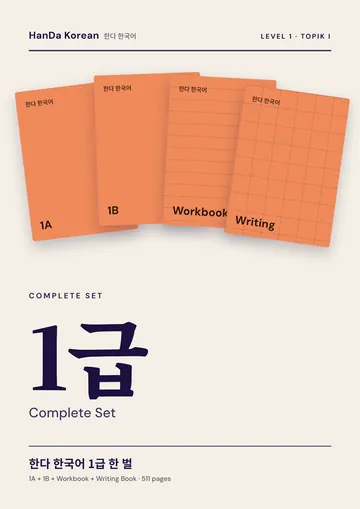 HanDa Korean Level 1 — Complete Set
Everything for level 1 — books, workbook and writing book · 511 pages
$10
HanDa Korean Level 1 — Complete Set
Everything for level 1 — books, workbook and writing book · 511 pages
$10
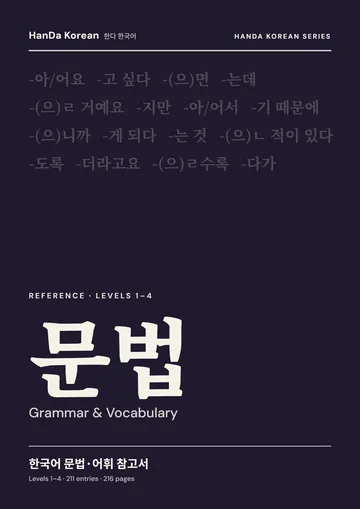 Korean Grammar & Vocabulary Reference
Every pattern in one place · 216 pages
$8
Korean Grammar & Vocabulary Reference
Every pattern in one place · 216 pages
$8
Practice this with an AI tutor
HanDa corrects every sentence you write or say — in real conversation, not flashcards.