Four Ways to Correct a Korean Mistake — and Which One You Need
Short answer: second-language research recognises several distinct ways to correct a spoken error — the main four being recast (reformulate it correctly without comment), metalinguistic (name the rule), explicit (state plainly that it was wrong and give the right form) and elicitation (prompt the learner to self-correct). They are not interchangeable. Explicit correction produces the fastest accuracy gains and the highest dropout; recasting keeps people talking and is easy to miss entirely.
Most language apps pick one of these, apply it to everybody, and never mention it. It's worth knowing which one you're getting, because it explains a lot about why an app either clicks with you or quietly makes you dread opening it.
The four types
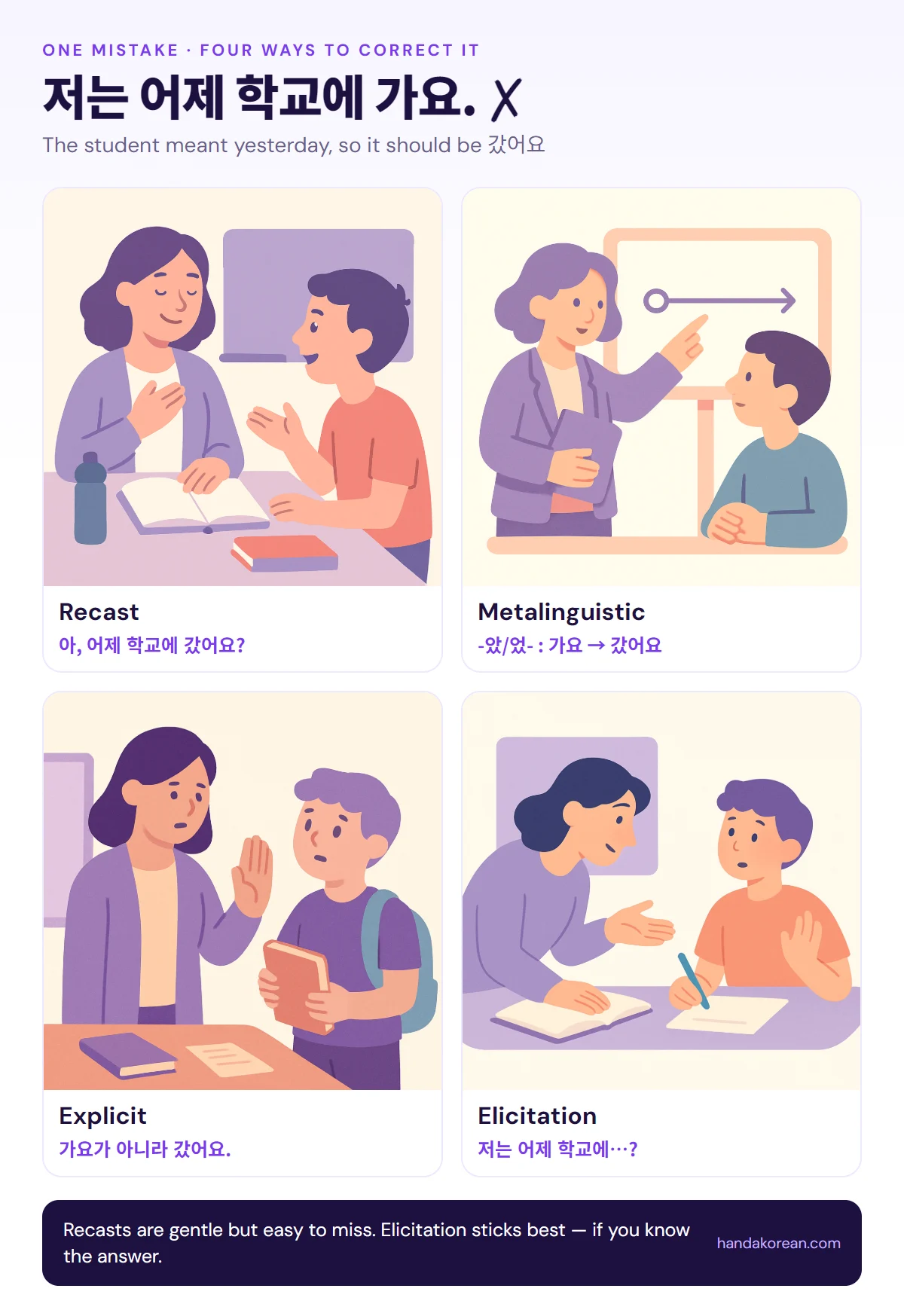
Recast. You say 저는 어제 학교에 가요. The teacher replies "아, 어제 학교에 갔어요?" and carries on. The correction is embedded in a natural response — no interruption, no lecture.
Good for: keeping momentum, and for learners who freeze when corrected. Risk: it's genuinely easy to not notice you were corrected at all. Learners often hear a recast as agreement.
Metalinguistic. "You used the present tense, but 어제 is past. Korean marks past tense with -았/었-, so 가요 becomes 갔어요."
Good for: analytical learners, and for errors that come from not knowing a rule rather than not applying it. Risk: slow, and it turns a conversation into a lesson.
Explicit. "That's wrong — it should be 갔어요."
Good for: speed and unambiguity. Nobody misses an explicit correction. Risk: it's the correction style most associated with learners disengaging, especially adults who are already self-conscious about speaking badly.
Elicitation. "저는 어제 학교에…?" — and waits for you to finish it correctly.
Good for: retention. Retrieving the right form yourself encodes it far better than hearing it. Risk: if you don't know the answer, the pause is excruciating and produces nothing.
Why the choice matters more in Korean
Two reasons specific to Korean.
Errors cluster in morphology, not word order. Most learner mistakes are conjugation, particle choice and speech level — small changes to endings. Recasts of these are especially easy to miss, because the sentence sounds nearly identical to what you said. Miss it, and you repeat the mistake for months.
Speech level errors are social, not grammatical. Using 반말 with someone you shouldn't isn't a grammar mistake, it's a rudeness. Recasting it teaches the form but not the stakes. This is one case where explicit correction genuinely serves the learner better.
Matching a style to yourself
Be honest about which of these you are:
- You stop talking when corrected. You need recast. Fluency first, accuracy later — you can't fix speech that isn't happening.
- You want to know why. Metalinguistic. You'll find recasts frustratingly vague and wonder why nothing is being explained.
- You want to be told straight. Explicit. Gentler styles will feel like the app is being evasive.
- You already know the rules but don't apply them under pressure. Elicitation. Your problem is retrieval, not knowledge, and only retrieval practice fixes retrieval.
Most people need different styles at different stages. Recast early when the priority is getting words out at all; explicit and elicitation later when the priority is accuracy.
How HanDa handles it
HanDa ships four AI teachers, and the difference between them is exactly this — the correction method, not the personality skin:
| Teacher | Method | Pacing |
|---|---|---|
| Soo | Recast — reformulates without interrupting | Gentle |
| Jiyeon | Metalinguistic — names and explains the rule | Standard |
| Junho | Recast, casual register and slang | Fast |
| Minjun | Explicit — states the error directly and drills it | Aggressive |
You can switch at any time, and switching is the point. A common pattern that works: start with Soo until speaking stops feeling frightening, move to Jiyeon while you're building grammar, then use Minjun when you're preparing for something with real stakes like a test or a trip.
If you're using a different app, it's still worth working out which of the four you're getting. It's usually obvious after three or four corrections, and it explains most of how the app feels to use.
Related reading
Learn this properly, not just once
Blog posts teach one thing at a time. The HanDa books teach level 1 in order — every lesson built to be spoken, with a workbook and writing book beside it.
 HanDa Korean 1 — Teacher's Guide
Goes with this post · 69 pages
$8
HanDa Korean 1 — Teacher's Guide
Goes with this post · 69 pages
$8
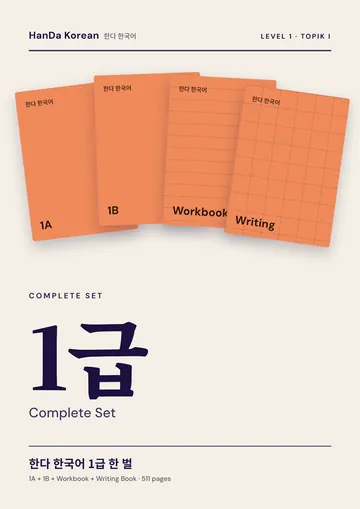 HanDa Korean Level 1 — Complete Set
Everything for level 1 — books, workbook and writing book · 511 pages
$10
HanDa Korean Level 1 — Complete Set
Everything for level 1 — books, workbook and writing book · 511 pages
$10
Practice this with an AI tutor
HanDa corrects every sentence you write or say — in real conversation, not flashcards.