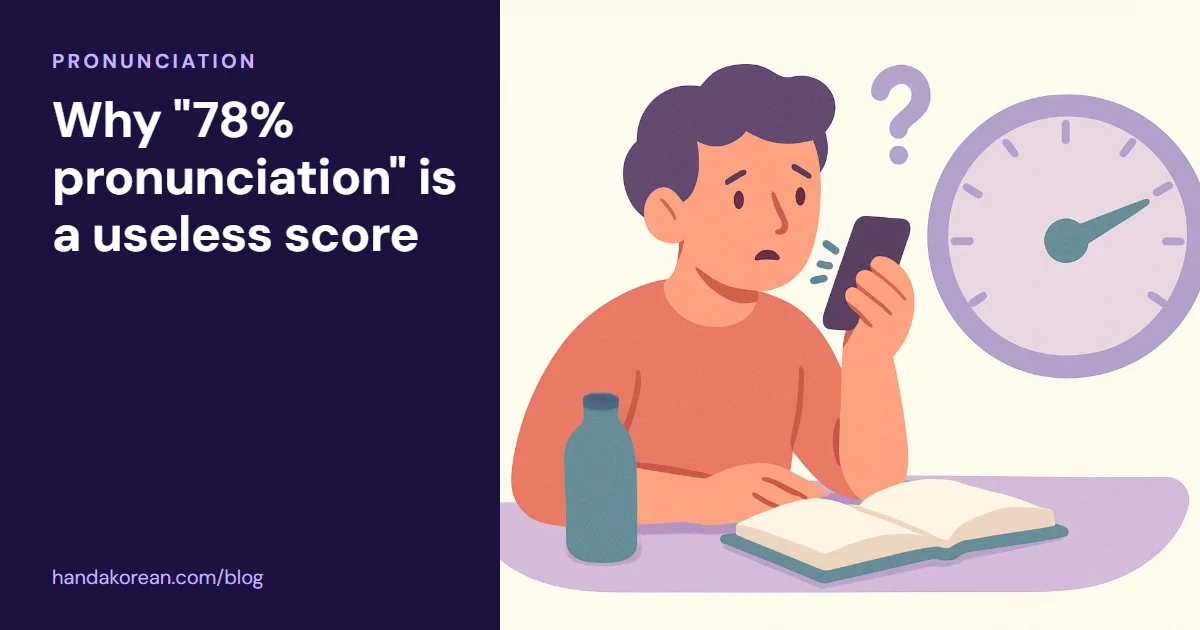
Why "78% Pronunciation" Is a Useless Score
Short answer: a single accuracy percentage per sentence tells you that something was wrong, not what. Useful pronunciation feedback is scored at the phoneme level — the individual sound — and tracked over time, so you can see that you consistently miss ㅓ or fail to distinguish ㄱ from ㄲ, and practise that specific thing.
What a sentence score actually measures
You say 저는 학생이에요. The app returns 78%.
Now what? You don't know whether the 22% came from one badly aspirated ㅎ, a vowel you flattened, or your rhythm across the whole phrase. So you say it again, slightly louder, and get 81%. You have learned nothing, but it felt like progress.
This is the core problem with sentence-level scoring: it's a grade, not a diagnosis. Grades are motivating and diagnoses are useful, and most apps optimise for the first because it feels better.
What phoneme-level assessment does instead
Phoneme-level assessment scores each individual sound in what you said, then aligns it against what you were supposed to say. The output isn't one number — it's a map:
- 저 — ㅈ good, ㅓ scored low
- 는 — good
- 학 — ㅎ good, ㅏ good, ㄱ final scored low
- 생 — good
- 이에요 — good
Now you know something actionable: your ㅓ is drifting, and you're not releasing final consonants correctly. Both are specific, both are fixable, and neither was visible in "78%".
The second half of this is tracking. One bad ㅓ is noise. ㅓ scoring low across forty sentences over two weeks is a habit, and it's the single most useful thing an app can tell you about your speaking.
The sounds English speakers actually miss
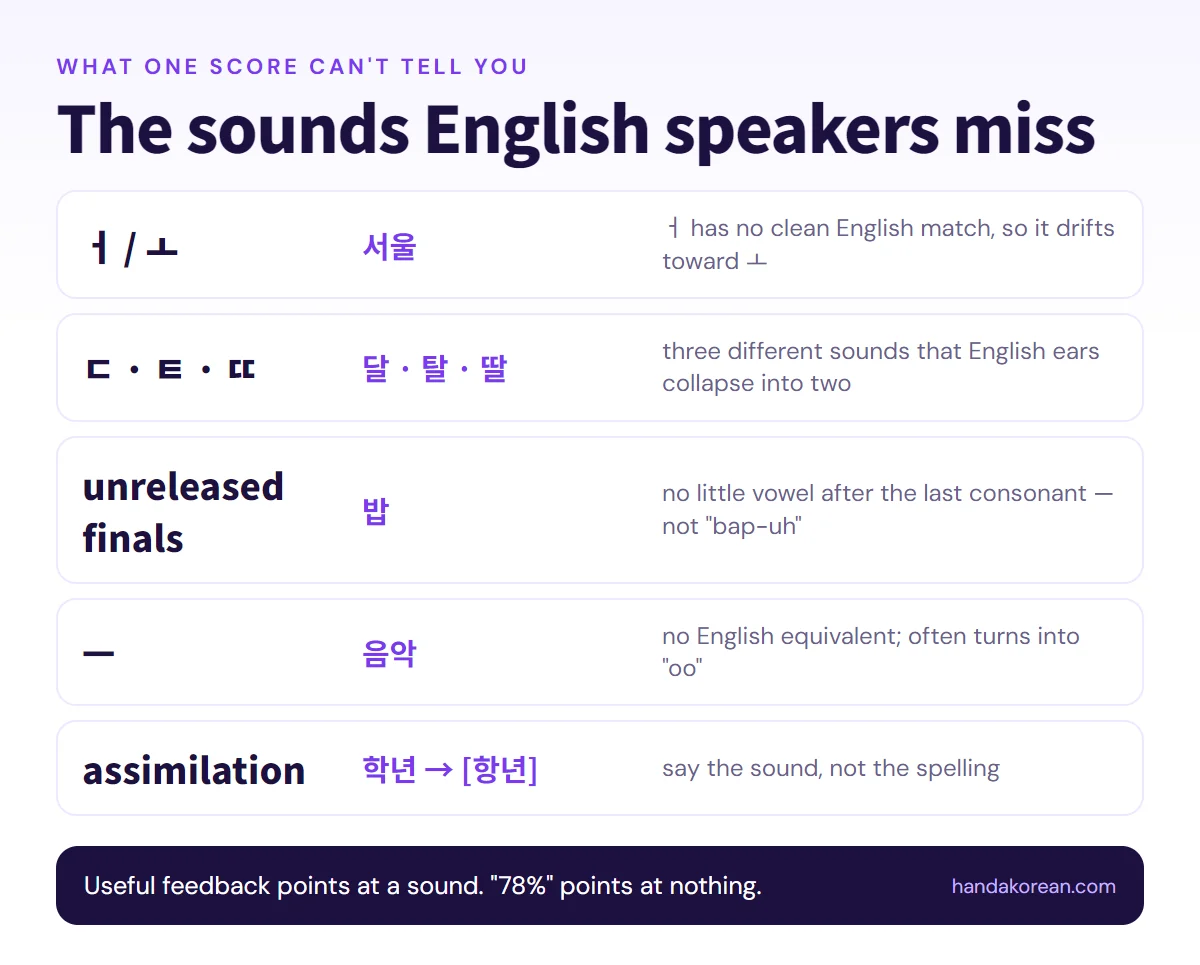
If you're coming from English, the same handful of things go wrong:
ㅓ vs ㅗ. English has no clean equivalent to ㅓ, so learners substitute the nearest English vowel and it lands somewhere between the two. 서울 becomes something closer to "Seoul" than 서울. This is the most common single error.
The three-way stop distinction. Korean distinguishes ㄱ / ㅋ / ㄲ, ㄷ / ㅌ / ㄸ, ㅂ / ㅍ / ㅃ. English has a two-way voiced/voiceless distinction, so learners collapse three sounds into two. 달 (moon), 탈 (mask) and 딸 (daughter) become indistinguishable.
Final consonant release. Korean final consonants are unreleased. English speakers release them, adding a faint vowel — 밥 comes out closer to "bap-uh". Native listeners notice immediately even when they can't name what's wrong.
ㅡ. There's no English equivalent at all, so it usually turns into "oo" or gets swallowed entirely.
Assimilation across syllable boundaries. 학년 is pronounced 항년, not 학년. Learners who read carefully often pronounce the spelling rather than the sound, which reads as robotic rather than wrong.
Notice that none of these are things a sentence-level score can point you at.
What to look for in an app
- Per-sound feedback, not one number per sentence.
- Persistence — does it remember that ㅓ is your weak point, or does each session start from zero?
- Both accuracy and fluency, reported separately. Accurate but halting and fluent but sloppy are different problems with different fixes.
- Real sentences, not isolated syllables. Korean sound changes happen at syllable boundaries, so practising sounds in isolation misses the errors that actually make you hard to understand.
HanDa scores at the phoneme level on every spoken sentence, reports accuracy and fluency separately, and tracks weak phonemes across sessions so recurring problems surface rather than resetting each time. Teuida also does AI pronunciation analysis and is worth looking at if video-based practice appeals to you.
The uncomfortable part
Phoneme-level feedback is more useful and less pleasant. A sentence score goes up over a session because you're repeating the same sentence. A phoneme map keeps telling you your ㅓ is wrong, session after session, because your ㅓ is wrong and saying it louder doesn't fix it.
That's the trade. Pick the feedback that tells you something true.
Related reading
Learn this properly, not just once
Blog posts teach one thing at a time. The HanDa books teach level 1 in order — every lesson built to be spoken, with a workbook and writing book beside it.
 Korean Pronunciation Workbook
Goes with this post · 85 pages
$7
Korean Pronunciation Workbook
Goes with this post · 85 pages
$7
 HanDa Korean Level 1 — Complete Set
Everything for level 1 — books, workbook and writing book · 511 pages
$10
HanDa Korean Level 1 — Complete Set
Everything for level 1 — books, workbook and writing book · 511 pages
$10
Practice this with an AI tutor
HanDa corrects every sentence you write or say — in real conversation, not flashcards.