The Best AI Korean Tutor Apps in 2026
Last updated: September 2026. Prices are US App Store monthly prices checked this month; annual plans are cheaper and every app runs regional pricing and promotions, so check the live price before you decide.
Most "best Korean app" lists are written by one of the apps on the list, which is worth knowing before you read any of them — including this one. We make HanDa. So instead of ranking twelve apps from 1 to 12, this page sorts them by who each one is for, and says plainly where HanDa is the wrong pick.
Short answer: if you want depth in Korean specifically, pick a Korean-only app. If you want one subscription that covers Korean plus other languages, pick a multi-language app such as Langua, Speak or Talkpal. If you have never touched Hangul, start with a structured beginner course and add a conversation app about a month in.
The fastest way to choose
| If you… | Look at |
|---|---|
| Want one subscription covering many languages | Langua, Speak, Talkpal, Praktika, Pingo AI |
| Want Korean-only depth and TOPIK alignment | HanDa, Chamelingo, Lingory, Teuida |
| Are starting from zero Hangul | Eggbun, Lingory, or a free Hangul course, then add a conversation app |
| Want to try AI conversation before paying | Talkpal and Langua (both have a limited free tier) |
| Want to study with a friend or partner | HanDa (Friend Rooms) |
| Care most about pronunciation detail | HanDa, Teuida |
| Want to spend nothing | HowToStudyKorean's free lessons |
Multi-language AI tutors that include Korean
Langua is the most frequently recommended AI speaking app in this category, and deservedly: its voices are the benchmark, and its Call Mode is good for hands-free practice while walking or driving. It covers 20+ languages under one subscription, with a small free tier. The tradeoff is breadth — its pages don't advertise Korean-specific machinery such as speech-level (존댓말/반말) practice or TOPIK-mapped levels. About $20–30/month.
Speak is the most polished product in the category and the strongest for learners who want structured, well-produced lessons rather than open conversation. It has a hands-free mode too. Two things to know before choosing it for Korean: the Korean course is only offered to people whose native language is English, and its sound-by-sound Pronunciation Coach is currently for learners of English only. iOS and Android. About $18/month for Premium and $40/month for Premium Plus, with annual plans much cheaper.
Talkpal covers 130+ languages with chat, call and role-play modes, and it is one of the few that also works in a web browser. The free tier (a few minutes a day) is a real way to try AI conversation before paying. Nothing in it is specific to Korean. About $20/month.
Praktika uses AI avatar tutors and has a large, well-rated library of lessons. It started as an English-learning app and Korean is one of fifteen languages, so the Korean content is thinner than its English core. Plans start at about $7/month.
Pingo AI is role-play conversation across 25+ languages, and its Korean page does cover formal and casual speech — worth a look if speech levels matter to you and you still want a multi-language app. The free trial is short. About $15–18/month.
Duolingo Max adds an AI Video Call to Duolingo's course, and Korean is supported. If you already use Duolingo, it's the lowest-friction way to add speaking. Duolingo doesn't publish the Max price on its site; check it in the app.
Memrise is vocabulary-first, with clips of native speakers and an AI conversation partner on the side. Good if your problem is words rather than conversation. About $25/month, with much cheaper annual and lifetime plans.
If you're studying Korean and Japanese, or you expect to switch target languages, a multi-language subscription is the rational choice and you can stop reading here.
Korean-only apps
Teuida is built around speaking from day one: first-person scenarios taught by bilingual tutors, with AI pronunciation analysis on what you say. It's scripted practice rather than open-ended AI chat, which suits learners who want guidance more than freedom. About $15/month.
Eggbun teaches through a chat interface with a character named Lanny. Lanny is a scripted chatbot rather than a generative AI tutor, but it remains the gentlest on-ramp for someone who has never studied Korean. Note that its iOS app hasn't been updated since mid-2025. About $10–15/month.
Lingory is content-led, built by certified Korean teachers, and covers reading, writing, listening and speaking; it added AI speaking practice and pronunciation feedback in 2025. Good structure, less conversational depth. About $7/month.
Chamelingo is a Korean-only structured course that teaches speech levels and prepares for TOPIK and KIIP, with AI tutor calls inside the lessons. Newer, and conversation is a feature rather than the core. About $13/month. (Like us, it also publishes comparison pages — read those with the same caution.)
HanDa — ours — is built around corrected conversation. Four AI teachers each correct mistakes using a different method: Soo recasts your sentence without interrupting, Jiyeon names the grammar rule and explains it, Junho keeps it casual with slang, Minjun corrects explicitly and drills you. Underneath sit 300 role-play scenarios with speech levels enforced, 159 readings mapped to TOPIK 1–6, 720 grammar patterns, 1,798 vocabulary words, and a structured course from Hangul through level 4. Pronunciation is scored sound by sound rather than as one number, and recurring mistakes become the next day's practice. Explanations come in seven languages, not only English. $10/month for Premium, $25/month for Host (which adds a Friend Room for two friends), 7-day free trial.
Where HanDa is the wrong choice: if you want a human tutor, if you want to learn a language other than Korean, if you want to study in a browser rather than on a phone, or if you want a free tier — HanDa has none of those. It also assumes you want to talk. If your goal this month is purely to memorise Hangul, a flashcard app — or the free course below — will serve you better.
Free options worth knowing
HowToStudyKorean has hundreds of free grammar lessons and remains a reference both learners and teachers point to. Talk To Me In Korean's full course is paid, but its first level has a free trial and it runs a free grammar podcast. HanDa's Hangul course and weekly Korean test are free on the web, no sign-up needed.
Plenty of people use a free grammar source for study and an AI app purely for speaking practice. That combination is often better than either alone.
What actually separates these apps
Feature lists all look the same in this category — every app claims conversation, corrections and pronunciation feedback. Four things actually differ:
- Does it remember your mistakes across sessions? A tutor that corrects the same error every week without noticing the pattern isn't teaching, it's reacting.
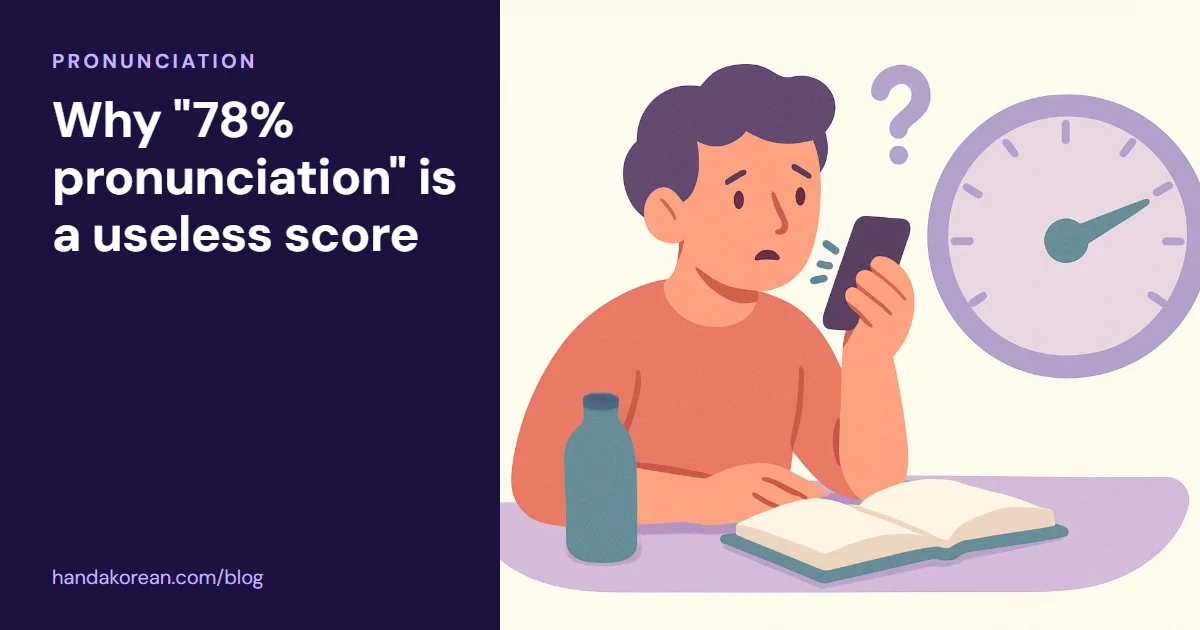
- How granular is pronunciation feedback? "78% accuracy" tells you nothing. Which sound you're getting wrong tells you what to practise.
- Does it handle speech levels? Korean punishes getting 존댓말 and 반말 wrong in a way that many language-agnostic apps don't model at all.
- Is difficulty matched to your level? Input that's too easy is comfortable and useless; too hard is noise.
Ask those four questions of any app on this list — ours included — and the marketing pages get a lot easier to read.
Related reading
Learn this properly, not just once
Blog posts teach one thing at a time. The HanDa books teach level 1 in order — every lesson built to be spoken, with a workbook and writing book beside it.
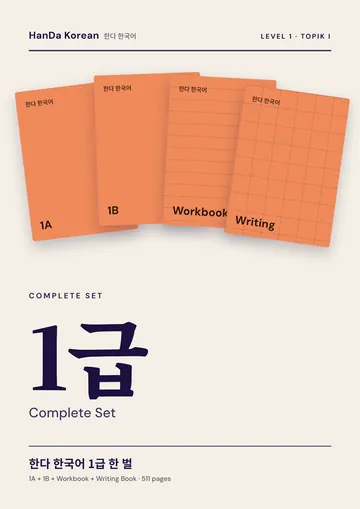 HanDa Korean Level 1 — Complete Set
Everything for level 1 — books, workbook and writing book · 511 pages
$10
HanDa Korean Level 1 — Complete Set
Everything for level 1 — books, workbook and writing book · 511 pages
$10
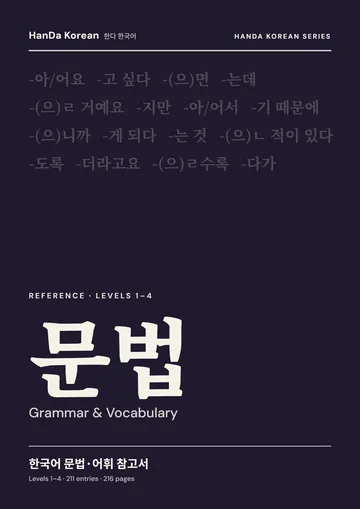 Korean Grammar & Vocabulary Reference
Every pattern in one place · 216 pages
$8
Korean Grammar & Vocabulary Reference
Every pattern in one place · 216 pages
$8
Practice this with an AI tutor
HanDa corrects every sentence you write or say — in real conversation, not flashcards.