Korean Listening Practice, Matched to Your TOPIK Level
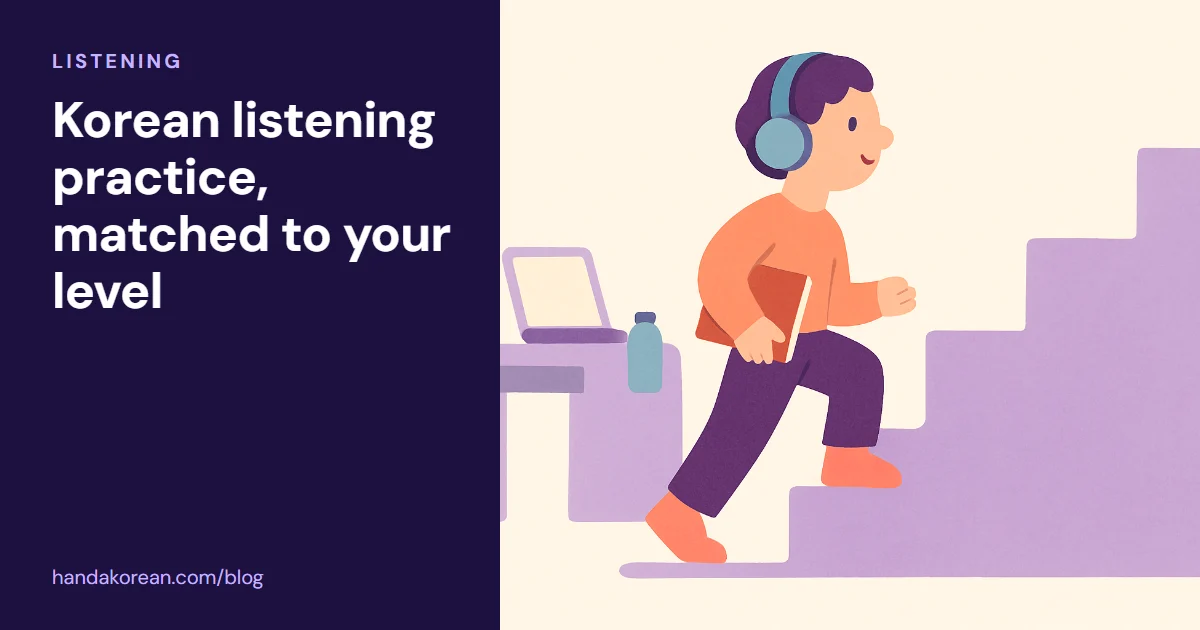
Short answer: listening improves when the material sits just above your current level — roughly 90–98% comprehensible, so context can carry the few words you don't know. K-dramas at TOPIK 1–2 are far below that threshold and mostly train you to tolerate not understanding. Graded material mapped to your level, listened to repeatedly, works better and feels worse.
Why dramas don't work early
Everyone starts with dramas because everyone starts learning Korean because of dramas. Then, after four months, they can catch 진짜?, 괜찮아 and 어떻게 and nothing else, and conclude their listening is broken.
It isn't. Native drama dialogue at natural speed with slang, contractions and overlapping speech is somewhere around 5–20% comprehensible for a beginner. Below roughly 90%, there isn't enough known material for your brain to use context to infer the unknown parts — so nothing gets inferred and nothing gets acquired. You're doing exposure, not learning.
This isn't an argument against dramas. Watch them. Enjoy them. Just don't count them as listening practice until you're around TOPIK 3, and use subtitles in your own language without guilt before then.
What "just above your level" means per TOPIK band
TOPIK 1 (beginner). Single sentences and very short exchanges, spoken slowly, on concrete topics — introductions, food, numbers, time. You should understand nearly all of it on the second listen. Textbook audio genuinely is right for this stage.
TOPIK 2 (upper beginner). Short dialogues and simple narratives, 5–10 sentences, past and future tense present. Slow children's stories work here.
TOPIK 3 (lower intermediate). Paragraph-length passages at moderate speed. Opinions and reasons appear alongside facts. Slow news, graded readers with audio, simple podcasts for learners. This is where drama with Korean subtitles becomes useful.
TOPIK 4 (intermediate). Near-natural speed on familiar topics. Interviews, vlogs, learner podcasts without heavy simplification. Drama without subtitles becomes partially possible.
TOPIK 5–6 (advanced). Native material — news, documentaries, panel shows, lectures. Abstract topics, formal register, speakers who interrupt each other. The goal shifts from comprehension to handling register and implication.
The common mistake is jumping bands because the lower one feels boring. Boring and comprehensible beats interesting and opaque, every time.
How to listen so it counts
Listen more than once. First pass for the gist, second for structure, third for detail. One pass through new material builds far less than three passes through the same material.
Read the transcript after, not during. Reading along while listening trains reading with audio accompaniment, which is a different skill. Listen blind first, then check.
Shadow a few sentences. Repeating out loud in sync with the audio does something passive listening doesn't — it forces you to produce the rhythm and the sound changes, and it exposes gaps between what you think you heard and what was said.
Accept that it's boring. Listening practice at the right level is genuinely less fun than watching a drama and understanding 15% of it. That's the trade for it actually working.
Where to find graded material
Free: Talk To Me In Korean's levelled audio, KBS World and other slow-news sources for TOPIK 3+, and children's storybooks read aloud on YouTube for TOPIK 2.
In HanDa: the Listen & Learn library holds 159 reading passages across levels 1–10, mapped to TOPIK 1–6, each with sentence-by-sentence audio, tap-to-translate and an AI breakdown of vocabulary, grammar and conjugation per sentence. It's built for exactly the "listen three times, then check" pattern above, and works passively — commuting, walking, chores.
The honest timeline
Listening is the slowest of the four skills for most learners, and the one where progress is least visible day to day. It tends to arrive in steps rather than a curve — months of feeling stuck, then a week where a whole register suddenly resolves.
If you've been at it for two months and dramas still sound like noise, nothing is wrong with you. You're just not at TOPIK 3 yet.
Related reading
Learn this properly, not just once
Blog posts teach one thing at a time. The HanDa books teach level 2 in order — every lesson built to be spoken, with a workbook and writing book beside it.
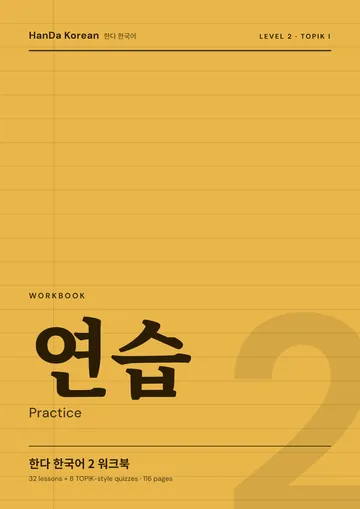 HanDa Korean 2 Workbook
Goes with this post · 116 pages
$6
HanDa Korean 2 Workbook
Goes with this post · 116 pages
$6
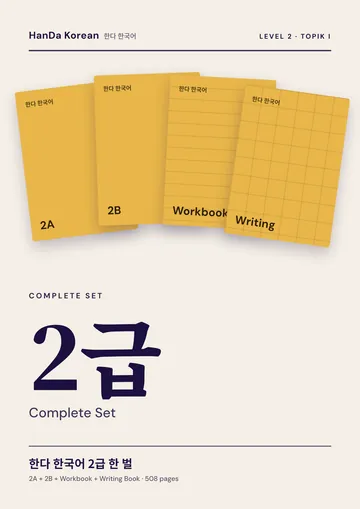 HanDa Korean Level 2 — Complete Set
Everything for level 2 — books, workbook and writing book · 508 pages
$10
HanDa Korean Level 2 — Complete Set
Everything for level 2 — books, workbook and writing book · 508 pages
$10
Practice this with an AI tutor
HanDa corrects every sentence you write or say — in real conversation, not flashcards.