Korean Conjugation Is a Production Problem, Not a Memory Problem
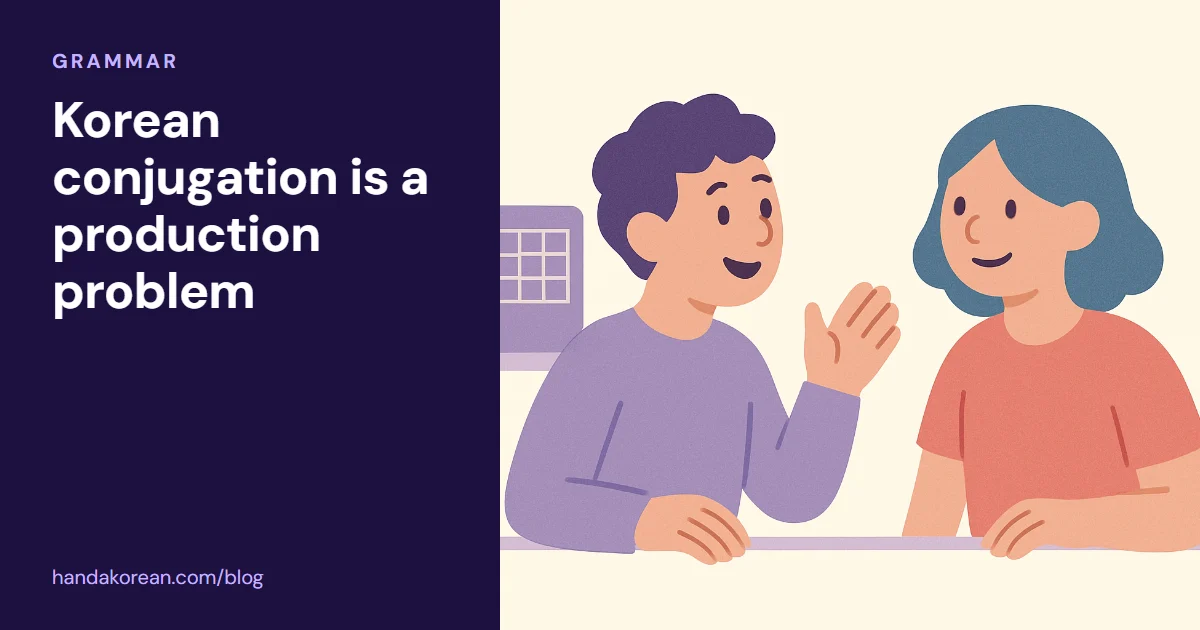
Short answer: most learners study conjugation by reading charts, which trains recognition — you can identify 갔어요 as past tense. Speaking requires production — generating 갔어요 from 가다 in under a second while also thinking about what you want to say. These are different skills, and only production practice builds the second one.
The test that shows the gap
Take a verb you "know". 돕다, to help.
Now, out loud, in under two seconds each: present polite, past polite, "let's", "if", "-고 싶다".
Most intermediate learners can read all five forms and recognise them instantly, and still stall on producing them cold. 돕다 is ㅂ-irregular, so it's 도와요, 도왔어요, 돕자, 도우면, 돕고 싶어요 — and the ㅂ behaves differently depending on what follows it.
If you had to stop and think, that's not a knowledge gap. You know the rule. It's a production gap, and no amount of re-reading the chart closes it.
Why charts don't transfer
A conjugation chart gives you the answer and the question at the same time. Your eye lands on "past tense: -았/었어요" and the correct form is right there next to it. Nothing is retrieved, so nothing is strengthened.
Worse, charts are organised by form — all the past tense together, all the irregulars together. Speech doesn't arrive organised by form. It arrives as "I need to say I helped my friend yesterday," and you have to pull the right ending out of the whole system with no category label attached.
There's a second problem specific to Korean: the irregulars aren't rare. ㅂ, ㄷ, ㅅ, ㅡ, 르, ㄹ and 하다 irregular patterns cover a large share of the verbs you'll use daily. A learner who has drilled only regular verbs has drilled the easy half of the language.
What production practice looks like
Four things make a conjugation drill actually transfer:
1. Meaning first, form second. The prompt should be in your language — "I helped my friend yesterday" — and you produce the Korean. Not "conjugate 돕다 into past polite." Real speech starts from meaning.
2. Retrieval before feedback. You must commit to an answer before seeing the correct one. Being wrong and then corrected is worth more than being right after peeking. This feels worse and works better.
3. Mixed, not blocked. Practising twenty past-tense forms in a row is blocked practice — accuracy looks great and retention is poor, because after the third item you've stopped choosing a tense and started pattern-matching. Mixing tenses and verb types is harder in the moment and durable afterwards.
4. Spaced by difficulty. The verbs you get wrong should come back sooner than the ones you get right.
A drill sequence that works
If you're building this yourself, with paper or an app:
- Pick one verb, run every form. 가다 through present, past, future, "let's", "if", "-고 싶다", "-아/어 주세요". This builds the map.
- Pick one form, run many verbs. Past polite across 가다, 먹다, 돕다, 듣다, 짓다, 쓰다, 부르다. This is where irregulars stop being trivia.
- Produce from meaning. Native-language prompt in, Korean sentence out, no chart visible.
- Take dictation. Hear the conjugated sentence, write it. This catches the gap between what you can say and what you can recognise at speed, which is usually wider than people expect.
- Use it in conversation the same day. A form that never leaves the drill stays in the drill.
Steps 3 and 4 are the ones people skip, and they're the ones that transfer.
Where to practise
HanDa's conjugation suite runs exactly this sequence — a pattern drill with spaced repetition, a verb-master mode that expands one verb across every rule, a build-up mode where you construct Korean sentences from native-language prompts with diff-based hints when you're wrong, and a dictation mode that pairs with it using the same verb pool. It's part of the standard subscription ($10/month Premium, 7-day free trial).
You can also do all of this with a notebook and a verb list. The method matters more than the tool — produce before you check, mix your forms, and don't skip the irregulars.
Related reading
Learn this properly, not just once
Blog posts teach one thing at a time. The HanDa books teach level 3 in order — every lesson built to be spoken, with a workbook and writing book beside it.
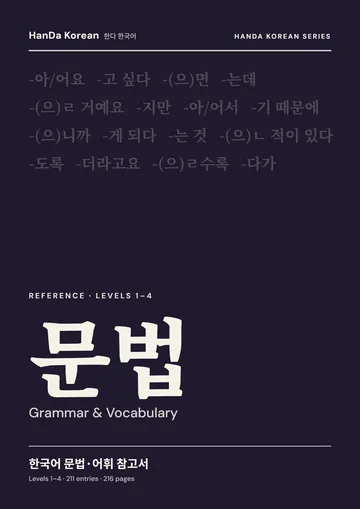 Korean Grammar & Vocabulary Reference
Goes with this post · 216 pages
$8
Korean Grammar & Vocabulary Reference
Goes with this post · 216 pages
$8
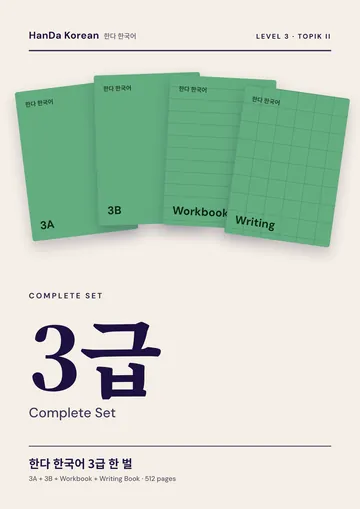 HanDa Korean Level 3 — Complete Set
Everything for level 3 — books, workbook and writing book · 512 pages
$10
HanDa Korean Level 3 — Complete Set
Everything for level 3 — books, workbook and writing book · 512 pages
$10
Practice this with an AI tutor
HanDa corrects every sentence you write or say — in real conversation, not flashcards.