9 Korean Titles to Use Instead of Someone's Name
You learn someone's name, you use their name. That's English. In Korean, the name is often the last thing you say out loud — you use their title instead, and if you don't know the title, you don't use anything at all.
This is one of the genuinely hard parts of Korean for English speakers, and it's hard for a sneaky reason: you can't open your mouth until you've decided who this person is to you. Older? Higher rank? Serving you? A stranger? In English you buy time with "hey" or "you." In Korean, "you" (너, 당신) is not a safe default — 너 is 반말 for close friends and children, and 당신 to a stranger's face sounds cold or picks a fight. Calling your boss by her bare first name lands the way calling a judge "hey buddy" lands in English: not just casual, slightly insulting.
The fix is small and very learnable. Memorize a handful of titles, learn one fallback phrase, and you will almost never be stuck. Here are the nine that cover most of daily life.
1. 선생님 — teacher, and much more
선생님, 질문 있어요. — Teacher, I have a question.
선생님 literally means "teacher," but Koreans stretch it far past the classroom. It's the standard way to address a doctor (의사 선생님), a pharmacist, a lawyer, or any respected adult whose job you don't know. If you're ever talking to an older professional and you're not sure what to call them, 선생님 is almost never wrong — it's respectful without claiming to know them.
2. 선배 / 선배님 — anyone who started before you
선배, 이거 어떻게 해요? — Senior, how do you do this?
선배 is someone ahead of you at the same school, company, or club — one year above counts. You call them 선배 (or 선배님 when you want more distance), and they call you by name. Note that 후배 is a word for talking about juniors, not for addressing them — nobody says it to your face. Saying a 선배's bare name instead of the title would sound like you're pretending to be equals. There's more of this school vocabulary in the K-drama school words guide.
3. 사장님 — the boss, the owner, the person running the place
사장님, 이거 하나 더 주세요. — Excuse me (sir/ma'am), one more of these please.
사장님 technically means "company president," but in everyday life it's what you call whoever owns or runs a small restaurant, shop, or salon. You don't need to know whether they really own it — using it is a small compliment and nobody minds. This is the single most useful title for travelers eating out.
4. 팀장님 / 과장님 — the job title at work
팀장님, 지금 시간 괜찮으세요? — Team leader, do you have a moment?
In a Korean office, you address colleagues above you by rank plus 님: 팀장님 (team leader), 과장님 (manager), 부장님 (department head). Names are not used upward. To people at your level or below, 씨 attached to the name does the work — 민수 씨, 지영 씨 — which is explained in what 씨 actually means.
5. 기사님 — anyone driving you
기사님, 여기서 세워 주세요. — Driver, please stop here.
기사 means a professional driver; 기사님 is how you address a taxi or bus driver, politely and normally. Learners often freeze here and say nothing, then point — 기사님 solves it in two syllables. More of this in taking a taxi in Korean.
6. 이모님 — the auntie at the restaurant
이모님, 여기 물 좀 주세요. — Auntie, could we get some water here?
이모 means "mother's sister," but in a casual restaurant it's a warm way to call an older female staff member — it says you feel like family here. Koreans who are regulars say plain 이모; as a learner, 이모님 is the safer, softer version. If the person looks close to your own age, don't use it — use 저기요 or 사장님 instead.
7. 언니 / 오빠 / 형 / 누나 — family words for people you're close to
언니, 저 먼저 갈게요. — Unnie, I'm heading out first.
These are sibling words used with non-relatives: a woman calls an older woman 언니 and an older man 오빠; a man says 누나 and 형. The key condition is closeness — a classmate, a coworker you get along with, your friend's older brother. Using them with someone you just met sounds like you're forcing intimacy, so wait for the other person to open the door: they might say 말 놔도 돼요 ("you can speak casually") or 편하게 불러요 ("call me whatever's comfortable"), or simply start calling you by name.
8. 저기요 — the fallback that always works
저기요, 여기 주문할게요. — Excuse me, we'd like to order here.
When you don't know the title, don't guess — use 저기요. It's the neutral "excuse me" for getting a stranger's or a server's attention, in a café, on the street, in a shop. 여기요 is the same move in a restaurant (literally "over here"). Neither is rude, and both buy you the three seconds you need to get the rest of the sentence out.
9. 손님 / 고객님 — what they call you
손님, 이쪽으로 오세요. — Sir/Ma'am (customer), please come this way.
You won't say this one, but you need to recognize it. Staff address customers as 손님, and 고객님 is the more formal version you'll hear in banks, phone centers, and announcements. If someone says 손님 near you, they are talking to you — it is not a name you missed.
The one rule under all nine
Go up, not across. Titles climb: you call people above you by title, people beside you by 이름 + 씨, and people clearly below or close to you by name. The polite marker 님 is what you add when you want more respect — 선배님, 이모님, 기사님 — and it's attached to titles, not to bare first names in speech.
And when you genuinely can't tell? Korean lets you drop the subject entirely. 감사합니다. 이거 하나 주세요. — no name, no title, perfectly natural. Dropping the address is always safer than guessing wrong.
Practice
Choose the natural address for each situation.
- You want one more serving of soup in a small family restaurant. Call the owner: ____, 하나 더 주세요.
- You're in a taxi and want to get out here: ____, 여기서 내릴게요.
- You're a first-year student asking a third-year student a question: ____, 이거 어떻게 해요?
- You're in a café and need to get the staff's attention — you don't know anything about them: ____, 여기 주문할게요.
- Your manager's name is 민수. You want him to check something. What's wrong with 민수, 이거 봐 주세요?
Answers
- 사장님 — 사장님, 하나 더 주세요. (이모님 also works if she's older and the place is casual.)
- 기사님 — 기사님, 여기서 내릴게요.
- 선배 or 선배님 — 선배, 이거 어떻게 해요?
- 저기요 (or 여기요) — 저기요, 여기 주문할게요.
- You never address someone above you at work by bare name. Use the rank: 팀장님, 이거 봐 주세요. Even 민수 씨 would be too familiar upward.
Learn this properly, not just once
Blog posts teach one thing at a time. The HanDa books teach level 1 in order — every lesson built to be spoken, with a workbook and writing book beside it.
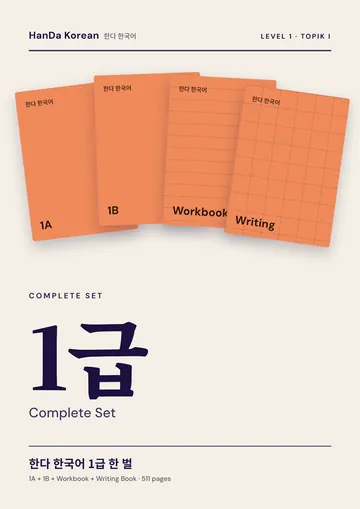 HanDa Korean Level 1 — Complete Set
Everything for level 1 — books, workbook and writing book · 511 pages
$10
HanDa Korean Level 1 — Complete Set
Everything for level 1 — books, workbook and writing book · 511 pages
$10
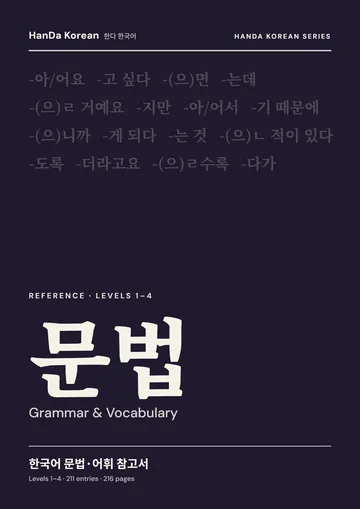 Korean Grammar & Vocabulary Reference
Every pattern in one place · 216 pages
$8
Korean Grammar & Vocabulary Reference
Every pattern in one place · 216 pages
$8
Practice this with an AI tutor
HanDa corrects every sentence you write or say — in real conversation, not flashcards.