How to Connect Korean Sentences: -아서, -니까, and -는데
Here is the single thing that breaks most intermediate plateaus: stop finishing your sentences so often.
You know a few hundred words. You can conjugate. You can order food, take a taxi, tell someone about your weekend. And yet you sound like a beginner, and you can feel it. The reason is usually not vocabulary. It's that you speak in sentence-sized pieces, one idea per breath, and you glue them together from the outside with 그리고, 그래서, 그런데.
Koreans glue them from the inside.
The same story, two ways
A learner at the plateau:
어제 친구를 만났어요. 우리는 영화를 봤어요. 영화가 재미있었어요. 그런데 너무 길었어요. Yesterday I met a friend. We saw a movie. The movie was fun. But it was too long.
Nothing there is wrong. Every sentence is grammatical. But a Korean speaker would say it in one go:
어제 친구를 만나서 영화를 봤는데, 재미있었지만 좀 길었어요. Yesterday I met a friend and we saw a movie — it was fun, but a bit long.
Same words, same tenses, same politeness. The difference is that four stops became one. That's the plateau in miniature: you have the parts, you just keep putting them down instead of linking them.
Why this is genuinely hard for English speakers
English marks tense in every clause. I was tired, so I went home — both verbs are past. English also lets you drop a conjunction at the front of a sentence and carry on: So I went home. But I couldn't sleep.
Korean does neither. In a Korean sentence, tense and politeness are marked once, at the very end:
- 배가 아파서 학교에 못 갔어요. → I had a stomachache, so I couldn't go to school.
Notice 아파서, not 아팠어서. The past lives on 갔어요 alone. The same sentence to a close friend is 배가 아파서 학교에 못 갔어. Only the last word moves — the connector never changes with the speech level you're using.
That's actually good news. It means connecting clauses is less work than you think: you conjugate once. But it feels hard because you have to decide the relationship between the two ideas before you say the first verb. English lets you decide afterwards. Korean doesn't. That planning gap is what makes learners stop at every period — and that's exactly the habit to break.
The four connectors that do most of the work
| Ending | Meaning | Attaches to |
|---|---|---|
| -아서/어서 | reason, or "and then" in sequence | verb stem, no tense marker |
| -(으)니까 | reason you're pointing out to someone | verb stem, tense marker allowed |
| -는데 | background, setup, soft contrast | verb (-는데), adjective (-ㄴ/은데) |
| -(으)면서 | two things at once | verb stem |
-아서/어서 — cause, and the default for apologies and thanks
- 늦어서 죄송합니다. — I'm sorry I'm late. (합쇼체)
- 도와주셔서 감사합니다. — Thank you for helping me.
- 머리가 아파서 일찍 잤어요. — I had a headache, so I went to bed early.
Two rules worth burning in: no tense marker before -아서 (어제 비가 와서 못 갔어요, never 왔어서), and no commands or suggestions after it. 시간이 없어서 택시 탑시다 is ungrammatical.
-(으)니까 — the reason you're telling them
-니까 presents the reason as your judgment, something you're pointing out. That's why it's the one that works with commands and suggestions:
- 비가 오니까 우산 가져가세요. — It's raining, so take an umbrella.
- 시간이 없으니까 택시 탑시다. — We're out of time, so let's take a taxi.
- 여기 사람 많으니까 저쪽으로 가요. — It's crowded here, let's go over there.
And here's where learners get burned: 늦어서 죄송합니다 is right, but 늦었으니까 죄송합니다 sounds, to a Korean ear, like you're pushing the reason at the listener — less I'm sorry I'm late and more look, I was late, okay? For apologies and thanks, use -아서. Always.
If you want a third tool for reasons — the one you use when the listener doesn't already know the reason — see how -거든요 works.
-는데 — the connector that unlocks everything
If you only drill one, drill this. -는데 doesn't mean "but." It sets the stage for whatever comes next. Sometimes that's contrast, often it's just context.
- 지금 밖인데 이따가 전화할게요. — I'm out right now, so I'll call you later.
- 한국어를 2년 배웠는데 아직 어려워요. — I've been learning Korean for two years, but it's still hard.
- 저기요, 이거 좀 작은데 다른 사이즈 있어요? — Excuse me, this is a bit small — do you have another size?
That last one is how you actually survive in a shop: state the situation with -는데, then ask. (If 저기요 feels unclear, here's how to get a stranger's attention in Korean.)
-는데 also works at the end of a sentence to soften it. 잘 모르겠는데요. — Hmm, I'm not sure... It leaves the door open instead of slamming it shut, which is why it sounds so much gentler than 몰라요.
-(으)면서 and -다가 — at the same time, and interrupted
- 저는 음악을 들으면서 공부해요. — I study while listening to music.
- 집에 가다가 친구를 만났어요. — I was on my way home when I ran into a friend.
-다가 is the one English speakers almost never reach for, and it's everywhere in natural speech: you were doing X, and mid-X, Y happened.
When a native picks which
Two quick calls you'll make constantly:
-아서 or -니까? If what follows is a command, a suggestion, or a 같이 ~해요, it must be -니까. If it's an apology or thanks, it must be -아서. Everywhere else, both work; -아서 feels more like a plain statement of cause, -니까 more like here's my reasoning.
-는데 or 그런데? If the two ideas belong to the same thought, put -는데 inside. Save 그런데 for a real change of direction — a new topic, a turn in the conversation. Starting every second sentence with 그런데 is the single clearest signal that someone is translating from English in their head.
The drill that actually moves you
For one week, ban 그리고, 그래서 and 그런데 at the start of a sentence. Out loud, in messages, in your head. You are allowed to say them only inside a sentence — which means you can't say them at all, because inside a sentence they become -고, -아서/니까, -는데.
Then do this three-step, five minutes a day:
- Say any true sentence about today. 어제 비가 왔어요.
- Say a second one that relates to it. 우산이 없었어요.
- Say them again as one sentence, in one breath. 어제 비가 왔는데 우산이 없었어요.
Twenty of those a day, and within two weeks the connector starts arriving before you need it — which is the whole skill. The plateau isn't a wall of new grammar. It's a habit of stopping, and habits are drillable.
Practice
Join each pair into one natural sentence.
- 비가 와요. + 우산을 가져가세요.
- 늦었어요. + 죄송합니다.
- 어제 명동에 갔어요. + 사람이 정말 많았어요.
- 밥을 먹어요. + 텔레비전을 봐요. (at the same time)
- Fix this: 시간이 없어서 택시 탑시다.
Answers
- 비가 오니까 우산을 가져가세요. — A command follows, so it has to be -니까.
- 늦어서 죄송합니다. — Apologies take -아서, never -니까. Also note: not 늦었어서.
- 어제 명동에 갔는데 사람이 정말 많았어요. — Past tense is fine before -는데, and the setup-then-comment feel is exactly what -는데 is for.
- 밥을 먹으면서 텔레비전을 봐요.
- 시간이 없으니까 택시 탑시다. — -아서 can't be followed by a suggestion.
Learn this properly, not just once
Blog posts teach one thing at a time. The HanDa books teach level 1 in order — every lesson built to be spoken, with a workbook and writing book beside it.
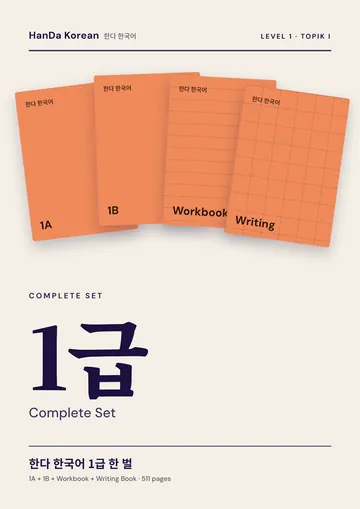 HanDa Korean Level 1 — Complete Set
Everything for level 1 — books, workbook and writing book · 511 pages
$10
HanDa Korean Level 1 — Complete Set
Everything for level 1 — books, workbook and writing book · 511 pages
$10
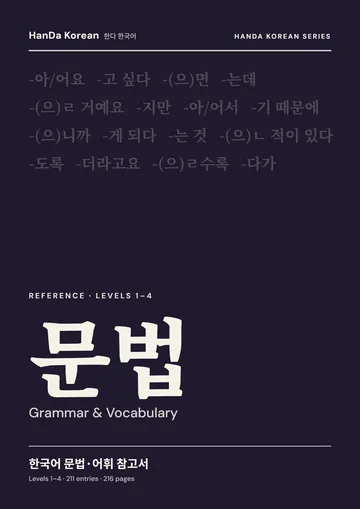 Korean Grammar & Vocabulary Reference
Every pattern in one place · 216 pages
$8
Korean Grammar & Vocabulary Reference
Every pattern in one place · 216 pages
$8
Practice this with an AI tutor
HanDa corrects every sentence you write or say — in real conversation, not flashcards.