9 Ways to Address Strangers in Korean: 저기요, 사장님, 이모
You learned 당신 means "you." Then you got to Korea and nobody used it. That's not an accident.
In Korean, calling a stranger "you" is close to rude. Instead you call them by a role — shop owner, driver, teacher, auntie — or you skip the word entirely and just say 저기요 ("excuse me"). Here's the one idea to walk away with: when you don't know what to call someone, say 저기요 and go straight into your sentence. It works in every shop, every restaurant, every street in the country, and no one will think twice about it. Everything below is a small upgrade on that base.
1. 저기요 — "Excuse me"
저기요, 물 좀 주세요. — Excuse me, could I get some water?
This is your default and it never fails. Use it to flag down a server, to stop someone who dropped a glove, to ask a shop worker where the restroom is. It's polite, neutral 해요체, and carries no guess about the person's age or job — which is exactly why it's safe. Say it at a normal volume with a slight rise, then say what you need.
2. 여기요 — "Over here" (in a restaurant)
여기요, 주문할게요. — Over here — we'd like to order.
여기요 is 저기요's restaurant cousin: it means "here, at this table." You'll hear it constantly in busy places where the staff are moving fast. It's a touch more casual than 저기요, so use it for ordering food and calling for the bill, not for asking a stranger on the street for directions.
3. 사장님 — "Boss" / shop owner
사장님, 이거 얼마예요? — Excuse me (owner), how much is this?
Literally "company president," but in daily life 사장님 means "the person who runs this place." Use it in small shops, market stalls, restaurants, hair salons, repair shops — and here's the trick: you don't need to know if they're actually the owner. Calling an employee 사장님 is flattering and completely normal; calling the owner something less is the mistake. The -님 on the end is the honorific suffix that makes it respectful.
4. 이모 — "Auntie" in a casual restaurant
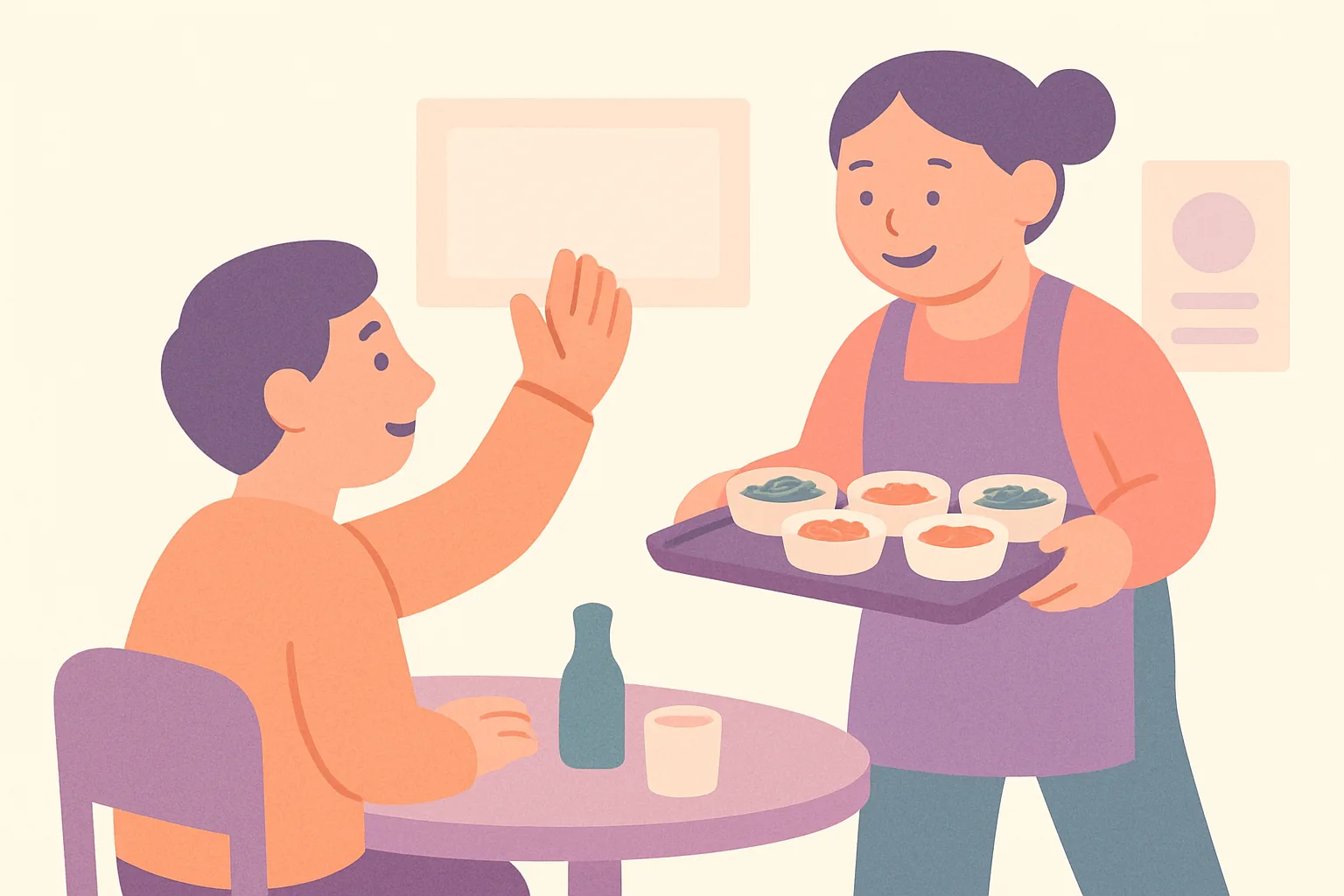
이모, 반찬 좀 더 주세요. — Auntie, could we get more side dishes, please?
이모 technically means "mother's sister," but in 분식집, 국밥집 and neighborhood restaurants it's a warm way to call a middle-aged woman working there. It sounds friendly and regular-customer-ish, like you've been coming for years. Two cautions: only for women who look clearly older than you, never for a young server, and never in a nice restaurant or a hotel — there, 저기요 or 사장님. If you want it a notch more respectful, 이모님 works too. Knowing when 이모 fits is pure reading the room — if you're unsure, you already have your answer: 저기요.
5. 아주머니 / 아저씨 — "Ma'am" / "Sir" (middle-aged)
아주머니, 이거 떨어뜨리셨어요. — Ma'am, you dropped this.
These are the standard words for a middle-aged woman and man. They're not insults — 아주머니 and 아저씨 are what you'd use to stop a stranger on the street who isn't working anywhere you can name. But a warning about the short form: 아줌마 can sting. Many women hear it as "you're old," and while friends and market regulars use it freely, a stranger saying it can land badly. Stick to 아주머니, or better, 저기요.
6. 기사님 — "Driver"
기사님, 여기서 내릴게요. — Driver, I'll get off here.
For taxi and bus drivers. Older speakers still say 아저씨, but 기사님 is the polite, current choice and it's what you want as a visitor. Useful companions: 여기서 세워 주세요 ("please stop here") and 앞에서 좌회전해 주세요 ("please turn left up ahead"). Note that -(으)ㄹ게요 in 내릴게요 announces what you are about to do — more on that in -(으)ㄹ게요 vs -(으)ㄹ래요.
7. 선생님 — "Teacher," used far beyond teachers
선생님, 감사합니다. — Thank you, sir/ma'am.
선생님 is the all-purpose respect word. Doctors, pharmacists, lawyers, professors, and any older stranger you want to treat with clear deference all get 선생님. It's the safest upgrade when someone is visibly older or in a professional role and 아저씨 feels too plain. You will also hear staff at a clinic call you 선생님 — that's them being polite to you, not a promotion.
8. 학생 — "Student" (to a young person)
학생, 이거 떨어뜨렸어요. — Hey — you dropped this.
Older Koreans use 학생 to address anyone who looks school- or university-aged, whether or not they're actually a student. It's friendly and slightly downward, so it only works if you're clearly the older one. As a learner, you'll hear this far more than you say it — if a 아주머니 on the subway says 학생, she's talking to you.
9. 언니 — "Older sister," with care
언니, 이거 다른 색도 있어요? — Excuse me, do you have this in another color?
Women sometimes call a female shop worker or server 언니 when she seems a little older — in clothing shops and markets especially. It's warm but familiar, so it's a native-speaker move rather than a beginner one, and it's for women speaking to women. Men should not use 언니 here; 오빠 and 누나 to a stranger sound like flirting or a bar. When in doubt, 사장님 covers it.
Two words to skip
당신 — textbook "you," but in real speech it's for spouses, song lyrics and arguments. Saying 당신 to a stranger sounds cold or like you're about to fight. If you need "you" in a sentence, use the person's title (사장님, 선생님) or just leave it out — Korean drops subjects happily.
너 — the casual "you" of 반말. Fine with close friends your age, wrong with anyone you just met. If you're still figuring out how to open a conversation with someone new, these first-meeting phrases are the safer ground, and what the clerk asks at a convenience store covers the other half of shop talk.
One last thing: none of these titles carry the sentence by themselves. 저기요 gets the eyes; the request does the work. So practice them as a pair — call, then ask.
Practice
What would you say?
- You're in a taxi and want to get out at the next corner.
- You're buying socks at a market stall from a man in his fifties, and you want to ask the price.
- You're in a busy 김밥집 and want more water from a woman in her fifties who works there.
- A woman around sixty just dropped her scarf on the street in front of you.
- You genuinely have no idea what to call the person. What's your fallback?
Answers
- 기사님, 여기서 내릴게요. (or 기사님, 여기서 세워 주세요.)
- 사장님, 이거 얼마예요?
- 이모, 물 좀 주세요. (이모님 or 저기요 are both fine too.)
- 저기요, 이거 떨어뜨리셨어요. (아주머니 also works — 아줌마 does not.)
- 저기요. Always.
Learn this properly, not just once
Blog posts teach one thing at a time. The HanDa books teach level 1 in order — every lesson built to be spoken, with a workbook and writing book beside it.
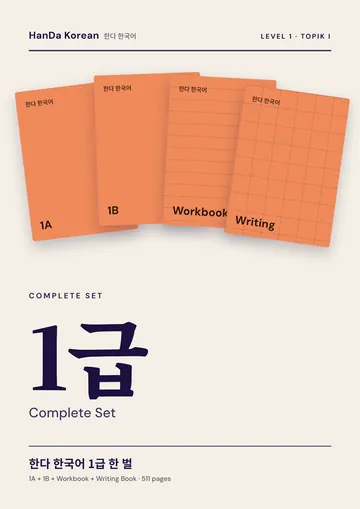 HanDa Korean Level 1 — Complete Set
Everything for level 1 — books, workbook and writing book · 511 pages
$10
HanDa Korean Level 1 — Complete Set
Everything for level 1 — books, workbook and writing book · 511 pages
$10
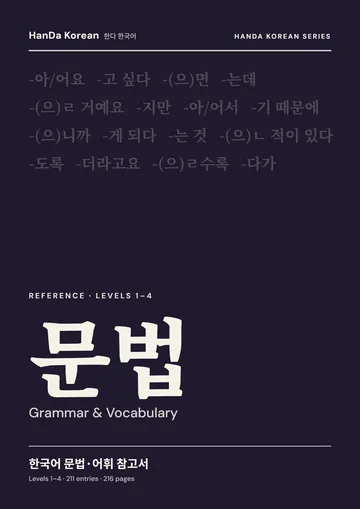 Korean Grammar & Vocabulary Reference
Every pattern in one place · 216 pages
$8
Korean Grammar & Vocabulary Reference
Every pattern in one place · 216 pages
$8
Practice this with an AI tutor
HanDa corrects every sentence you write or say — in real conversation, not flashcards.