8 Korean 눈치 Phrases for Reading the Room in K-Dramas
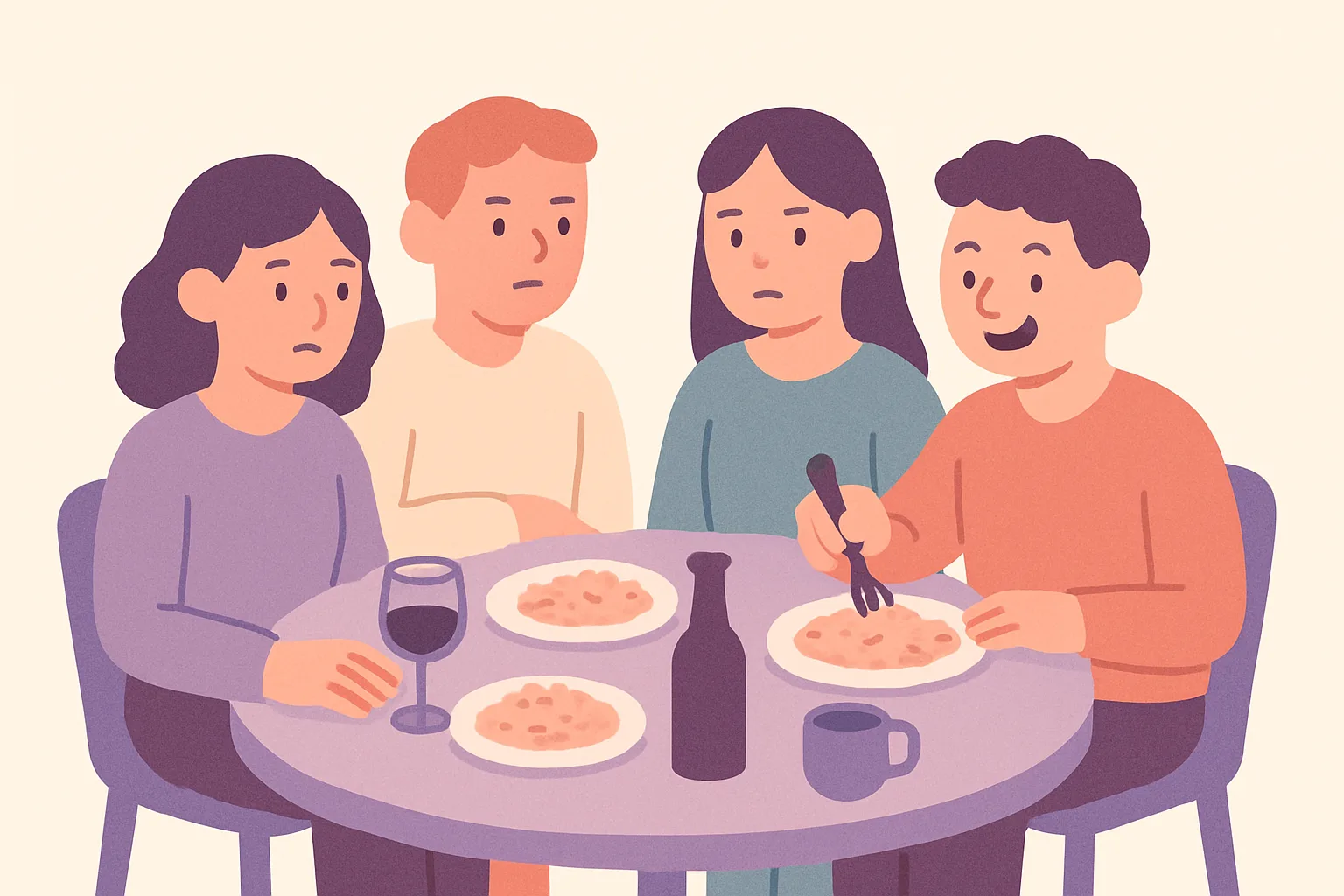
You've heard it a hundred times. A character says one wrong sentence at dinner, everyone freezes, and a friend hisses something with 눈치 in it. The subtitle says "tact" or "read the room" or sometimes nothing at all.
Here's the one thing to take away: 눈치 is a noun — a skill, a quantity of social radar — and the verb you attach to it completely changes the meaning. 눈치를 보다 is not the same as 눈치를 주다, and neither is 눈치채다. Learn the verbs and the whole family opens up at once.
눈치 is one of those words that never quite lands in English, like a handful of other Korean words with no clean translation. Literally it's "eye measure" — the ability to look at a room and know what's going on without being told. In Korea it's not a personality quirk. It's a social competence people are judged on.
1. 눈치가 없다 — "can't read the room"
그 사람 진짜 눈치가 없어요. — That person really can't read the room.
This is the insult version. It describes someone who keeps talking when everyone wants to go home, or asks a cheerful question right after bad news. To a Korean ear it's not "he's rude" — it's closer to "he's oblivious," which is somehow worse, because rudeness is a choice and this is a deficiency. In dramas it's the running joke about the sweet, clueless friend.
2. 눈치가 빠르다 — "quick on the uptake"
우리 언니는 눈치가 빨라요. — My older sister catches on fast.
The opposite, and a genuine compliment. 눈치가 빠르다 means you notice the mood shift before anyone says a word — you see that the boss is in a bad mood and quietly close the door. Note it's 빠르다 (fast), not 좋다. Koreans also say 눈치가 있다, but 눈치가 빠르다 is the natural praise.
3. 눈치(를) 보다 — "to watch someone's mood"
저는 눈치 보느라 아무 말도 못 했어요. — I was so busy reading everyone's mood that I couldn't say a thing.
This is the one learners misread most. 눈치를 보다 does not mean "to look at someone" — it means you're anxiously monitoring a more powerful person's face to decide what to do. An employee watching the boss, a kid watching an angry parent. It carries a small, tired feeling of powerlessness. In conversation the 를 usually drops: 눈치 보다.
4. 눈치가 보이다 — "it feels awkward to"
먼저 가기가 좀 눈치 보여요. — I feel a bit awkward leaving first.
Same word, passive verb, different angle: now you're the one feeling watched. This is the phrase for taking a day off when everyone else is busy, or leaving the office at 6 while your team stays. If you want to turn something down and the real reason is social pressure, this is how Koreans say it — though when you actually have to decline, the softer refusal phrases do the heavy lifting.
5. 눈치(를) 주다 — "to shoot someone a look"
친구가 그만하라고 눈치를 줬어요. — My friend gave me a look to stop.
눈치를 주다 is sending the message without words — a glance, a tiny cough, a foot tap under the table. It's a staple of drama dinner scenes: someone starts telling an embarrassing story and their partner is frantically 눈치 주는 중. Notice the direction: 주다 = I send the signal, 보다 = I read the signal. Mixing those two up is the single most common 눈치 mistake.
6. 눈치(를) 채다 — "to catch on, to figure it out"
엄마가 벌써 눈치챘어요. — Mom already figured it out.
This one is about a specific hidden fact, not a general mood — a secret relationship, a surprise party, a lie. 눈치채다 is written as one word, and it's the verb behind half of all drama tension: does she know or not? Compare with #2: 눈치가 빠르다 is a trait you have, 눈치채다 is a thing that happens in a moment.
7. 눈치껏 — "use your judgment"
눈치껏 알아서 하세요. — Read the situation and handle it yourself.
The suffix -껏 means "to the full extent of," so 눈치껏 is "as far as your social radar takes you." A senior colleague says this instead of giving instructions, and it means: I'm not going to explain the rules, figure them out. It sounds practical in Korean, mildly terrifying in translation. Often paired with 알아서 (on your own).
8. 분위기 파악 좀 해 — "read the room" (blunt version)
분위기 파악 좀 해. — Read the room, would you.
Not 눈치, but its close cousin: 분위기 (atmosphere) + 파악 (grasping). This is 반말 and it's sharp — you say it to a close friend who just made things awkward, and half the time it's said with a laugh. Don't say it to anyone older or senior. Said gently between friends it lands somewhere near "come on, read the room." Said flat, it stings.
Why it matters more than "tact"
English treats reading the room as a bonus skill. Korean treats it as a baseline one, because so much gets communicated indirectly — a slightly slower yes, a pause before an answer, a change of subject. Someone who says 괜찮아요 in a small voice while looking away is often not fine, and the listener is expected to catch it.
This is also why K-drama dialogue can feel strangely quiet compared to the subtitles. The information is in the face, the pause, the 눈치. When you next watch a scene where nobody says anything for five seconds, that silence is doing work — the same work that the little exclamations like 헐 and 어머 do out loud.
One caution: 눈치 words describe people you know in shared situations. Don't open a conversation with a stranger by saying 눈치가 없으시네요. That's not reading the room — that's the opposite.
Practice
Fill in the blank with the right 눈치 expression, or translate.
- My younger sibling figured out my secret. → 동생이 제 비밀을 ______.
- Everyone watches the boss's mood. → 다들 사장님 ______.
- My friend gave me a look to be quiet. → 친구가 조용히 하라고 ______.
- I feel awkward about taking a vacation day. → 휴가 쓰기가 ______.
- Which fits someone who notices your bad mood instantly — 눈치가 없어요 or 눈치가 빨라요?
Answers
- 동생이 제 비밀을 눈치챘어요.
- 다들 사장님 눈치를 봐요. (also natural: 사장님 눈치 봐요)
- 친구가 조용히 하라고 눈치를 줬어요.
- 휴가 쓰기가 눈치 보여요.
- 눈치가 빨라요 — quick social radar. 눈치가 없어요 is the opposite.
Learn this properly, not just once
Blog posts teach one thing at a time. The HanDa books teach level 1 in order — every lesson built to be spoken, with a workbook and writing book beside it.
 HanDa Korean Level 1 — Complete Set
Everything for level 1 — books, workbook and writing book · 511 pages
$10
HanDa Korean Level 1 — Complete Set
Everything for level 1 — books, workbook and writing book · 511 pages
$10
 Korean Grammar & Vocabulary Reference
Every pattern in one place · 216 pages
$8
Korean Grammar & Vocabulary Reference
Every pattern in one place · 216 pages
$8
Practice this with an AI tutor
HanDa corrects every sentence you write or say — in real conversation, not flashcards.