How to Say No Politely in Korean: 괜찮아요, 됐어요, 다음에요
Here is the one idea: in Korean, the word 아니요 answers a question. It doesn't decline an offer. When someone offers you something, invites you somewhere, or asks you for a favour, a bare 아니요 lands oddly — like answering "Would you like some coffee?" with a flat "Negative." Native speakers decline with a softener: a word or half-sentence that says no without ever landing on the word no.
There are about six of these in daily use, and they are not interchangeable. Pick the wrong one and you go from gracious to cold in one syllable. Let's go through them.
아니요 — for questions of fact
아니요 is correct and common. It just belongs in a different job: answering a yes/no question.
- 한국 사람이에요? — 아니요. 미국 사람이에요. Are you Korean? — No. I'm American.
- 이거 매워요? — 아니요, 안 매워요. Is this spicy? — No, it's not spicy.
When an offer is on the table, 아니요 almost never stands alone. It turns into a launching pad for the real refusal: 아니요, 괜찮아요. That second half is doing all the work.
괜찮아요 — "I'm fine as I am"
The workhorse. 괜찮아요 declines by saying my current state is acceptable, so no change is needed. That framing is why it never sounds rude — you're not rejecting the person, you're reporting that you're okay.
- 봉투 드릴까요? — 아니요, 괜찮아요. Would you like a bag? — No, I'm fine.
- 도와드릴까요? — 괜찮아요. 그냥 볼게요. Can I help you? — I'm okay. I'm just looking.
- 좀 더 드릴까요? — 아니요, 괜찮습니다. Shall I give you some more? — No, I'm fine. (합쇼체, to a server or in a formal shop)
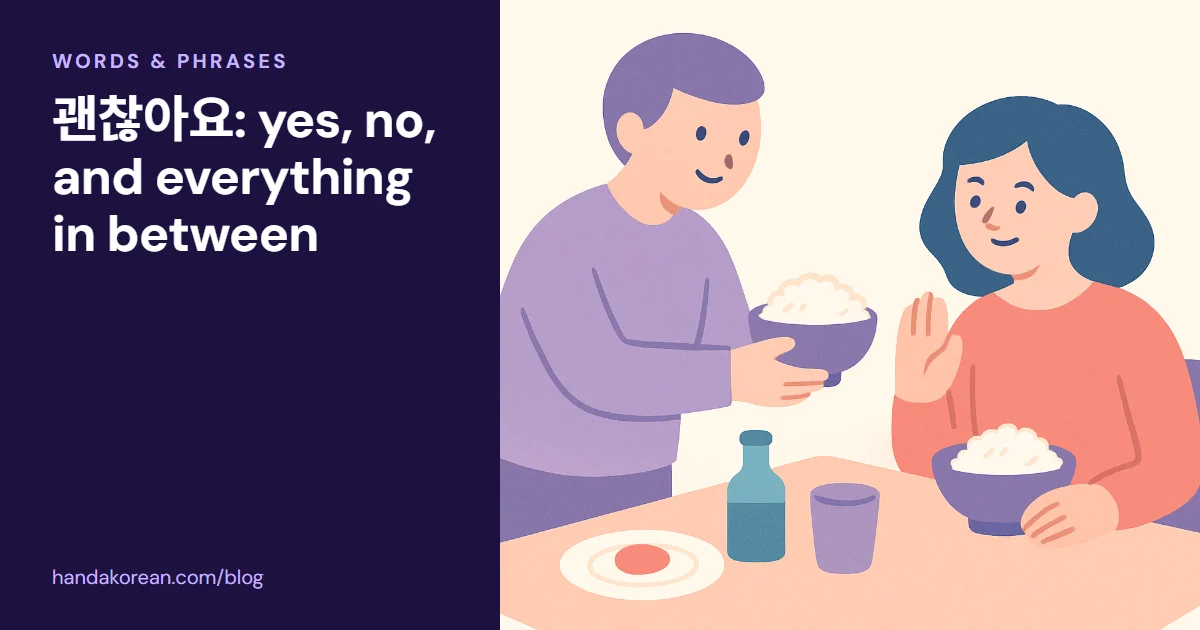
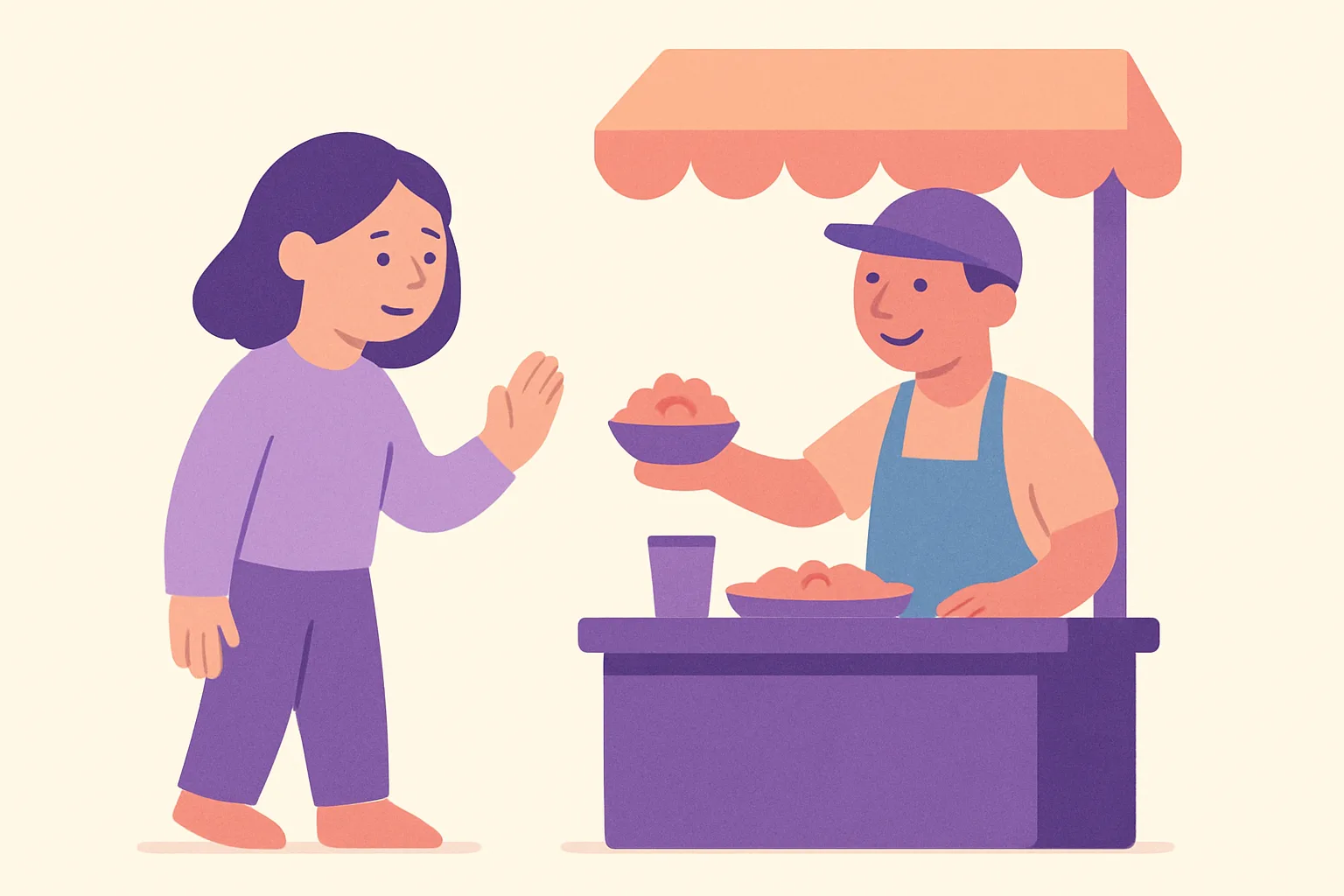
A small physical detail matters here: Koreans usually raise one hand slightly, palm out, and dip the head a little while saying it. Word plus gesture reads as warm. Word with a stone face reads as annoyed. If you want the full range of this word — including the times it means yes — I wrote about everything 괜찮아요 can mean separately.
아니에요 — "no need" and "not at all"
괜찮아요 says I'm fine. 아니에요 says that's not so — so it's the one for waving away thanks, compliments, and offers of help you feel slightly guilty about.
- 감사합니다. — 아니에요. Thank you. — Not at all.
- 한국어 정말 잘하시네요. — 아니에요, 아직 멀었어요. Your Korean is really good. — Oh no, I've got a long way to go.
- 제가 들어 드릴까요? — 아니에요, 제가 들게요. Shall I carry that for you? — No no, I'll carry it.
You'll often hear both together: 아니에요, 괜찮아요. That's not redundant to a Korean ear. It's no need — I'm fine, and it's the softest, safest refusal in the language.
됐어요 — the one to be careful with
됐어요 literally means "it's become / it's done," and as a refusal it means that's enough, stop. Sometimes that's exactly right. Often it's colder than you intend.
- (friend keeps apologising) 됐어, 신경 쓰지 마. Forget it, don't worry about it. (반말, warm between close friends)
- (someone keeps offering food you've already refused twice) 아, 됐어요. Ah, that's enough. — this one has an edge.
Even the polite-sounding 됐습니다 keeps the edge; it's a shutdown, not a softener. My advice for the first year or two: understand 됐어요 when you hear it, and say 괜찮아요 instead. If you catch a Korean friend saying 됐어 to you with a smile, that's affection. From a stranger, it's a door closing.
어려울 것 같아요 — the adult no to invitations and requests
This is the one most learners are missing. When you have to turn down an invitation, a request, or a favour, Koreans don't say 안 돼요 ("not possible") — that's for rules and machines. They say it seems like it would be difficult, with 것 같아요 blurring the edges.
- 금요일에 같이 저녁 먹을래요? — 아, 금요일은 좀 어려울 것 같아요. Want to have dinner together on Friday? — Ah, Friday might be difficult.
- 주말에 잠깐 도와줄 수 있어요? — 죄송한데 이번 주말은 힘들 것 같아요. Could you help me for a bit this weekend? — Sorry, but this weekend looks tough.
The 것 같아요 is not indecision. Everyone knows the answer is no. It's a politeness cushion, and dropping it — 금요일은 어려워요 — sounds noticeably firmer, almost irritated.
다음에요 — no with the door left open
If you'd genuinely like to accept another time, say so. This is the difference between declining a plan and declining a person.
- 오늘 노래방 갈까요? — 오늘은 좀… 다음에 가요! Shall we go to noraebang today? — Today is a bit… let's go next time!
- 다음에 꼭 갈게요. I'll definitely go next time.
Note that 다음에 가요 is an invitation of your own — you refused and then offered something back. That's the move that keeps the relationship level. (If the invitation involves a 방, here's what happens inside them.)
생각해 볼게요 — the shopping no
In a clothes shop or a market, when the assistant is enthusiastic and you want out:
- 좀 더 생각해 볼게요. I'll think about it a bit more.
- 다음에 다시 올게요. I'll come back another time.
Both are understood as no. Nobody is waiting by the door for you.
Trailing off: 오늘은 좀…
The most native-sounding refusal is often an unfinished sentence. 좀 ("a bit") plus silence is a complete no.
- 내일 시간 있어요? — 내일은 좀… Do you have time tomorrow? — Tomorrow is a bit…
- 죄송해요, 오늘 약속이 있어서요. Sorry, I have plans today. (the sentence stops on the reason — very natural)
That 있어서요 ending, and the 는데요 ending in 오늘은 좀 바쁜데요, both leave the sentence hanging on purpose. The listener finishes it for you, which is exactly the point. If those two endings feel slippery, -지만 vs -는데 explains why 는데 is the one that lets you trail off.
Quick reference
| Expression | Literally | Use it when |
|---|---|---|
| 아니요 | no | answering a yes/no question |
| 괜찮아요 | I'm fine | declining anything offered to you |
| 아니에요 | it's not so | waving off thanks, compliments, help |
| 됐어요 | that's done | close friends only — otherwise it stings |
| 어려울 것 같아요 | it'd be difficult | invitations, requests, favours |
| 다음에요 | next time | you want to accept another day |
| 생각해 볼게요 | I'll think about it | shops, sales pressure |
One more thing about tone
All of these live or die on delivery. Said quickly with a small smile and a half-bow, 괜찮아요 is gracious. Said flatly while looking away, the same two words read as cold. This is worth saying out loud a few times rather than just reading — refusals are muscle memory, and you need them to arrive fast. If you don't have anyone to rehearse with, here's how to practise speaking alone.
Practice
What would you say?
- A shop assistant approaches you: 도와드릴까요? You're only browsing.
- A coworker invites you out on Friday. You can't go, but you'd like to go another time.
- Someone compliments your Korean: 한국어 잘하시네요.
- Your boss offers you a second helping of food at a work dinner. Which is safer — 됐어요 or 괜찮습니다?
- A market seller is pushing hard and you want to leave without buying.
Answers
- 괜찮아요. 그냥 볼게요. — I'm okay. I'm just looking.
- 금요일은 좀 어려울 것 같아요. 다음에 가요! — Friday might be difficult. Let's go next time!
- 아니에요, 아직 멀었어요. — Not at all, I've got a long way to go.
- 괜찮습니다. 됐어요 sounds curt to a superior; 괜찮습니다 (합쇼체) is the safe choice.
- 좀 더 생각해 볼게요. / 다음에 다시 올게요. — I'll think about it a bit more. / I'll come back another time.
Practice this with an AI tutor
HanDa corrects every sentence you write or say — in real conversation, not flashcards.