-지만 vs -는데: Korean's two "but"s aren't the same
If your textbook told you that both -지만 and -는데 mean "but," it wasn't lying — but it left out the part that matters. Here's the one idea to take away:
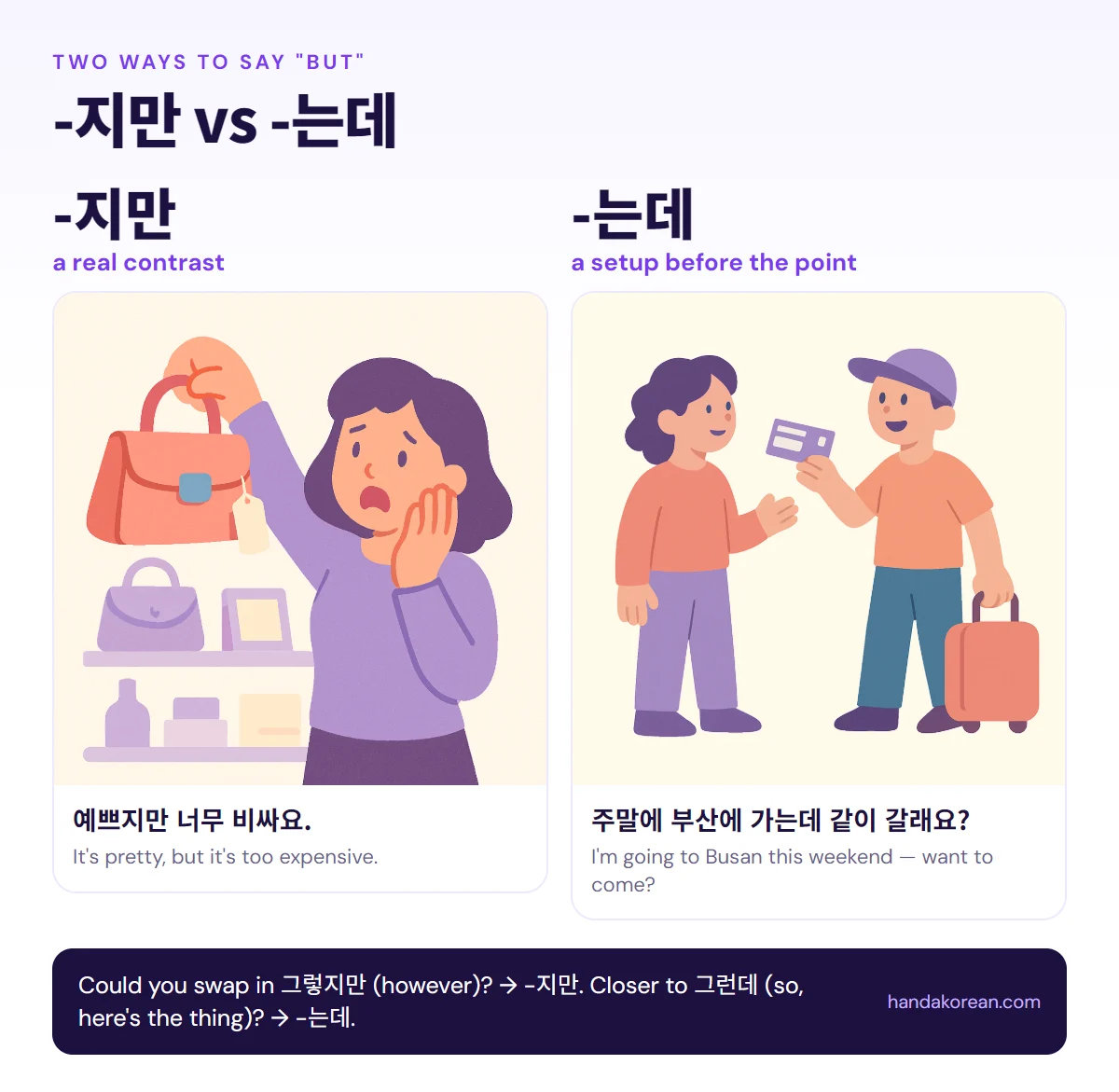
-지만 is a contrast. -는데 is a setup.
-지만 says: this is true, and the next thing goes against it. -는데 says: here's the situation — now listen to what I'm about to say. Sometimes that situation happens to contrast with what follows, which is why "but" works as a translation. Often it doesn't contrast at all, and "but" is simply wrong.
Once you feel that difference, a lot of your Korean will suddenly sound less like a textbook.
The forms first
-지만 is easy: it attaches straight to the stem, no vowel-checking.
| Dictionary form | -지만 |
|---|---|
| 먹다 | 먹지만 |
| 좋다 | 좋지만 |
| 있다 / 없다 | 있지만 / 없지만 |
| 학생이다 | 학생이지만 |
| Past (먹다) | 먹었지만 |
-는데 changes depending on what kind of word it follows. This is where most mistakes happen.
| Type | Rule | Example |
|---|---|---|
| Verb | -는데 | 가다 → 가는데, 먹다 → 먹는데 |
| Adjective (vowel/ㄹ) | -ㄴ데 | 바쁘다 → 바쁜데, 길다 → 긴데 |
| Adjective (consonant) | -은데 | 좋다 → 좋은데, 많다 → 많은데 |
| 있다 / 없다 | -는데 | 있는데 / 없는데 |
| Noun + 이다 | -인데 | 학생인데 |
| Any past tense | -았/었는데 | 갔는데, 좋았는데 |
Two traps: 좋다 and 많다 are adjectives, so it's 좋은데, 많은데 — never 좋는데. But 있다/없다 behave like verbs here: 재미있는데, 시간 없는데. And in the past tense everything becomes -는데, so you never have to think about it.
-지만: a real contrast
Use -지만 when the second clause genuinely pushes against the first. You could put although in front of the first clause in English and it would still make sense.
- 이 가방은 예쁘지만 너무 비싸요. — This bag is pretty, but it's too expensive.
- 김치는 맵지만 맛있어요. — Kimchi is spicy, but it's delicious.
- 저는 한국에 살지만 한국 사람은 아니에요. — I live in Korea, but I'm not Korean.
- 표를 샀지만 못 갔어요. — I bought a ticket, but I couldn't go.
-지만 also feels a bit more written and a bit more formal. In essays, announcements and news writing it's everywhere. In casual speech Koreans use it too, but less often than learners do.
-는데: background before the point
-는데 hands the listener a piece of context and then delivers the real message. The second clause can contrast, explain, ask, or request — -는데 doesn't care.
Context, then the main news:
- 어제 그 영화 봤는데 진짜 재미있었어요. — I saw that movie yesterday and it was really good.
- 주말에 부산에 가는데 같이 갈래요? — I'm going to Busan this weekend — do you want to come?
Notice you can't say "but" in either of those. That's -는데 doing its real job.
Softening a request or a refusal:
- 죄송한데 여기 자리 있어요? — Sorry, is this seat taken?
- 지금 좀 바쁜데 나중에 얘기해도 돼요? — I'm a little busy right now — can we talk later?
- 그 색깔도 좋은데 다른 색은 없어요? — That color is nice too, but do you have another color?
Contrast (yes, it does this too):
- 아까 전화했는데 안 받으시더라고요. — I called earlier but you didn't pick up.
- 날씨는 좋은데 좀 추워요. — The weather is nice, but it's a bit cold.
All of these are 해요체 — everyday polite speech, which is where -는데 lives most comfortably.
The nuance natives feel
Here's the test I'd give a student: can you replace the connector with 그렇지만 ("however") and still sound sane? If yes, -지만 fits. If what you really mean is closer to 그런데 ("so anyway, here's the thing"), use -는데.
Compare:
- 어제 그 책 읽었는데 너무 좋았어요. ✅ I read that book yesterday and it was great.
- 어제 그 책 읽었지만 너무 좋았어요. ❌
The second sentence isn't ungrammatical — it's just strange. To a Korean ear, -지만 promises a reversal, so 읽었지만 sets up something like "…but I didn't understand it." Then "it was great" arrives and the listener has to mentally back up. It's like saying in English, "Although I read that book, it was great." Technically parsable. Nobody talks like that.
The other thing: -는데 is polite because it's indirect. Starting with context instead of a demand gives the listener room to move. Compare these two ways of asking a shop assistant for help:
- 다른 사이즈 주세요. — Give me another size. (fine, but blunt)
- 이거 조금 작은데 다른 사이즈 있어요? — This is a bit small — do you have another size? (natural, soft)
That second pattern is one of the most useful things in spoken Korean. A huge share of real requests begin with a -는데 clause.
And -는데 can even end the sentence, trailing off to imply the rest:
- 이거 좀 비싼데요. — This is a little pricey… (= so I'd rather not)
- 지금은 좀 어려운데요. — That's a bit difficult right now… (a soft no)
That final -요 keeps it polite. Without it (비싼데…) it's 반말, for friends only.
Common mistakes
1. 좋는데, 많는데, 바쁘는데 — adjectives take -ㄴ/은데. Say 좋은데, 많은데, 바쁜데.
2. Using -지만 for everything. Learners reach for -지만 because it has one form. The result sounds stiff and sometimes accidentally argumentative. When you're just giving background, switch to -는데.
3. Building the past tense by hand. The error is 가았는데 or 갔은데. Past + -는데 is always -았/었는데: 갔는데, 먹었는데, 좋았는데.
4. 죄송하지만 vs 죄송한데. Both exist and both are correct. 죄송하지만 is the more formal, set phrase (announcements, customer service, 합쇼체 contexts). 죄송한데 is what you say to a stranger on the street. Use whichever matches the room.
Quick decision guide
| You want to… | Use |
|---|---|
| State a real contradiction | -지만 |
| Write formally or make a clean "although" | -지만 |
| Give context before your question or request | -는데 |
| Soften a refusal or an opinion | -는데 |
| Tell a story ("so I went there and…") | -는데 |
Practice
- Conjugate: 시간이 없다 + -는데 → ?
- Conjugate: 어제 친구를 만나다 (past) + -는데 → ?
- Which is natural? (a) 어제 카페에 갔지만 사람이 많았어요. (b) 어제 카페에 갔는데 사람이 많았어요.
- Fix the mistake: 날씨가 좋는데 밖에 나갈까요?
- Say it in Korean (해요체): "I'm a little busy right now — can we talk later?"
Answers
- 없는데 (있다/없다 take -는데)
- 만났는데 (past tense is always -았/었는데)
- (b) 어제 카페에 갔는데 사람이 많았어요. — It's background, not a contradiction. (a) makes the listener expect a reversal that never comes.
- 날씨가 좋은데 밖에 나갈까요? — 좋다 is an adjective, so -은데.
- 지금 좀 바쁜데 나중에 얘기해도 돼요? (Also fine: 지금 좀 바쁜데 이따가 얘기할까요?)
One small habit to build this week: every time you're about to ask a Korean speaker for something, start with a -는데 clause. 저기요, 길 좀 물어보려고 하는데요. It's a tiny change, and it makes you sound considerably more fluent than your vocabulary says you are.
Practice this with an AI tutor
HanDa corrects every sentence you write or say — in real conversation, not flashcards.