8 Korean Words With No English Equivalent (With Pictures)
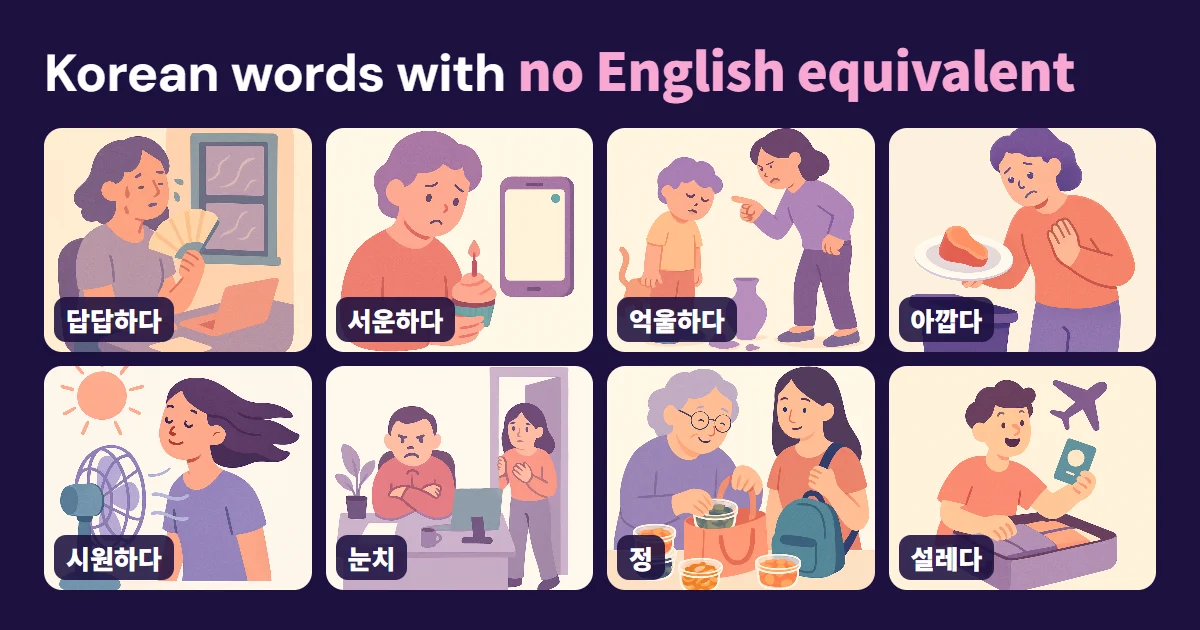
Sooner or later a Korean friend sighs 아, 답답해! and you reach for the dictionary. It offers stuffy, frustrated, suffocating — and none of them quite matches what just happened.
That's not because these words are mysterious. It's because Korean cuts feelings up in different places. Where English has three or four separate words for different situations, Korean has one word for the feeling those situations share. Learn the feeling, and the word stops being "untranslatable."
So instead of definitions, each word below comes with a picture card: one Korean word, four everyday situations, and the English word you'd need for each. Look for what the four pictures have in common.
1. 답답하다 — when something is blocked
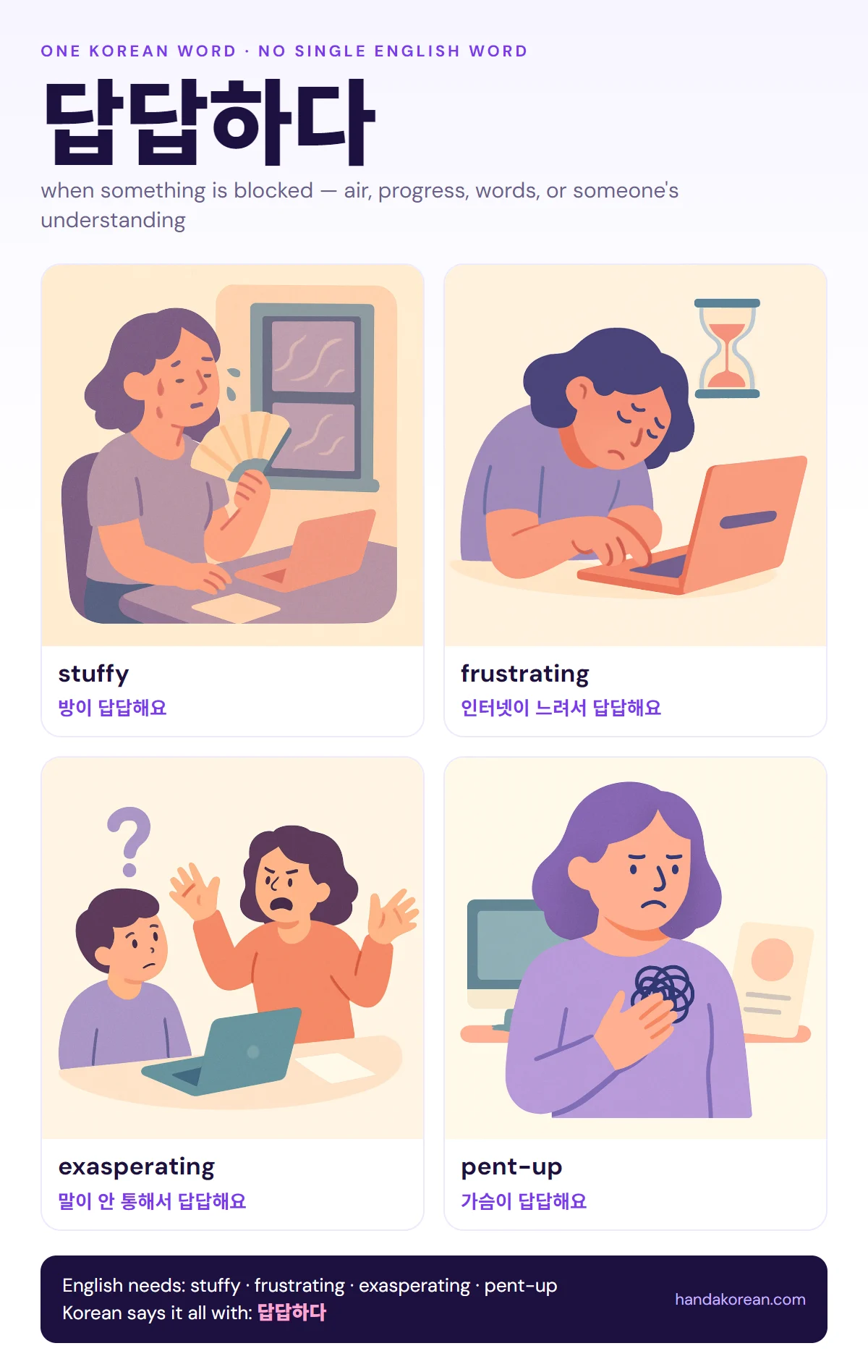
The picture behind 답답하다 is flow that's blocked. Air that doesn't move. Progress that doesn't move. Words that don't get through. Feelings stuck in your chest. English splits these into stuffy, frustrating, exasperating and pent-up; Korean hears one sensation.
방이 너무 답답해요. 창문 좀 열까요? The room is so stuffy. Shall I open the window?
인터넷이 너무 느려서 답답해요. The internet is so slow — it's driving me up the wall.
몇 번을 설명해도 못 알아들어서 답답해요. No matter how many times I explain, they don't get it. It's so frustrating.
하고 싶은 말을 못 하니까 가슴이 답답해요. I can't say what I want to say, so my chest feels tight.
A person can be 답답하다 too — someone slow to act or stubbornly not getting it. 그 사람 좀 답답해요 is a real complaint, so don't say it to their face.
2. 서운하다 — hurt, by someone close
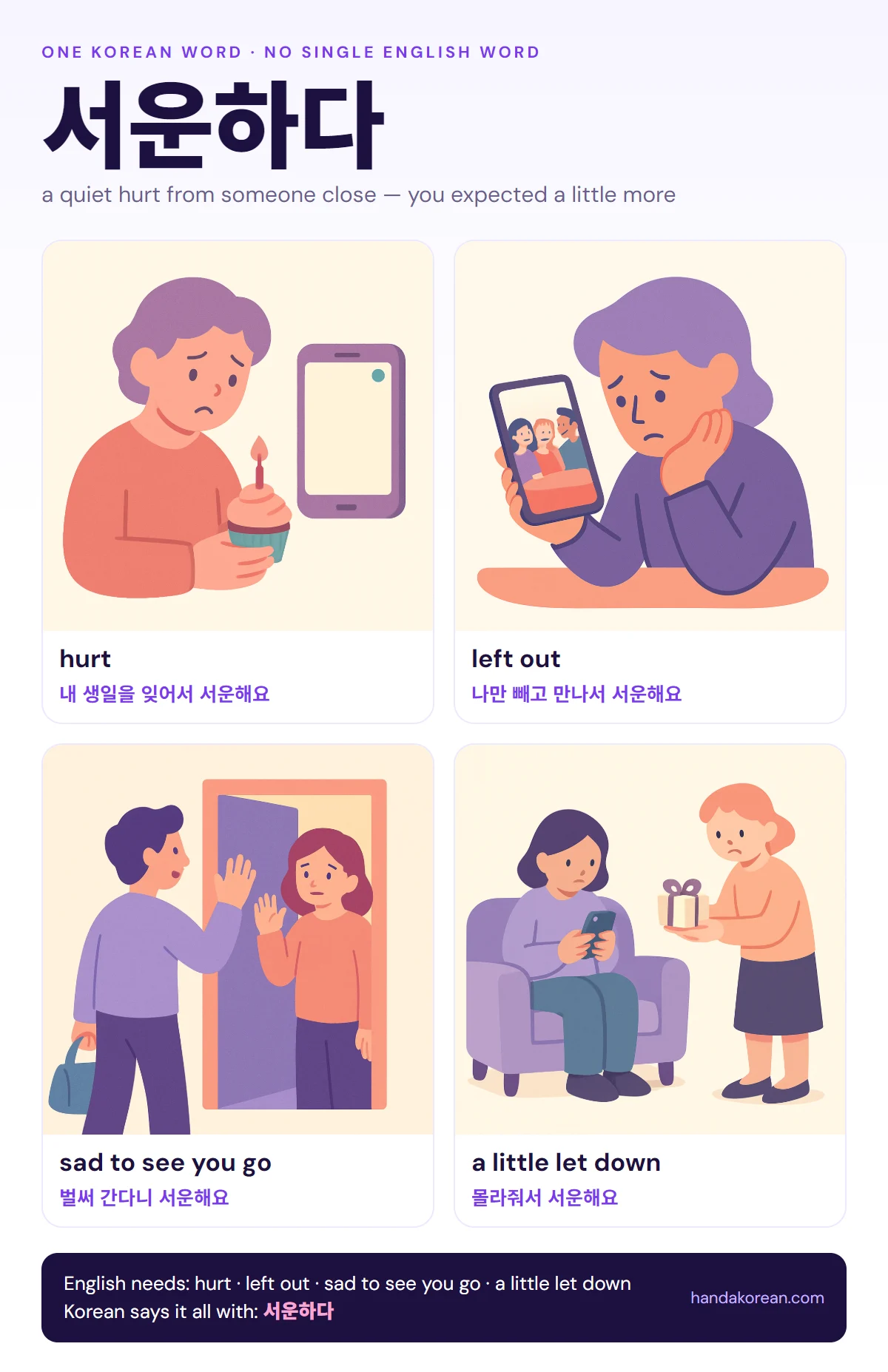
서운하다 is the small ache you feel when someone close to you doesn't do what you hoped. They forgot, they didn't invite you, they're leaving, they didn't notice. It isn't anger, and it isn't deep sadness.
What surprises learners is that Koreans often say it directly to the person. Telling a friend "서운해" is a gentle way of saying you matter to me, so this stung a little.
내 생일을 잊어버리다니, 좀 서운하다. You forgot my birthday? I'm a little hurt. (반말, to a close friend)
저만 빼고 다 같이 밥 먹었대요. 좀 서운했어요. Apparently everyone had dinner together without me. I felt a bit left out.
벌써 가요? 서운하네요. You're leaving already? I'll miss you.
You'll also hear 섭섭하다, which is very close in meaning.
3. 억울하다 — unfair, and it's happening to me
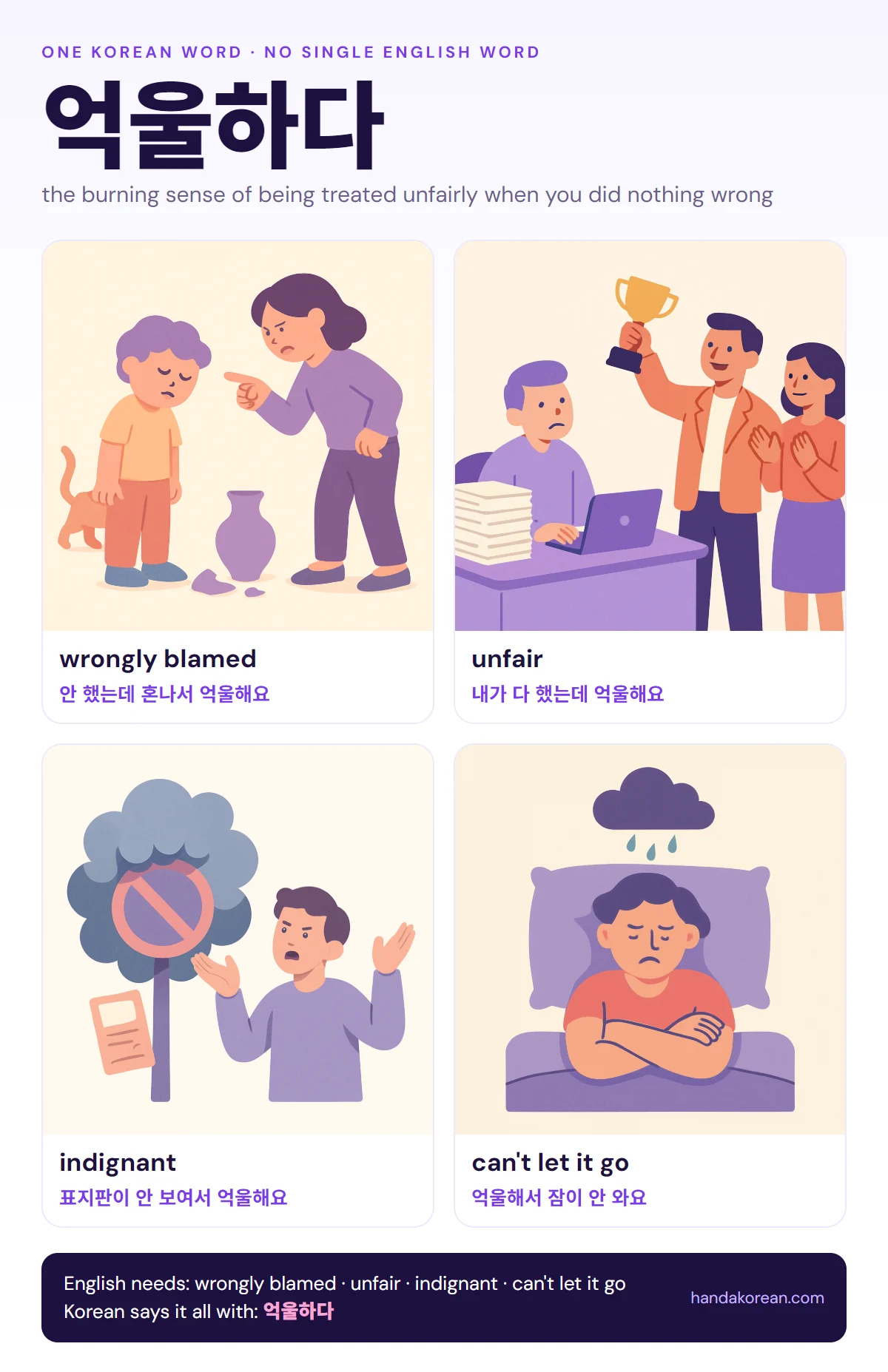
English unfair describes a situation from the outside. 억울하다 is how injustice feels from the inside when you're the one it happened to: blamed for something you didn't do, not credited for something you did, punished when you had no way to know.
저는 안 했는데 저만 혼났어요. 진짜 억울해요. I didn't do it, but I'm the one who got told off. It's so unfair.
제가 다 했는데 칭찬은 다른 사람이 받았어요. 너무 억울해요. I did all the work, and someone else got the praise. It's so unfair.
표지판이 나무에 가려서 안 보였어요. 억울해요! The sign was hidden behind a tree — I couldn't see it. It's not fair!
서운하다 vs 억울하다: 서운하다 is about a relationship (someone close let you down). 억울하다 is about fairness (you were treated unjustly).
4. 아깝다 — something good is going to waste
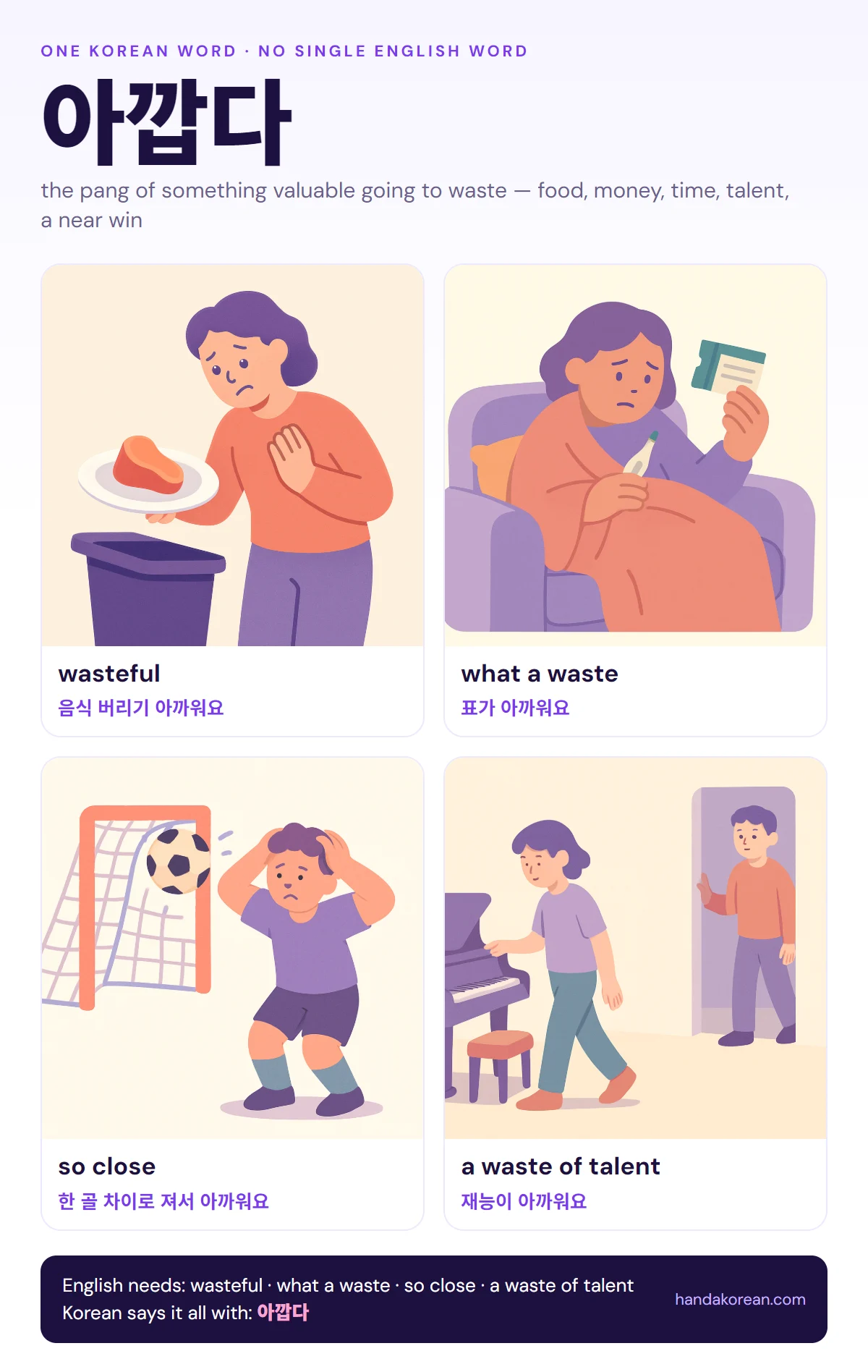
아깝다 is the pang you feel when something valuable is lost or not used: food in the bin, a ticket you couldn't use, a win that slipped away by one goal, a talented person giving up.
음식을 이렇게 버리면 너무 아까워요. It's such a waste to throw food away like this.
표를 샀는데 아파서 못 갔어요. 돈이 아까워요. I bought a ticket but got sick and couldn't go. What a waste of money.
한 골 차이로 졌어요. 정말 아깝다! We lost by one goal. So close!
그렇게 잘하는데 그만두다니, 재능이 아까워요. You're that good and you're quitting? What a waste of talent.
Two more uses you'll hear all the time:
너무 예뻐서 쓰기 아까워요. It's so pretty I can't bring myself to use it.
그 사람한테 네가 아까워. You're too good for them.
5. 시원하다 — relief, even from hot soup
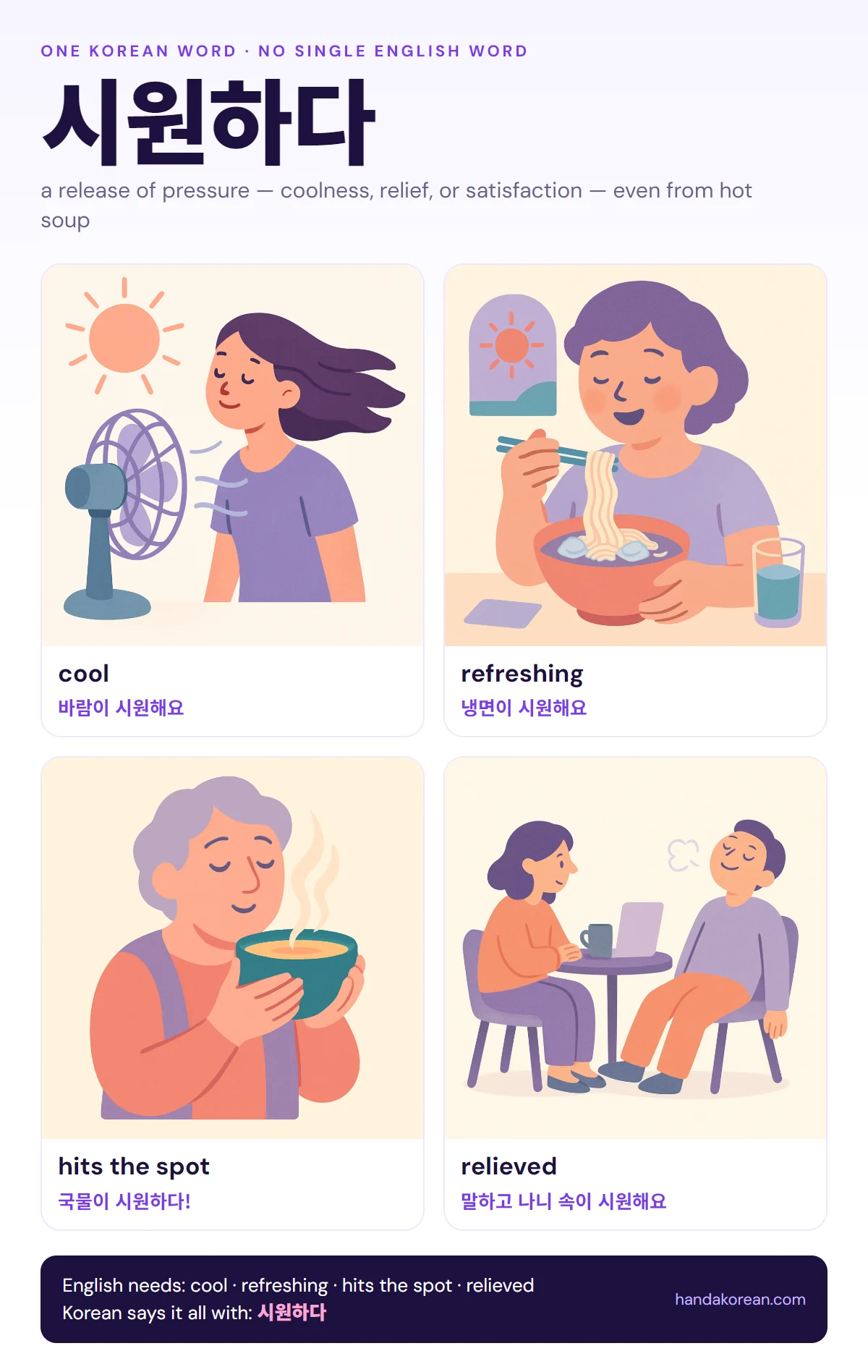
This is the word that confuses everyone: a Korean takes a spoonful of boiling soup and says 시원하다, which the dictionary says means cool.
The key is that 시원하다 isn't really about temperature. It's about pressure being released. A breeze on a hot day, cold noodles, hot broth that clears you out, a massage on a tight shoulder, finally saying what you needed to say — all of them feel like something opening up.
바람이 불어서 시원해요. There's a breeze, so it's nice and cool.
(뜨거운 국물을 한 입 먹고) 아, 시원하다! (after a sip of hot broth) Ah, that hits the spot!
거기 좀 더 세게 눌러 주세요. 아, 시원해요. Press a little harder there. Ah, that feels so good.
하고 싶은 말을 다 하니까 속이 시원해요. I said everything I wanted to say, and I feel so much lighter.
Notice the pair: 답답하다 is blocked, 시원하다 is released. 속이 답답해요 means your insides feel knotted up; 속이 시원해요 means they've finally cleared.
6. 눈치 — reading what nobody says
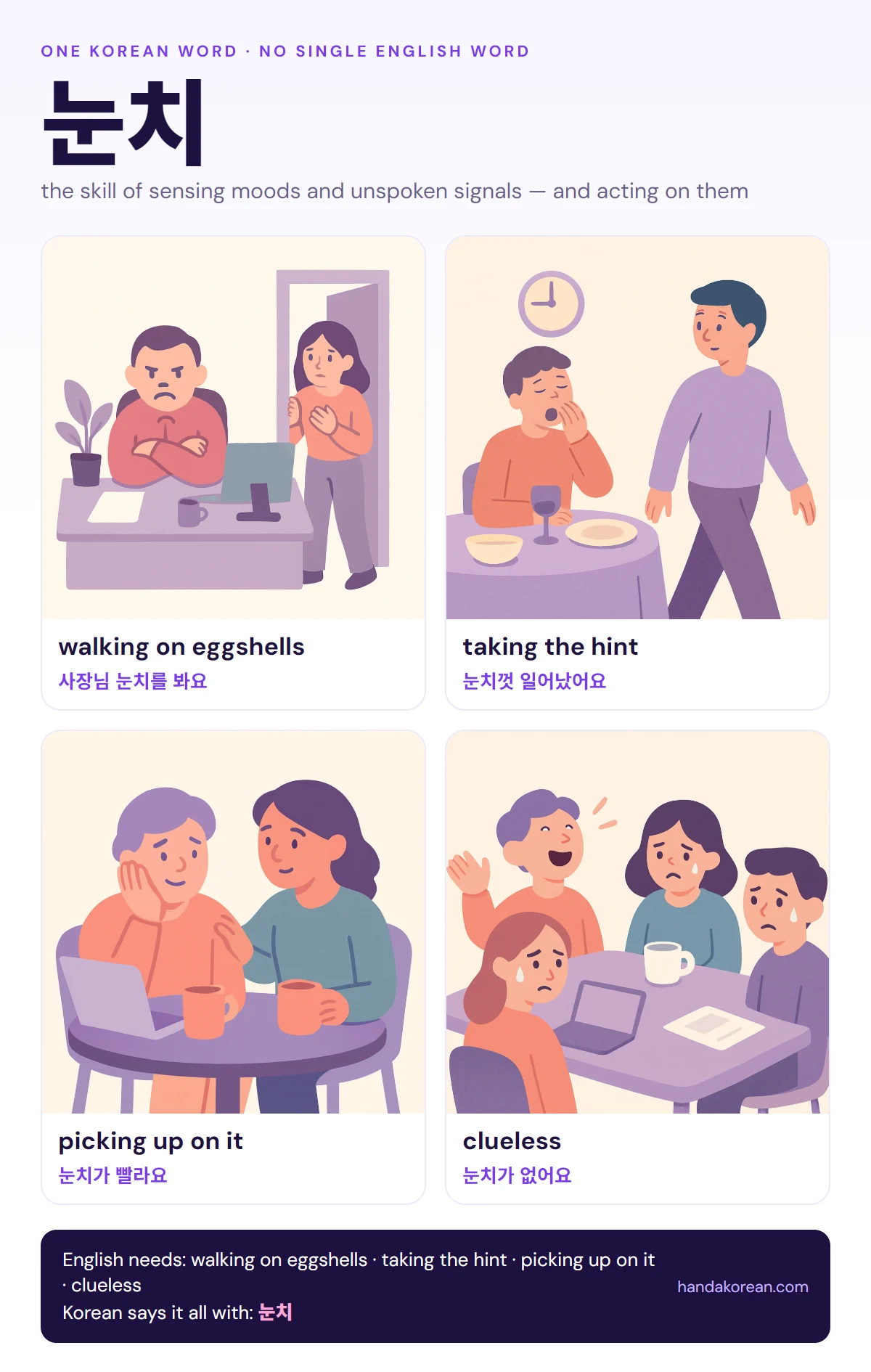
눈치 is a noun: the ability to sense moods and unspoken signals, and act on them without being told. English needs phrases for it — reading the room, taking the hint, picking up on things. In Korea it's treated as a basic social skill, so you'll mostly meet it in a few set expressions:
| Expression | Meaning |
|---|---|
| 눈치가 빠르다 | to be quick to read people |
| 눈치가 없다 | to be clueless about the mood |
| 눈치를 보다 | to watch how others react, often anxiously |
| 눈치껏 | using your own judgment about the situation |
제 친구는 눈치가 빨라서 말 안 해도 다 알아요. My friend is quick to read people — they know without being told.
사장님 눈치 보여서 먼저 퇴근을 못 하겠어요. I'm too conscious of the boss to leave work before them.
지금 그런 얘기를 하면 어떡해요. 눈치가 없네요. How could you bring that up right now? You really can't read the room.
분위기가 안 좋아서 눈치껏 먼저 나왔어요. The mood wasn't great, so I took the hint and left early.
눈치를 보다 leans a little negative: it suggests you feel you have to tiptoe around someone.
7. 정 — the bond that builds up
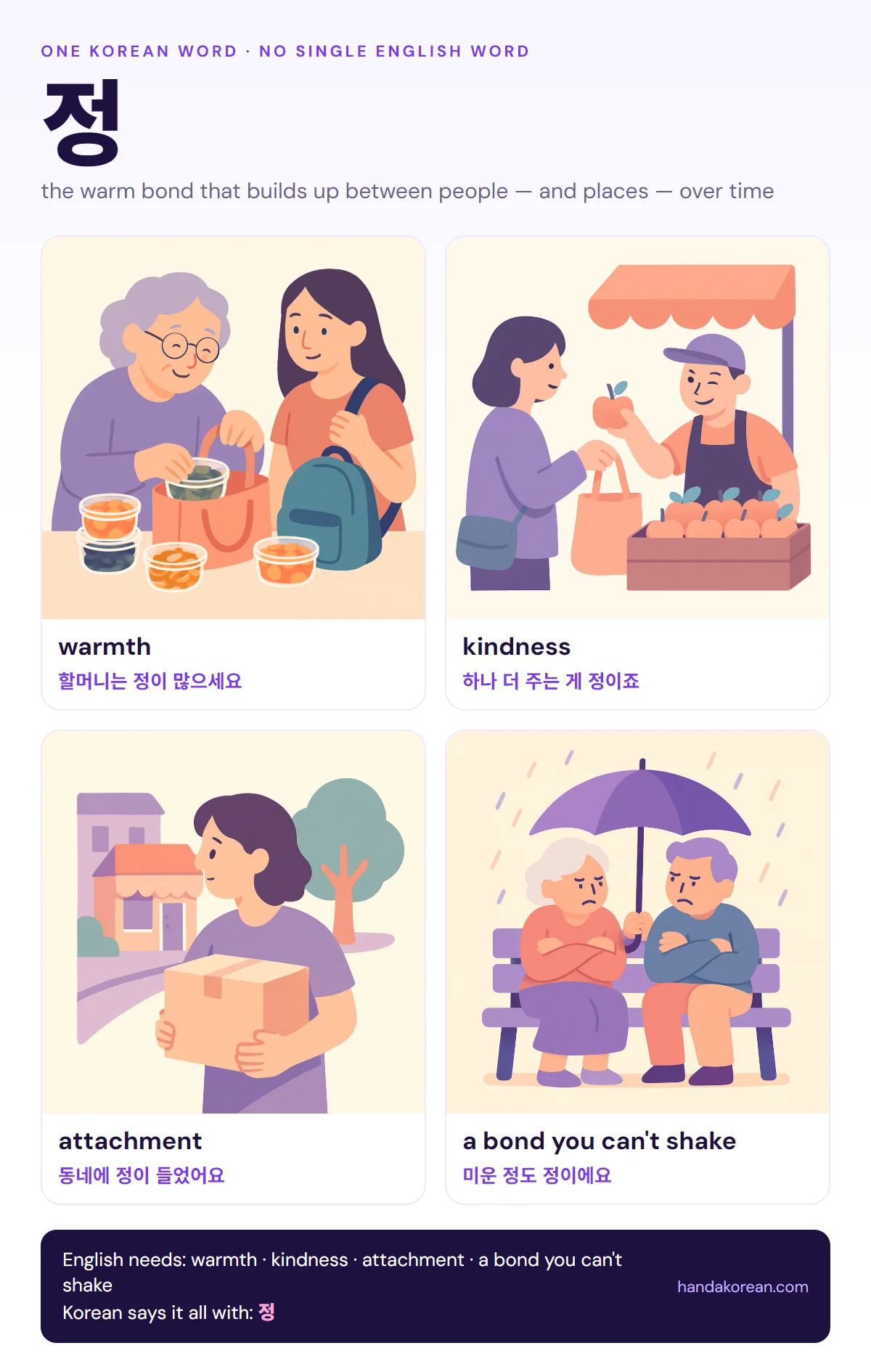
정 is the affection and attachment that accumulates between people over time — through meals, small kindnesses, and simply being around each other. It isn't romantic love and it isn't exactly friendship. You can feel 정 for a neighbor, a shop owner, an old street, even a person who drives you up the wall.
Two expressions to learn with it: 정이 많다 (to be warm-hearted) and 정이 들다 (to grow attached).
할머니는 정이 많으셔서 늘 반찬을 싸 주세요. My grandma is so warm-hearted — she always packs side dishes for me.
오래 살던 동네라서 정이 많이 들었어요. I lived in this neighborhood for a long time, so I've grown really attached to it.
사장님이 하나 더 넣어 주셨어요. 이런 게 정이죠. The owner threw in an extra one. That's 정 for you.
매일 싸우지만 미운 정도 정이에요. We fight every day, but a bond built on bickering is still a bond.
8. 설레다 — excited, with a flutter
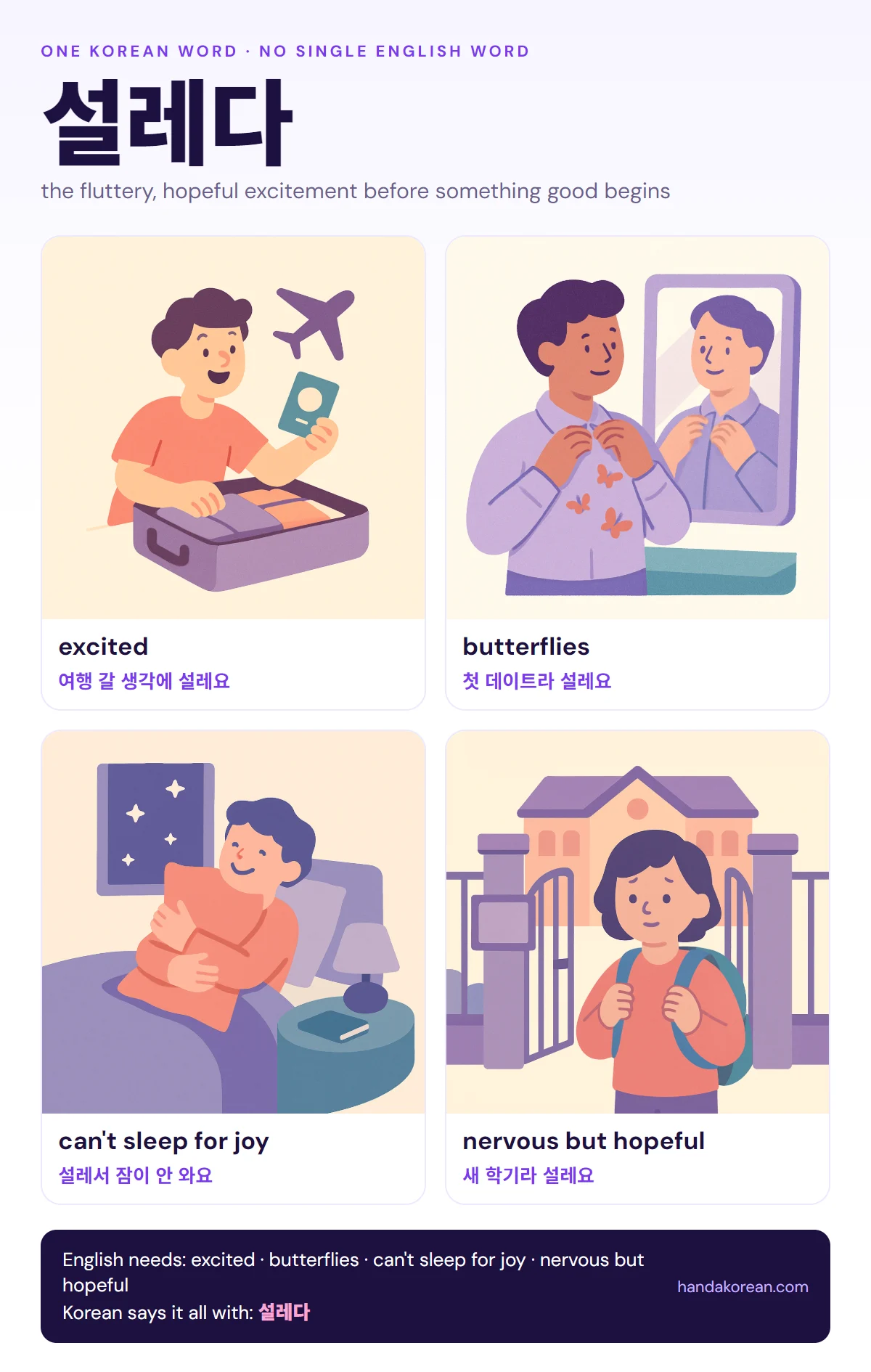
설레다 is the fluttery, hopeful excitement before something good begins: the night before a trip, a first date, the first day of a new semester, a message from someone you like.
It's different from 신나다, which is the fun, energetic excitement of doing something enjoyable. 설레다 lives in the waiting, and it usually has a little nervousness mixed in.
내일 여행 가요. 벌써 설레요! I'm going on a trip tomorrow. I'm already so excited!
첫 데이트라서 너무 설레서 잠이 안 와요. It's our first date — I'm so excited I can't sleep.
새 학기라 설레기도 하고 떨리기도 해요. It's a new semester, so I'm excited and nervous at the same time.
A spelling note, because this one is misspelled constantly: the verb is 설레다 and the noun is 설렘. Not 설레이다, not 설레임.
Quick review
| Korean | The shared feeling | English needs |
|---|---|---|
| 답답하다 | something is blocked | stuffy, frustrating, exasperating, pent-up |
| 서운하다 | someone close let you down a little | hurt, left out, sad to see you go |
| 억울하다 | you were treated unfairly | wrongly blamed, unfair, indignant |
| 아깝다 | something valuable is wasted | wasteful, so close, a waste of talent |
| 시원하다 | pressure is released | cool, refreshing, hits the spot, relieved |
| 눈치 | sensing what nobody says | reading the room, taking the hint |
| 정 | a bond built up over time | warmth, kindness, attachment |
| 설레다 | hopeful excitement before something | excited, butterflies |
Practice
Fill in each blank with one of the eight words, in the right form.
- 친구들이 저만 빼고 여행을 갔어요. 좀 ___.
- 창문이 없어서 방이 너무 ___.
- 뜨거운 국물을 먹으니까 속이 ___.
- 제가 안 깼는데 저만 혼났어요. 너무 ___.
- 내일 첫 출근이에요. 긴장되지만 ___.
- 이 옷은 너무 예뻐서 입기 ___.
Answers
- 서운했어요 — My friends went on a trip without me. I felt a bit hurt.
- 답답해요 — There's no window, so the room is really stuffy.
- 시원해요 — Having hot broth makes my insides feel great.
- 억울해요 — I didn't break it, but I'm the only one who got told off. It's so unfair.
- 설레요 — Tomorrow is my first day at work. I'm nervous, but excited.
- 아까워요 — These clothes are so pretty I can't bring myself to wear them.
The fastest way to make these words yours is to catch them in real conversations. Next time you hear one, look at the situation and ask which of the four pictures it belongs to.
Practice this with an AI tutor
HanDa corrects every sentence you write or say — in real conversation, not flashcards.