At the Convenience Store in Korean: What the Clerk Asks You
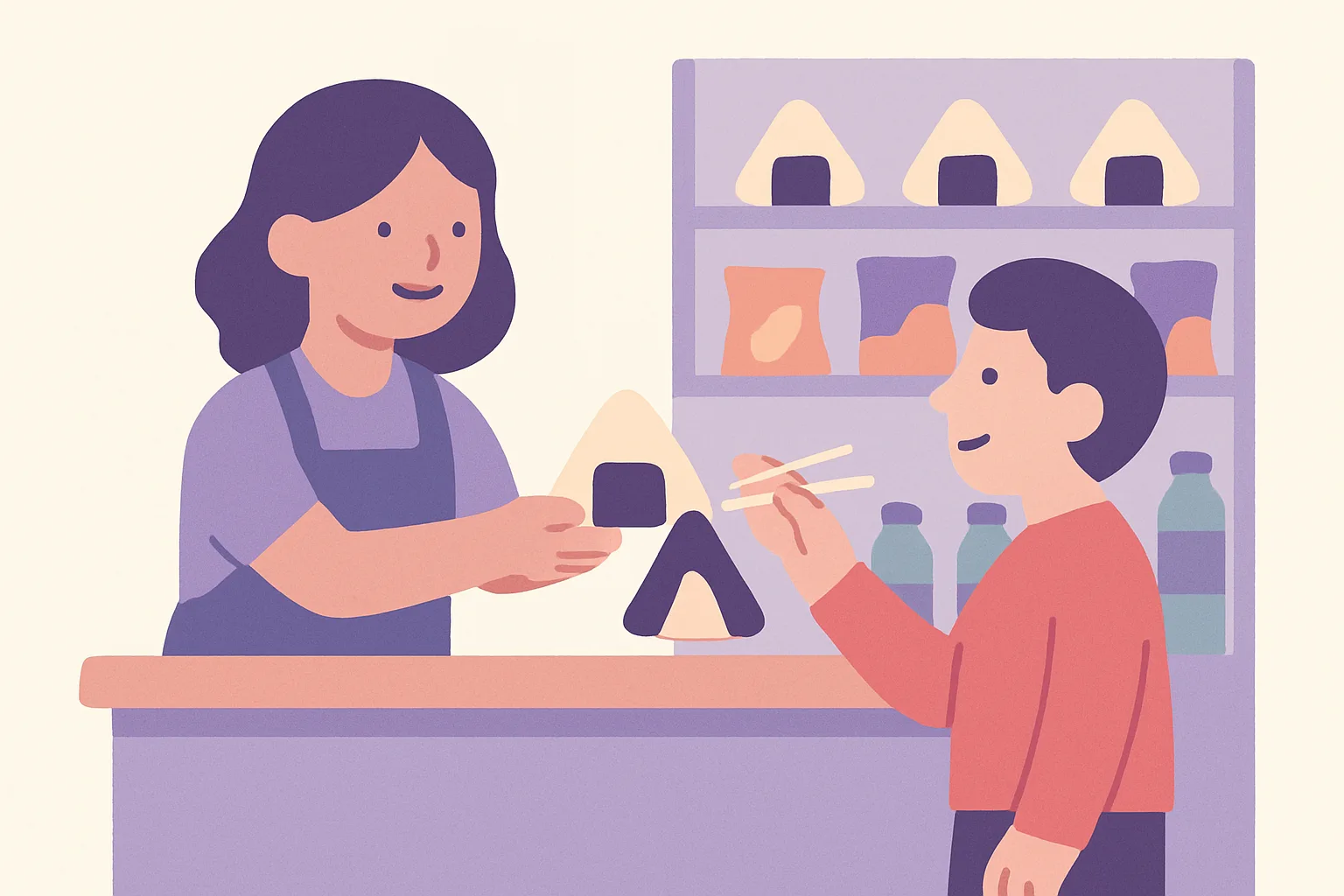
Here's the one thing that makes a Korean convenience store easy: you are not the one who has to talk first. You put your things on the counter, and the clerk asks a short list of questions. The list barely changes — bag, heat it up, chopsticks, points card, receipt. Your whole job is to recognize those questions and answer in two or three words.
So don't study "how to buy things." Study the four or five sentences that are going to be said to you. That's the shape of the conversation.
The whole thing, start to finish
A normal 편의점 visit. The clerk (점원) speaks in polite 합쇼체 and -(으)세요 forms; you answer in 해요체. Nobody expects a customer to use 합쇼체 back.
점원: 안녕하세요. 결제 도와드리겠습니다. Hello. I'll help you with your payment.
점원: 삼각김밥 데워 드릴까요? Shall I heat up the rice ball?
손님: 네, 데워 주세요. Yes, please heat it up.
점원: 젓가락 드릴까요? Would you like chopsticks?
손님: 네, 주세요. Yes, please.
점원: 봉투 필요하세요? Do you need a bag?
손님: 아니요, 괜찮아요. No, I'm fine.
점원: 적립카드 있으세요? Do you have a points card?
손님: 아니요, 없어요. No, I don't.
점원: 카드 여기 꽂아 주세요. … 결제되었습니다. 영수증 드릴까요? Please insert your card here. … Payment complete. Would you like the receipt?
손님: 괜찮아요. 감사합니다. I'm fine, thanks. Thank you.
That's it. Count the words you actually produced: 네, 데워 주세요, 주세요, 아니요, 괜찮아요, 없어요, 감사합니다. Seven chunks, and four of them are 네 or 아니요 plus something.
The questions, and what to say back
| 점원 says | It means | You say |
|---|---|---|
| 봉투 필요하세요? | Do you need a bag? | 네, 하나 주세요. / 아니요, 괜찮아요. |
| 봉투 드릴까요? | Shall I give you a bag? | 네, 주세요. / 아니요, 괜찮아요. |
| 데워 드릴까요? | Shall I heat it up? | 네, 데워 주세요. / 아니요, 괜찮아요. |
| 젓가락 드릴까요? | Would you like chopsticks? | 네, 주세요. |
| 숟가락도 드릴까요? | A spoon too? | 네, 주세요. / 아니요, 괜찮아요. |
| 적립카드 있으세요? | Do you have a points card? | 아니요, 없어요. |
| 현금영수증 필요하세요? | Do you need a cash receipt? | 아니요, 괜찮아요. |
| 영수증 드릴까요? | Would you like the receipt? | 네, 주세요. / 괜찮아요. |
| 드시고 가세요? | Are you eating here? | 네, 여기서 먹을게요. / 아니요, 가지고 갈게요. |
Notice how many of these end in -드릴까요? — literally "shall I give you (humbly)?" It's an offer, and the natural answer to an offer is 주세요, not a full sentence. If the clerk says 젓가락 드릴까요? and you answer 네, 젓가락이 필요해요, it isn't wrong, it's just heavy — like answering "Want a bag?" with "Yes, I require a bag."
Why 괜찮아요 is the word that does the work
Every "no" in that list is 괜찮아요, not 아니요 on its own and definitely not 필요 없어요.
아니요 by itself is a bare fact. It's fine, but it lands flat, and Koreans usually soften it by adding something. 필요 없어요 ("I don't need it") is grammatically perfect and sounds cold in this situation — it's the tone of refusing a pushy salesperson. 됐어요 is worse; it carries a little enough already.
괜찮아요 means "I'm fine as I am," which is exactly what you mean. It's the standard polite decline for anything offered to you — a bag, a receipt, a refill, a second helping. If you want more on this word's double life, 괜찮아요 does yes, no, and everything in between, and there's a fuller set of polite refusals in how to say no politely in Korean.
One small thing: bags are not free in Korean convenience stores, so 봉투 필요하세요? is a real question about spending money, not a formality. If you brought your own bag, 괜찮아요 is all you need.
The three sentences you say first
There are only a few moments where you open your mouth before the clerk does.
- 이거 주세요. — This one, please. (pointing at something behind the counter)
- 이거 얼마예요? — How much is this?
- 카드로 할게요. — I'll pay by card. (or 현금으로 할게요 for cash)
That last one is worth a second. Koreans say 카드로 할게요, not 카드로 하고 싶어요. The -(으)ㄹ게요 ending announces a decision you're making right now on the spot, which is exactly what paying is. 하고 싶어요 ("I want to") sounds like you're expressing a preference and waiting for permission. The difference between these two moods is the whole story in -(으)ㄹ게요 vs -(으)ㄹ래요.
And if you want two of something, use native numbers with a counter: 봉투 두 개 주세요 (two bags, please), 삼각김밥 세 개 주세요. Not 이 개. If that split still trips you up, when to use 하나, 둘 vs 일, 이 sorts it out.
When it goes off script
Things that actually happen, and the line for each:
- You changed your mind about an item. → 이거는 뺄게요. I'll take this one off. Say it while pointing. This is the standard phrase; the clerk will cancel it without a word.
- You want one more bag. → 봉투 하나 더 주세요. One more bag, please.
- You want everything in one bag. → 같이 담아 주세요. Please put it all together.
- You're making instant ramyeon there. → 뜨거운 물 어디 있어요? Where's the hot water?
- You want to use the microwave. → 전자레인지 좀 쓸게요. I'm going to use the microwave. (You're informing, not asking — that's why -(으)ㄹ게요 again. 써도 돼요? also works if you'd rather ask.)
- Your card doesn't go through. The clerk will say something like 카드가 안 되네요. You say 다른 카드로 할게요 (I'll use a different card) or 현금으로 할게요.
- You missed the question entirely. → 네? with a rising tone, or 다시 말씀해 주세요. Please say that again. Both are completely normal. Nobody minds.
- You want to check a promotion. → 이거 1+1 맞아요? Is this buy-one-get-one? (read aloud as 원 플러스 원)
And when you leave: 감사합니다. The clerk will often say 안녕히 가세요. You don't need to answer it.
Practice
Write or say the Korean out loud before you open the answers.
- The clerk asks 봉투 필요하세요? — you don't want one. Decline politely.
- Ask the clerk to heat up your food.
- Tell the clerk you'll pay by card.
- The clerk asks 젓가락 드릴까요? — you want them.
- Ask for one more bag.
Answers
- 아니요, 괜찮아요.
- 데워 주세요.
- 카드로 할게요.
- 네, 주세요.
- 봉투 하나 더 주세요.
Run through the clerk's questions once in your head before you walk in. The first time you hear 데워 드릴까요? and answer without freezing, the convenience store stops being a test and goes back to being a place that sells rice balls.
Learn this properly, not just once
Blog posts teach one thing at a time. The HanDa books teach level 1 in order — every lesson built to be spoken, with a workbook and writing book beside it.
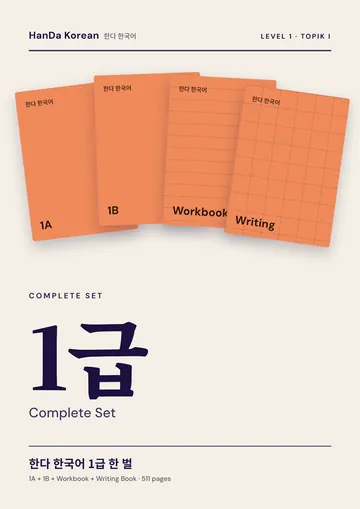 HanDa Korean Level 1 — Complete Set
Everything for level 1 — books, workbook and writing book · 511 pages
$10
HanDa Korean Level 1 — Complete Set
Everything for level 1 — books, workbook and writing book · 511 pages
$10
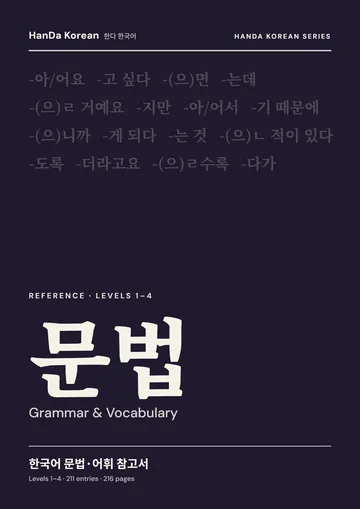 Korean Grammar & Vocabulary Reference
Every pattern in one place · 216 pages
$8
Korean Grammar & Vocabulary Reference
Every pattern in one place · 216 pages
$8
Practice this with an AI tutor
HanDa corrects every sentence you write or say — in real conversation, not flashcards.