Korean Phone Call Phrases: 여보세요 and What Comes Next
여보세요 is not "hello"
Here's the one thing to take away: 여보세요 doesn't mean "hello." It means something like "are you there?"
That's why you only use it when you can't see the other person — on the phone, or calling into a dark apartment to check if anyone's home. It's a sound you make into empty space. Say it to someone standing in front of you and a Korean will laugh, because it sounds like you've mistaken their face for a phone.
And because 여보세요 isn't a greeting, it doesn't do a greeting's work. It just confirms the line is open. Everything that actually matters — who you are, why you're calling, whether now is okay — happens in the lines right after it. Those lines are short, fixed, and almost the same every time. Learn them and a Korean phone call stops being scary.
A call between friends
Two friends, 반말:
A: 여보세요. (Hello?) B: 어, 민수야. 나 지은이야. 지금 통화 괜찮아? (Hey, Minsu. It's Jieun. Is now okay to talk?) A: 어, 괜찮아. 무슨 일이야? (Yeah, it's fine. What's up?) B: 내일 몇 시에 만날지 물어보려고. (I wanted to ask what time we're meeting tomorrow.) A: 아, 맞다. 일곱 시에 보자. (Oh, right. Let's meet at seven.) B: 알겠어. 그럼 내일 봐. 끊을게. (Got it. See you tomorrow. I'll hang up.)
Notice that B says her own name immediately, even though a phone shows who's calling. Koreans still do this. It's a tiny courtesy, and skipping it feels abrupt.
Also notice 끊을게 — literally "I'll hang up." In English, announcing that you're about to hang up sounds rude. In Korean it's the normal, polite way to close. Ending a call with only 안녕 and silence feels unfinished.
A call to an office
Now the polite version. The office worker uses 해요체 and 합쇼체 mixed, which is exactly what you'll hear:
A: 네, ○○무역입니다. (Yes, this is ○○ Trading.) B: 안녕하세요. 저 한국대학교 김지은이라고 하는데요. 박민수 씨 계세요? (Hello. My name is Kim Jieun, from Hanguk University. Is Mr. Park Minsu there?) A: 네, 잠시만요. 바꿔 드릴게요. (Yes, one moment. I'll put him on.)
Or, if he isn't:
A: 지금 자리에 안 계시는데요. 메모 남기시겠어요? (He's not at his desk right now. Would you like to leave a message?) B: 아니요, 제가 이따가 다시 걸게요. 감사합니다. (No, I'll call back later. Thank you.) A: 네, 들어가세요. (Yes, goodbye.)
Two things worth staring at.
First, the person answering a business line does not say 여보세요. They say 네, plus the company name plus -입니다. Answering a work call with 여보세요 sounds unprepared, like you picked up your own phone at home. The same goes for answering a call from your boss: 네, 과장님 is better than 여보세요. If you want to know why -입니다 feels different from -이에요 here, see Korean speech levels explained.
Second, 들어가세요 at the end. Literally "go inside," it's the standard polite way to finish a phone call — a leftover from wishing someone a safe trip home. You can also say 수고하세요 (to a worker) or 네, 감사합니다. Learners often reach for 안녕히 계세요, which isn't wrong, but 들어가세요 is what you'll actually hear.
The four moves of a Korean phone call
1. Pick up
| Situation | What you say |
|---|---|
| Unknown number | 여보세요? |
| A close friend | 어. / 응, 왜? |
| At work, outside call | 네, ○○회사입니다. |
| Your boss calling | 네, 부장님. |
2. Say who you are
- 저 지은인데요. — It's Jieun. (casual-polite)
- 김지은이라고 하는데요. — My name is Kim Jieun. (first contact, polite)
That -인데요 / -는데요 ending is doing real work. It's not "but" — it leaves the sentence open, as if to say "…and here's why I'm calling." A flat 김지은입니다. is correct but lands like a soldier reporting in. The soft, trailing version is friendlier; there's more on this pattern in when -는데 isn't "but" at all.
And if they ask whether it's you — 혹시 김지은 씨세요? — the answer is:
- 네, 전데요. — Yes, speaking. (from 저인데요)
3. Check that now is a good time
This step barely exists in English, and it's close to obligatory in Korean:
- 지금 통화 괜찮으세요? — Is now a good time to talk?
- 혹시 지금 통화 가능하세요? — Are you able to talk right now?
If it isn't a good time for you, you can say:
- 제가 지금 좀 바빠서요. 이따가 다시 걸게요. — I'm a bit busy right now. I'll call back later.
4. Ask for someone
- 민수 씨 계세요? — Is Minsu there?
- 사장님 좀 바꿔 주시겠어요? — Could you put the boss on, please?
Use name + 씨 for a colleague, and the job title for anyone above you — the same logic as how 씨 and titles work when you address people.
When it goes off script
This is where most learners freeze. Four lines cover almost everything:
- 소리가 잘 안 들려요. — I can't hear you well.
- 여기 신호가 안 좋아서요. 다시 걸게요. — The signal is bad here. I'll call again.
- 전화 잘못 거신 것 같아요. — I think you've got the wrong number.
- 죄송합니다. 잘못 걸었어요. — Sorry, I dialed the wrong number.
And if the line goes quiet mid-call, this is the one moment you repeat 여보세요 — with a rising question tone:
- 여보세요? 여보세요? 들리세요? — Hello? Hello? Can you hear me?
That's 여보세요 doing its real job: not greeting anyone, just checking whether there's still a person on the other end.
One last thing. If you need to say a number — a phone number, a room number — Koreans read phone numbers digit by digit with 공 for zero, and often pause with 에 where the hyphen goes: 공일공에 일이삼사에 오륙칠팔. If the other person speaks too fast, 천천히 말씀해 주세요. (Please speak slowly.) is perfectly polite and nobody will mind.
Practice
Say these out loud in Korean.
- You pick up a call from a number you don't recognize. (One word.)
- Someone asks 혹시 김지은 씨세요? Confirm that it's you.
- You call a coworker. Politely ask whether now is a good time to talk.
- The connection is bad. Tell them you can't hear well.
- End a polite call with a colleague.
Answers
- 여보세요?
- 네, 전데요.
- 지금 통화 괜찮으세요? (or 혹시 지금 통화 가능하세요?)
- 소리가 잘 안 들려요.
- 네, 감사합니다. 들어가세요. (or 수고하세요.)
Learn this properly, not just once
Blog posts teach one thing at a time. The HanDa books teach level 1 in order — every lesson built to be spoken, with a workbook and writing book beside it.
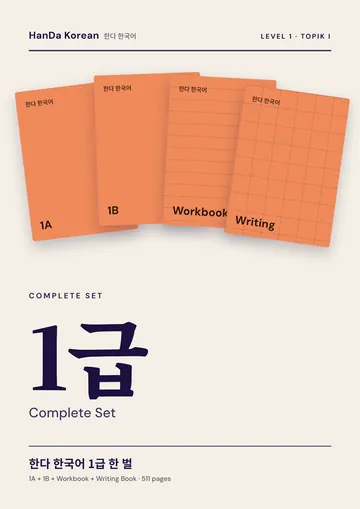 HanDa Korean Level 1 — Complete Set
Everything for level 1 — books, workbook and writing book · 511 pages
$10
HanDa Korean Level 1 — Complete Set
Everything for level 1 — books, workbook and writing book · 511 pages
$10
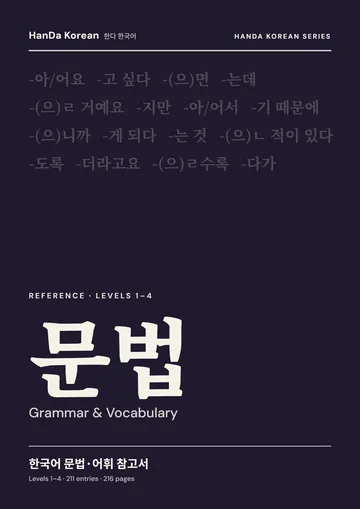 Korean Grammar & Vocabulary Reference
Every pattern in one place · 216 pages
$8
Korean Grammar & Vocabulary Reference
Every pattern in one place · 216 pages
$8
Practice this with an AI tutor
HanDa corrects every sentence you write or say — in real conversation, not flashcards.