How to Say Thank You in Korean: 감사합니다 vs 고마워

Quick answer: The safe, everyday "thank you" in Korean is 감사합니다 (gamsahamnida) — use it with strangers, staff, and anyone older. 고맙습니다 (gomapseumnida) is equally polite and a touch warmer. 고마워요 is the softer 해요체 version for people you know, and 고마워 is 반말, for close friends and people younger than you. To reply, say 아니에요 ("it's nothing").
The one idea to take away: all four words mean the same thing. You are not choosing a meaning, you are choosing a speech level — how close you are to the person and how much respect the situation asks for. Get that right and you sound normal. Get it wrong and a perfectly kind sentence lands badly.
The four forms, side by side
| Korean | Level | Say it to |
|---|---|---|
| 감사합니다 | 합쇼체 (formal polite) | Strangers, shop staff, your boss, anyone older — the default |
| 고맙습니다 | 합쇼체 (formal polite) | Same people, slightly warmer feel |
| 고마워요 | 해요체 (polite) | Classmates, coworkers you're friendly with, a neighbor you know |
| 고마워 | 반말 (casual) | Close friends, younger siblings, people clearly younger than you |
If you only remember one, remember 감사합니다. It is never wrong in public. A taxi driver, a café worker, someone who holds the door — 감사합니다 covers all of it. (If you want the full map of these levels, I wrote about Korean speech levels alongside greetings.)
It happens like this
You drop your card on the way out of a café. Someone behind you picks it up.
지나가던 사람: 저기요, 이거 떨어뜨리셨어요. Excuse me, you dropped this.
나: 아, 감사합니다! Oh, thank you!
지나가던 사람: 아니에요. It's nothing.
That's the whole exchange. Three lines, and the second one is the only thing you have to produce. Notice there's no "you're welcome" in the English sense — the reply is literally "no, it isn't" (아니에요), which is how Korean usually waves off thanks.
A small bow of the head goes with it almost automatically. If you want the details of how deep and when, see bowing in Korea.
감사합니다 vs 고맙습니다 — is there really a difference?
Both are polite, both are correct, and no Korean will correct you for picking the wrong one. The difference is flavor.
감사하다 comes from Sino-Korean roots and feels official — announcements, service counters, the end of a presentation. 고맙다 is a native Korean word and feels a little more personal, a little more like it came from you rather than from a script.
So a convenience store clerk handing you your change says 감사합니다. But a neighbor who carried your groceries up the stairs might get:
- 고맙습니다. 덕분에 살았어요. — Thank you. You saved me.
That 고맙습니다 sounds warmer than 감사합니다 would there. In writing — an email, a formal note — you'll also see 감사드립니다, which is 감사합니다 turned up one notch for very formal contexts.
One more you'll hear: 감사해요. It exists and it's not wrong, but it's much less common than 고마워요 in speech, and some speakers find it slightly odd. If you want 해요체, go with 고마워요.
고마워요 and 고마워: the trap
Here is where learners get burned. 고마워요 has 요 on the end, so it looks polite — and it is polite. But it's casual polite. You wouldn't say it to your boss, to a professor, or to a stranger twenty years older than you. To them, 요 is not enough; you need 감사합니다 or 고맙습니다.
고마워요 fits a coworker your own age, a friend's friend, a classmate.
- 도와줘서 고마워요. — Thanks for helping me.
고마워 is 반말 — no 요 at all. Close friends, people younger than you, family of your generation or below.
- 야, 진짜 고마워. — Hey, thanks so much.
What does the mistake sound like? Saying 고마워 to a 60-year-old shopkeeper sounds roughly like a child patting an adult on the head. It isn't offensive on purpose, but it is startling. Going the other way — saying 감사합니다 to your closest friend — sounds stiff and joking, like you're putting on a voice. That's actually a thing friends do for comedy, but do it by accident and it just sounds distant. This mix-up shows up constantly in common learner mistakes.
Thanking someone for a specific thing
Attach -아/어 줘서 (casual) or -아/어 주셔서 (honorific) to the verb. This is the pattern that makes your thank-you sound like a real sentence instead of a word.
- 와 주셔서 감사합니다. — Thank you for coming.
- 기다려 주셔서 감사합니다. — Thank you for waiting.
- 빌려줘서 고마워. — Thanks for lending it to me.
- 어제 도와주셔서 정말 감사했습니다. — Thank you so much for helping yesterday.
That last one is in the past tense, which Koreans use when thanking someone for something that finished earlier — after an event, the next day at the office.
How to reply when someone thanks you
This is the half nobody practices, and then it arrives and you freeze. Keep three answers ready.
| Reply | Level | Feel |
|---|---|---|
| 아니에요 | polite | "It's nothing." The default, works everywhere |
| 별말씀을요 | formal | "Don't mention it." For someone older or senior |
| 아니야 / 뭘 | 반말 | "Nah." For friends |
And a fourth that isn't a reply at all: 네. With a nod and a small smile, a plain 네 is completely acceptable from staff and from strangers. Korean doesn't demand a full sentence back.
What about 천만에요? You'll find it in old textbooks as "you're welcome." Koreans almost never say it in conversation. It sounds like something from a dubbed film. Use 아니에요 instead and you'll sound like you live there.
When it goes off script
They thank you back. Common between friends: you say 고마워, they say 나도 고마워 (I'm thankful too).
They keep insisting it was nothing. You can close it with 덕분이에요 — it's thanks to you. Short, warm, very Korean.
You missed what they said. Don't guess. 네? with a rising tone means "sorry, what?" and is perfectly polite.
You're texting. In messages you'll see ㄱㅅ or ㄳ — the consonants of 감사 — between friends only. Never in a work message. More of these in Korean texting abbreviations.
FAQ
What is the difference between 감사합니다 and 고맙습니다?
They mean the same thing and are both polite. 감사합니다 comes from Sino-Korean vocabulary and sounds a little more official — announcements, service situations, formal speech. 고맙습니다 is a native Korean word and feels slightly warmer and more personal. Either is correct with a stranger or someone older.
Can I say 고마워요 to my boss?
Better not to. 고마워요 is polite but casual, and to a senior at work it can sound a little too familiar. Use 감사합니다 or 고맙습니다 with your boss, and save 고마워요 for coworkers your own age or people you're friendly with.
How do you say "you're welcome" in Korean?
The natural answer is 아니에요 — literally "it's nothing." With someone older or senior, 별말씀을요 works well; with friends, 아니야 or 뭘. Skip 천만에요 from older textbooks; real speakers rarely use it.
Practice
Choose the natural thank-you or reply for each situation.
- A bus driver waits for you as you run to the door. What do you say?
- Your close friend buys you a coffee. What do you say?
- A coworker your age fixes your file for you. What do you say?
- Someone older says 고맙습니다 to you. How do you reply?
- Say "thank you for coming" politely, to guests at an event.
Answers
- 감사합니다. (A stranger in public — formal polite is the only safe choice.)
- 고마워. (반말 with a close friend. 야, 진짜 고마워 also works.)
- 고마워요. (해요체 fits a friendly coworker of the same age. 고쳐 줘서 고마워요 is even better.)
- 아니에요. (Or 별말씀을요 if you want to be extra respectful.)
- 와 주셔서 감사합니다.
Learn this properly, not just once
Blog posts teach one thing at a time. The HanDa books teach level 1 in order — every lesson built to be spoken, with a workbook and writing book beside it.
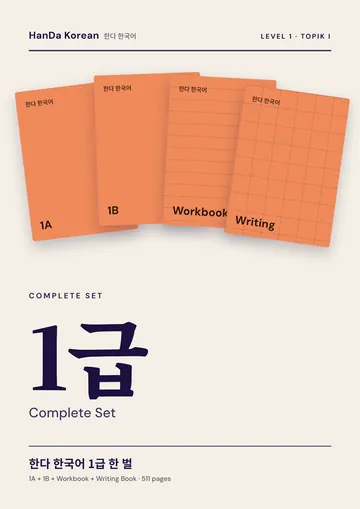 HanDa Korean Level 1 — Complete Set
Everything for level 1 — books, workbook and writing book · 511 pages
$10
HanDa Korean Level 1 — Complete Set
Everything for level 1 — books, workbook and writing book · 511 pages
$10
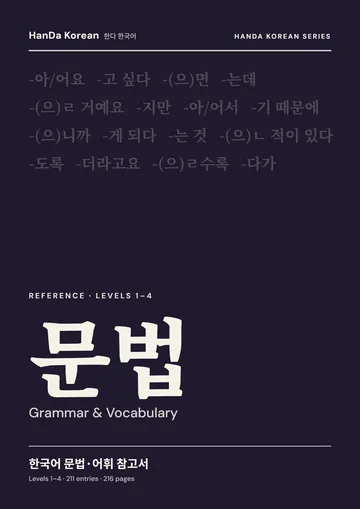 Korean Grammar & Vocabulary Reference
Every pattern in one place · 216 pages
$8
Korean Grammar & Vocabulary Reference
Every pattern in one place · 216 pages
$8
Practice this with an AI tutor
HanDa corrects every sentence you write or say — in real conversation, not flashcards.