The Most Common Korean Mistakes: What 60 Real Learner Errors Show
Quick answer: In 60 real mistakes from 25 HanDa learners, the most common Korean mistake was speech level — using the wrong level of politeness (25%). Next came verb endings and tense (22%), word choice (15%) and particles such as 에 vs 에서 (13%). Spelling, sentence structure, set greetings and counters made up the rest.
Most "common Korean mistakes" lists are written from a teacher's memory. This one comes from data: the corrections HanDa's AI teachers gave learners in real conversations between March and October 2026. We removed test accounts, unclear audio, repeats of the same mistake by the same person, and corrections that weren't really errors (an added question mark, a reworded sentence that was already fine). That left 60 distinct mistakes from 25 learners.
Sixty is a small number, so read the percentages as a direction, not a law. But the direction is clear, and a few findings surprised us.
| Type of mistake | Share |
|---|---|
| Speech level and politeness | 25% |
| Verb endings and tense | 22% |
| Word choice | 15% |
| Particles | 13% |
| Spelling of a word you know | 8% |
| Sentence structure | 7% |
| Set greetings | 5% |
| Counters and numbers | 5% |
1. Speech level: the mistake grammar books don't drill
잘 지냈어요? → 잘 지내셨어요? — Have you been well? (to an older neighbor)
A quarter of all mistakes were about who you're talking to, not what you're saying. The sentence was grammatical; the level was wrong. Saying 고마워 to a shop clerk instead of 감사합니다, or leaving out the honorific -시- with an older person, is the kind of slip that makes a Korean listener wince even when everything else is perfect. If you want the whole system in one place, see the three Korean speech levels.
The surprise: too much politeness was almost as common as too little. Six of the fifteen politeness mistakes went the other way:
- 저는 미국에서 오셨어요 → 저는 미국에서 왔어요 — I'm from the US. The honorific -시- raises the person doing the action, so you never use it about yourself.
- 네, 괜찮으세요 → 네, 괜찮아요 — Yes, that works for me. Same problem: 괜찮으세요 asks about them.
- 미안해요 → 미안해 — to a close friend of the same age, 해요체 can sound oddly distant.
Rule of thumb: -시- goes on other people, never on 저.
2. Verb endings: 이에요 or 예요?
사라이에요 → 사라예요 — I'm Sarah.
The single biggest trap inside this group was 이에요 / 예요 after a name or noun, and almost every case came up in a self-introduction. The rule is mechanical: a noun ending in a consonant takes 이에요 (민준이에요), a noun ending in a vowel takes 예요 (사라예요).
The rest were the classic conjugation slips: 기쁘여 → 기뻐요 (the ㅡ drops before -어요), and longer patterns that fall apart mid-sentence, like 입어봤고는 적이 있어 → 입어 본 적이 있어요 — I've tried it on before.
3. Word choice: right idea, wrong word
다음 년 → 내년 — next year
Learners often build a word from parts that make sense in English. 다음 주 (next week) and 다음 달 (next month) are fine, so 다음 년 feels logical — but Korean says 내년. Another: 쇼핑을 먹어 → 쇼핑했어요. Activities like shopping, studying and exercising usually take 하다, not a verb borrowed from somewhere else in the sentence.
4. Particles: 에 vs 에서 again
학교에 일해요 → 학교에서 일해요 — I work at a school.
에 marks where something is or where you go; 에서 marks where an action happens. Working is an action, so it's 에서. Particle mistakes were 13% of the total — fewer than you might expect, because many learners simply drop particles in speech, and Koreans do too.
5. Counters: it's always the number two
투 권 주세요 → 두 권 주세요 — Two books, please.
Every counter mistake in the data involved the number two. 투 comes from English "two"; the Korean native number before a counter is 두. The other pattern was word order: 두 할머니 → 할머니 두 분 — two grandmothers. Korean puts the noun first, then the number, then the counter, and 분 is the respectful counter for people.
6. The greeting that blends two greetings
안녕 가세요 → 안녕하세요 or 안녕히 가세요
One learner said this eight times, so it counts once in our data — but it's the most repeated single mistake we saw. It mixes 안녕하세요 (hello) with 안녕히 가세요 (goodbye, to someone who is leaving). If you are the one leaving and the other person stays, it's 안녕히 계세요. There's more on that in Korean goodbyes.
What this means for how you practise
Two of the top three mistakes — speech level and set phrases — are about the situation, not the grammar. You can't fix them with a conjugation table. You fix them by speaking in situations: to a shop clerk, a neighbor, a friend, a stranger, and noticing which level each one gets.
FAQ
What is the most common mistake Korean learners make?
In our data, using the wrong speech level: 반말 where polite speech was needed, a missing honorific with an older person, or honorifics used about yourself. It made up a quarter of all real mistakes.
Is it rude if I use 반말 by accident?
Koreans usually forgive learners, especially if you switch to 요 as soon as you notice. With service staff, older people and anyone you've just met, start polite and let the other person suggest dropping it.
When do I use 이에요 and when do I use 예요?
Look at the last letter of the noun. A final consonant takes 이에요 (학생이에요); a vowel takes 예요 (의사예요).
Practice
- Ask an older neighbor, politely, "Have you been well?"
- Introduce yourself as 지수.
- Ask for two books at a bookshop.
- Say "I work at a hospital." (병원)
- You're leaving a shop and the clerk is staying. What do you say?
Answers
- 잘 지내셨어요?
- 저는 지수예요.
- 책 두 권 주세요.
- 병원에서 일해요.
- 안녕히 계세요.
Quick reference for the patterns above: -(으)시- (honorific) · 에서 (where an action happens) · -아/어요 · all Korean grammar patterns.
Learn this properly, not just once
Blog posts teach one thing at a time. The HanDa books teach level 1 in order — every lesson built to be spoken, with a workbook and writing book beside it.
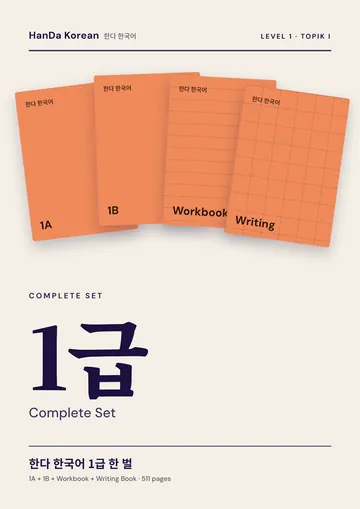 HanDa Korean Level 1 — Complete Set
Everything for level 1 — books, workbook and writing book · 511 pages
$10
HanDa Korean Level 1 — Complete Set
Everything for level 1 — books, workbook and writing book · 511 pages
$10
 Korean Grammar & Vocabulary Reference
Every pattern in one place · 216 pages
$8
Korean Grammar & Vocabulary Reference
Every pattern in one place · 216 pages
$8
Practice this with an AI tutor
HanDa corrects every sentence you write or say — in real conversation, not flashcards.