9 Korean Words from Rich-Family K-Dramas: 회장님, 사모님, 재벌

You know the scene. Marble staircase, long dining table, someone in a black suit standing by the door with their hands folded. Everybody is speaking Korean that sounds stiffer than the Korean in your textbook, and the subtitles just say "sir" and "ma'am."
Here's the one idea to take away: in rich-family dramas, almost every line is marking rank. Not politeness in general — rank. Who serves whom, who may speak first, whose name is never said out loud. Korean has specific words for all of that, and English subtitles flatten them into "sir," "madam," "young master," or nothing at all. Learn these nine and you'll hear a whole layer of the show you were missing.
1. 회장님 — the chairman
회장님, 손님 오셨습니다. — Sir, your guest has arrived.
회장 is the chairman of a company group; 님 is the honorific suffix that makes it an address title. In these dramas the 회장님 is usually the grandfather or father who controls everything, and notice that nobody calls him by name — ever. In Korean workplaces generally, titles replace names (사장님, 부장님, 선생님), so hearing a character use the chairman's actual name is a loud signal that something is very wrong.
2. 사모님 — ma'am, the wife of an important man
사모님께서 기다리고 계십니다. — Madam is waiting for you.
사모님 originally meant a teacher's wife, and it grew into the polite way to address the wife of a man with status — a chairman, a boss, a professor. In the drama it's what the housekeeper and the driver call the lady of the house. In real life you'll still hear shop staff and restaurant owners call a well-dressed middle-aged customer 사모님, which is flattery as much as politeness.
3. 재벌 3세 — third-generation chaebol heir
그 사람 재벌 3세래. — Apparently he's a third-generation chaebol heir.
재벌 is the family-controlled conglomerate itself; a person can be 재벌 (from such a family) and more specifically 재벌 2세 or 재벌 3세 — second or third generation. Read it 재벌 삼세. The number matters to Korean viewers: a 3세 was born into money and never saw the struggle, which is exactly the character flaw the first ten episodes are built on.
4. 도련님 / 아가씨 — young master / young lady
도련님, 식사 준비됐습니다. — Young master, your meal is ready.
These are what household staff call the unmarried son and daughter of the house. 도련님 is also what a woman calls her husband's younger unmarried brother, which is normal family vocabulary today. 아가씨 is the one to be careful with: inside the drama's mansion it's respectful, but calling a young woman you don't know 아가씨 on the street in 2025 sounds dated at best and rude at worst — use a name plus 씨 or 저기요 instead.
5. 김 비서 — Secretary Kim
김 비서, 잠깐 들어와 봐요. — Secretary Kim, come in for a moment.
비서 is a secretary or personal assistant, and the standard address is surname + 비서. Notice the boss says 들어와 봐요, not 들어오세요 — 해요체 that is polite enough to be civil but clearly downward. When a chairman switches to flat 반말 with his secretary (들어와) in one scene and 해요체 in another, that shift is the plot. If speech levels are still fuzzy for you, the speech level map is worth ten minutes.
6. 기사님 — the driver
기사님, 정문 앞에서 기다려 주세요. — Driver, please wait in front of the main gate.
기사님 covers the family's chauffeur, and it's the same word you use for a taxi or bus driver in real life — always with 님. Rich-family dramas use the car as a private room: the driver hears everything and says nothing, and a character who actually talks to the 기사님 is being coded as decent. You'll use this word yourself the moment you're in a taxi in Seoul.
7. 모시다 — to serve, to escort (someone above you)
제가 모시고 가겠습니다. — I'll take you there, sir.
모시다 is the humble verb that replaces 데리고 가다 (take someone along) when the person is your senior. You 데리고 가다 a child or a friend, but you 모시고 가다 a parent, a boss, or the chairman. It also means "to serve" in a life sense — 부모님을 모시고 살다 means living with and caring for your parents.
8. 회장님께서 찾으십니다 — honorific endings stacked up
회장님께서 찾으십니다. — The chairman is asking for you.
This single line has three honorific parts: 님 on the title, 께서 instead of 이/가 as the subject marker, and -(으)시- inside the verb. Stacking all three is formal 합쇼체 speech used about a superior to someone else, and it's exactly how staff talk in these households. In ordinary life you'll hear 께서 mostly in announcements, news, and when speaking about someone's parents — using it about your friend would sound like a joke.
9. 집안 — family, in the bloodline sense
두 사람은 집안 차이가 너무 커요. — The gap between their families is too big.
집 is a house; 집안 is the family as a lineage — its name, status, and reputation. 집안 차이 (difference in family background) and 집안의 반대 (the family's opposition) are the engine of nearly every rich-family romance. The related slang 금수저, "gold spoon," means born rich, with 흙수저, "dirt spoon," as its opposite: 쟤는 금수저야. — He was born with a gold spoon.
Why this vocabulary feels so cold
Because it's all role and no name. The housekeeper says 사모님, the secretary says 회장님, the driver says 네, 알겠습니다 — nobody in that house is addressed as a person. So when a character finally uses someone's given name, or drops to 반말 with the heir, a Korean viewer feels the temperature change instantly. That's the moment the subtitle can't carry, and now you can hear it.
Practice
Fill in the blank with the best word.
- The housekeeper tells the lady of the house her guest has arrived: \_\_\_\_\_, 손님 오셨습니다.
- You're in a taxi and want the driver to stop at the corner. What do you call him?
- "I'll escort my grandmother there." 할머니를 제가 \_\_\_\_\_ 가겠습니다.
- Which subject marker goes with 회장님 in formal speech: 이/가 or 께서?
- A friend says 걔 재벌 3세래. What exactly is she telling you?
Answers
- 사모님 — 사모님, 손님 오셨습니다.
- 기사님 — always with 님. 기사님, 저기 모퉁이에서 세워 주세요.
- 모시고 — 할머니를 제가 모시고 가겠습니다. (데리고 would sound disrespectful here.)
- 께서 — 회장님께서 찾으십니다.
- That he's the third generation of a chaebol family — born into the money, not the one who made it.
Learn this properly, not just once
Blog posts teach one thing at a time. The HanDa books teach level 1 in order — every lesson built to be spoken, with a workbook and writing book beside it.
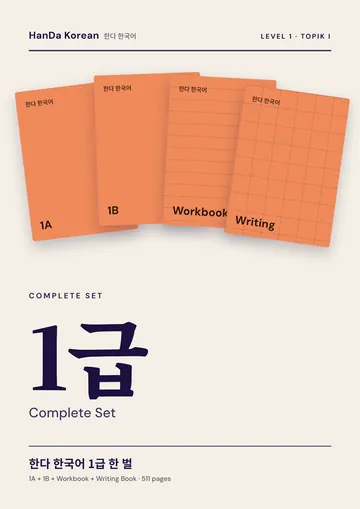 HanDa Korean Level 1 — Complete Set
Everything for level 1 — books, workbook and writing book · 511 pages
$10
HanDa Korean Level 1 — Complete Set
Everything for level 1 — books, workbook and writing book · 511 pages
$10
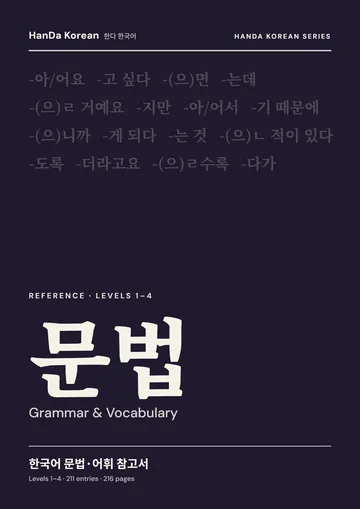 Korean Grammar & Vocabulary Reference
Every pattern in one place · 216 pages
$8
Korean Grammar & Vocabulary Reference
Every pattern in one place · 216 pages
$8
Practice this with an AI tutor
HanDa corrects every sentence you write or say — in real conversation, not flashcards.