Korean Money Words: 용돈, 월급, 할인, 거스름돈
Quick answer: 용돈 (yongdon) is pocket money or an allowance, 월급 (wolgeup) is a monthly salary, 할인 is a discount off a price, and 거스름돈 is the change a cashier hands back to you. Korean names money by where it comes from, so you can't swap these words around — the money you get from your parents and the money you get from your job have different names.
That's the one idea for today. In English, "money" covers everything and you add words around it: pocket money, monthly pay, money off, money back. Korean builds a separate noun for each situation, and native speakers pick the noun first and the verb second. Once you know which noun belongs to which moment, the sentences around it are short and easy.
용돈 — money someone gives you to spend
용돈 is money handed to you with no strings attached, for everyday spending. Kids get it from parents. Students get it from grandparents at holidays. And — this is the part learners don't expect — grown adults give 용돈 to their parents.
- 이번 달 용돈 다 썼어요. — I've already spent this month's allowance.
- 할머니가 용돈을 주셨어요. — Grandma gave me some spending money.
- 부모님께 용돈을 드려요. — I give my parents spending money.
Notice the verb changes with direction and respect: 주다 for giving downward or sideways, 드리다 when you give to someone older. Giving your parents 용돈 every month is completely normal in Korea and is talked about warmly, not awkwardly.
One caution: 용돈 is not a word for your own earnings. If you made the money yourself, it's not 용돈.
월급 — your monthly salary
월 (month) + 급 (pay). Korean workers are typically paid monthly, so 월급 is the default word for a paycheck, and 월급날 (payday) is a word everyone knows.
- 오늘 월급 들어왔어요. — My salary came in today. (Literally "went in" — into your bank account.)
- 월급날이 언제예요? — When is payday?
- 월급이 조금 올랐어요. — My salary went up a little.
Related words that are not interchangeable:
- 연봉 — annual salary. This is the number people quote when talking about a job offer.
- 알바비 — pay from a part-time job. 알바비 받으면 밥 살게요. — When I get my part-time pay, I'll buy you a meal.
- 시급 — hourly wage.
So: a student with a part-time café job says 알바비, an office worker says 월급, and someone comparing job offers says 연봉.
할인 — a discount
할인 is the price being cut. The word shows up on every shop window in Korea, and you'll hear it at the register.
- 이거 할인되나요? — Is this discounted?
- 학생 할인 되나요? — Is there a student discount?
- 카드로 결제하면 할인을 받을 수 있어요. — If you pay by card, you can get a discount.
- 지금 세일 중이에요. — It's on sale right now.
할인 vs 세일: 세일 (from English "sale") usually means a store-wide sale event — a season, a holiday weekend. 할인 is the actual reduction applied to an item or to you. A shop is 세일 중, but your membership card gives you a 할인.
깎아 주세요 is the haggling version — literally "shave it down for me." Save it for traditional markets or a street stall:
- 조금만 깎아 주세요. — Could you take a little off?
Saying 깎아 주세요 in a department store or a chain café sounds out of place, a bit like asking a barista to knock a dollar off your latte. In those places, ask 할인되나요? instead. The same polite-request shape shows up all over shopping conversations, like the ones in asking to try clothes on.
거스름돈 — the change you get back
거스름돈 is specifically the money returned to you when you pay more than the price. The cashier's line is usually 합쇼체 (the formal polite style used in service work):
- 거스름돈 여기 있습니다. — Here's your change.
- 거스름돈 받으세요. — Please take your change.
거스름돈 vs 잔돈: 잔돈 means small money — coins and small bills — regardless of whether anyone is giving it back. The two overlap in daily speech, but they're not the same thing.
- 잔돈 있으세요? — Do you have small change? (The cashier is asking if you can hand over coins.)
- 잔돈이 없어요. — I don't have any small bills.
- 거스름돈을 안 받았어요. — I didn't get my change.
If you tell a clerk 잔돈 주세요, they'll understand you want your change, but what you literally asked for is small denominations. 거스름돈 is the precise word. And in a taxi, when you want them to keep it, the natural line is 잔돈은 괜찮아요. — Keep the change.
You'll also hear 현금영수증 해 드릴까요? — "Shall I do a cash receipt for you?" It's a tax receipt tied to your phone number. If you don't need it, 괜찮아요 is a complete answer. More register-counter lines are in how to pay at a Korean restaurant.
The money words table
| Korean | Parts | Use it for |
|---|---|---|
| 용돈 | 용 (use) + 돈 (money) | allowance; money given to kids or to parents |
| 월급 | 월 (month) + 급 (pay) | a monthly salary |
| 연봉 | 연 (year) + 봉 (pay) | annual salary |
| 알바비 | 알바 + 비 (fee) | part-time job pay |
| 할인 | 할 (cut) + 인 (pull) | a discount off the price |
| 거스름돈 | 거스르다 (to reverse) + 돈 | change handed back to you |
| 잔돈 | 잔 (remaining) + 돈 | coins and small bills |
비, 값, 요금: the three "cost" endings
Once you can read the endings, dozens of money words open up at once — the same payoff you get from learning Sino-Korean roots.
- -비 = a cost you pay for something in your life: 교통비 (transport costs), 식비 (food costs), 택시비 (taxi fare).
- -값 = the price of a physical thing: 밥값 (the cost of the meal), 기름값 (fuel prices), 옷값.
- 요금 = an official charge: 전기 요금, 택시 요금, 요금이 올랐어요.
In practice, 택시비 and 택시 요금 both exist — 택시비 is what a friend says, 택시 요금 is what a sign says.
The verbs that go with money
Korean verbs here are picky, so learn them as pairs:
- 돈을 벌다 — to earn money. 돈을 벌고 싶어요. — I want to earn money.
- 돈을 쓰다 — to spend money. 이번 달에 돈을 너무 많이 썼어요. — I spent way too much this month.
- 돈을 모으다 — to save up (gather money toward a goal). 여행 가려고 돈을 모으고 있어요. — I'm saving up to travel.
- 돈을 아끼다 — to be careful with money, spend less.
- 돈을 내다 — to pay (hand over the money). 제가 낼게요. — I'll pay.
A common learner mistake is 돈을 저축하다 in casual speech — it's correct, but it sounds like a bank brochure. Friends say 돈을 모으다.
FAQ
What does 용돈 mean in Korean?
용돈 means pocket money or an allowance — money someone gives you to spend freely. Parents give 용돈 to children, relatives give it to kids at holidays, and adult children often give 용돈 to their parents. Use 주다 when giving to someone younger or the same age, and 드리다 when giving to someone older.
How do you ask for a discount in Korean?
In a normal shop or café, ask 할인되나요? (Is there a discount?) or 학생 할인 되나요? (Is there a student discount?). At a traditional market or street stall, where bargaining is expected, you can say 조금만 깎아 주세요 (Take a little off, please). Don't use 깎아 주세요 in chain stores — it sounds out of place.
What's the difference between 거스름돈 and 잔돈?
거스름돈 is the change given back to you after you overpay — it only exists in a transaction. 잔돈 means small money in general: coins and small bills, whether in your pocket or in the register. A cashier asking 잔돈 있으세요? wants you to hand over coins; a cashier saying 거스름돈 여기 있습니다 is returning your change.
Practice
Fill in the blank with 용돈, 월급, 할인, 거스름돈 or 잔돈.
- 아이에게 매달 ____을 줘요.
- 오늘 ____ 들어왔어요. 제가 밥 살게요.
- (cashier) ____ 여기 있습니다.
- 동전이 없어요. ____이 하나도 없어요.
- 이거 ____되나요?
Answers
- 용돈 — 아이에게 매달 용돈을 줘요. (I give my child an allowance every month.)
- 월급 — 오늘 월급 들어왔어요. 제가 밥 살게요. (My salary came in today. I'll buy the meal.)
- 거스름돈 — 거스름돈 여기 있습니다. (Here's your change.)
- 잔돈 — 동전이 없어요. 잔돈이 하나도 없어요. (I have no coins. I don't have any small change at all.)
- 할인 — 이거 할인되나요? (Is this discounted?)
Learn this properly, not just once
Blog posts teach one thing at a time. The HanDa books teach level 1 in order — every lesson built to be spoken, with a workbook and writing book beside it.
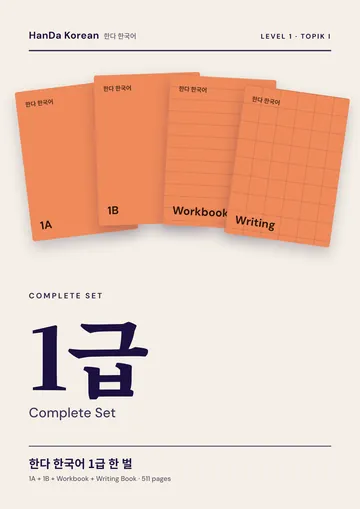 HanDa Korean Level 1 — Complete Set
Everything for level 1 — books, workbook and writing book · 511 pages
$10
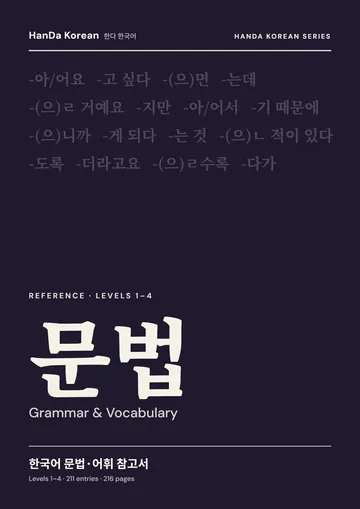 Korean Grammar & Vocabulary Reference
Every pattern in one place · 216 pages
$8
Practice this with an AI tutor
HanDa corrects every sentence you write or say — in real conversation, not flashcards.