-아/어서 vs -(으)니까: 9 Ways to Say "Because" in Korean

Here is the one rule that unlocks this pair:
**-아/어서 states a cause as a plain fact. -(으)니까 presents a reason as your grounds for telling the listener something.**
That second half explains almost everything else — including why you can say 비가 오니까 우산 가져가세요 but not 비가 와서 우산 가져가세요. If you're giving an order, a request, or a suggestion, you're leaning on your reason to push the listener, and that's -(으)니까 territory.
Quick form check first:
| -아/어서 | -(으)니까 | |
|---|---|---|
| 가다 | 가서 | 가니까 |
| 먹다 | 먹어서 | 먹으니까 |
| 춥다 | 추워서 | 추우니까 |
| 하다 | 해서 | 하니까 |
| 학생이다 | 학생이라서 | 학생이니까 |
One more form rule worth tattooing somewhere: past tense -었- can attach to -(으)니까, never to -아/어서. 먹었으니까 ✓, 먹었어서 ✗. If you want more on how these two sit alongside -는데, there's a fuller map in this guide to connecting Korean sentences.
Now the nine sentences.
1. 비가 와서 길이 많이 막혔어요.
비가 와서 길이 많이 막혔어요. — It rained, so the traffic was terrible.
This is -아/어서 doing its core job: A happened, therefore B happened. No opinion, no instruction, nothing aimed at the listener — just one fact causing another. When you're simply describing why something turned out the way it did, -아/어서 is the default, and a Korean ear hears it as neutral and matter-of-fact.
2. 비가 오니까 우산 가져가세요.
비가 오니까 우산 가져가세요. — It's raining, so take an umbrella.
The moment the second clause is a command (-(으)세요), a suggestion (-(으)ㅂ시다, -자), or a question urging action, you must use -(으)니까. 비가 와서 우산 가져가세요 is not just "less natural" — it's broken Korean, the kind of mistake that makes a native speaker stop and re-listen. Same with 시간 없으니까 빨리 가자 (We're out of time, so let's hurry): 없어서 가자 simply can't happen.
3. 늦어서 죄송합니다.
늦어서 죄송합니다. — I'm sorry for being late.
Apologies take -아/어서, always. You're naming your fault as a bare fact and handing it over. 늦으니까 죄송합니다 sounds genuinely strange — as if you're pointing at your lateness as a justification, something like "well, I'm late, so obviously, sorry." It lands as defensive, not apologetic. Other fixed ones: 기다리게 해서 죄송해요 (Sorry for making you wait), 연락이 늦어서 미안해요 (Sorry for the late reply).
4. 와 주셔서 감사합니다.
와 주셔서 감사합니다. — Thank you for coming.
Thanks work the same way as apologies: the thing you're grateful for is a fact, so it's -아/어서. 도와주셔서 감사합니다 (Thank you for helping me), 초대해 주셔서 감사합니다 (Thank you for inviting me). This is 합쇼체, the formal polite style you'd use at a wedding, in an email, or to a customer; in 해요체 it's 와 주셔서 감사해요. If the speech levels are still fuzzy, here's the rundown.
5. 밥 먹었으니까 이제 커피 마시러 가요.
밥 먹었으니까 이제 커피 마시러 가요. — We've eaten, so let's go get coffee now.
Two things at once here. The second clause is a suggestion, so -(으)니까 is required — and the reason is in the past tense, which -아/어서 can't carry anyway. 먹었어서 does not exist in Korean. With -아/어서, the tense of the whole sentence lives in the final verb: 밥을 먹어서 배가 불러요 (I ate, so I'm full).
6. 오늘은 휴일이라서 문을 안 열어요.
오늘은 휴일이라서 문을 안 열어요. — Today's a holiday, so they're not open.
After a noun, 이다 becomes -이라서 after a consonant and -라서 after a vowel (학생이라서, 가수라서) — the alternative forms 학생이어서 / 가수여서 are also possible — and -(이)니까 (학생이니까, 가수니까). Learners often produce 휴일해서 or 휴일서, which sounds like a word has gone missing. Compare: 초보자라서 천천히 했어요 (I'm a beginner, so I went slowly) vs. 초보자니까 천천히 하세요 (You're a beginner, so take it slow).
7. 왜 안 드세요? — 조금 매워서요.
조금 매워서요. — Because it's a bit spicy.
You can stop a sentence right at -아/어서 and add 요. It's the soft, slightly apologetic way to answer "why?" — you give the cause and trail off instead of pressing it. This is the safest answer to a boss or a teacher: 차가 많이 막혀서요 (Because the traffic was bad). If you want the version that implies you probably didn't know this, that's -거든요, a close cousin worth knowing.
8. 제가 할게요. 제가 더 빠르니까요.
제가 할게요. 제가 더 빠르니까요. — I'll do it. Because I'm faster.
-(으)니까요 also ends sentences, but it lands differently: it's you putting your reason on the table to back up what you just said. Confident, sometimes a little insistent. That's why 차가 막혔으니까요 to a supervisor who asked why you were late sounds like talking back — "because the traffic was bad, obviously." Same information, completely different temperature. Use -아/어서요 when you're explaining yourself to someone above you, and -(으)니까요 when you're defending a decision among equals.
9. 먹어 보니까 생각보다 맛있었어요.
먹어 보니까 생각보다 맛있었어요. — I tried it, and it was better than I expected.
This -(으)니까 isn't "because" at all. After a verb of doing or going, it means "upon doing A, I discovered B." 가 보니까 아무도 없었어요 (I went and found nobody there), 만나 보니까 정말 친절한 분이었어요 (I met her, and she turned out to be really kind). -아/어서 can never do this, and it's one of the most useful patterns in everyday spoken Korean — you'll hear 보니까 constantly.
The quick decision
Ask yourself: am I telling the listener to do something? If yes → -(으)니까. Am I apologizing or thanking? If yes → -아/어서. Is my reason in the past tense? If yes → -(으)니까. Everything else, -아/어서 is the safe neutral choice, and it rarely sounds wrong.
One last note: 그래서 and 그러니까 are the standalone versions of these same two, and they behave identically. 그래서 안 갔어요 (So I didn't go) vs. 그러니까 빨리 오세요 (So hurry up and come).
Practice
- Fill in: 시간이 없___ 택시 타고 가세요. (서 or 니까?)
- Fill in: 길이 막혀___ 늦었어요. (서 or 니까?)
- Fix the mistake: 어제 비가 왔어서 안 갔어요.
- Fix the mistake: 날씨가 추워서 창문 좀 닫으세요.
- Say in Korean (합쇼체): Thank you for helping me.
Answers
- 시간이 없으니까 택시 타고 가세요. — The second clause is a request, so -(으)니까 is the only option.
- 길이 막혀서 늦었어요. — Plain cause and effect, no instruction. -아/어서.
- 어제 비가 와서 안 갔어요. — Past tense can't attach to -아/어서. (어제 비가 왔으니까 안 갔어요 is also grammatical, but it sounds like you're justifying yourself.)
- 날씨가 추우니까 창문 좀 닫으세요. — 닫으세요 is a request, so -(으)니까.
- 도와주셔서 감사합니다. — Thanks always take -아/어서.
Learn this properly, not just once
Blog posts teach one thing at a time. The HanDa books teach level 1 in order — every lesson built to be spoken, with a workbook and writing book beside it.
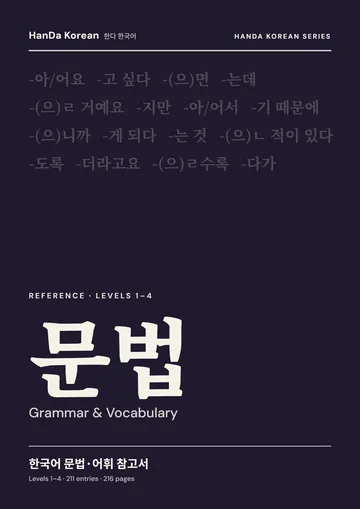 Korean Grammar & Vocabulary Reference
Goes with this post · 216 pages
$8
Korean Grammar & Vocabulary Reference
Goes with this post · 216 pages
$8
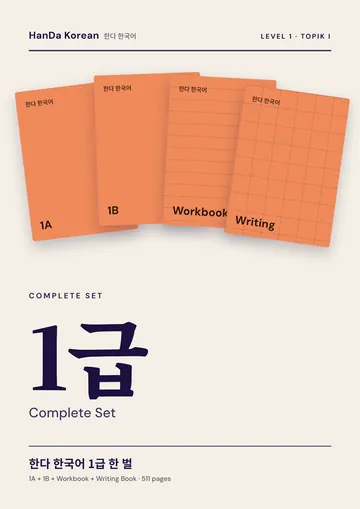 HanDa Korean Level 1 — Complete Set
Everything for level 1 — books, workbook and writing book · 511 pages
$10
HanDa Korean Level 1 — Complete Set
Everything for level 1 — books, workbook and writing book · 511 pages
$10
Practice this with an AI tutor
HanDa corrects every sentence you write or say — in real conversation, not flashcards.