Korean Pronunciation Rules: Why 국물 Sounds Like [궁물]
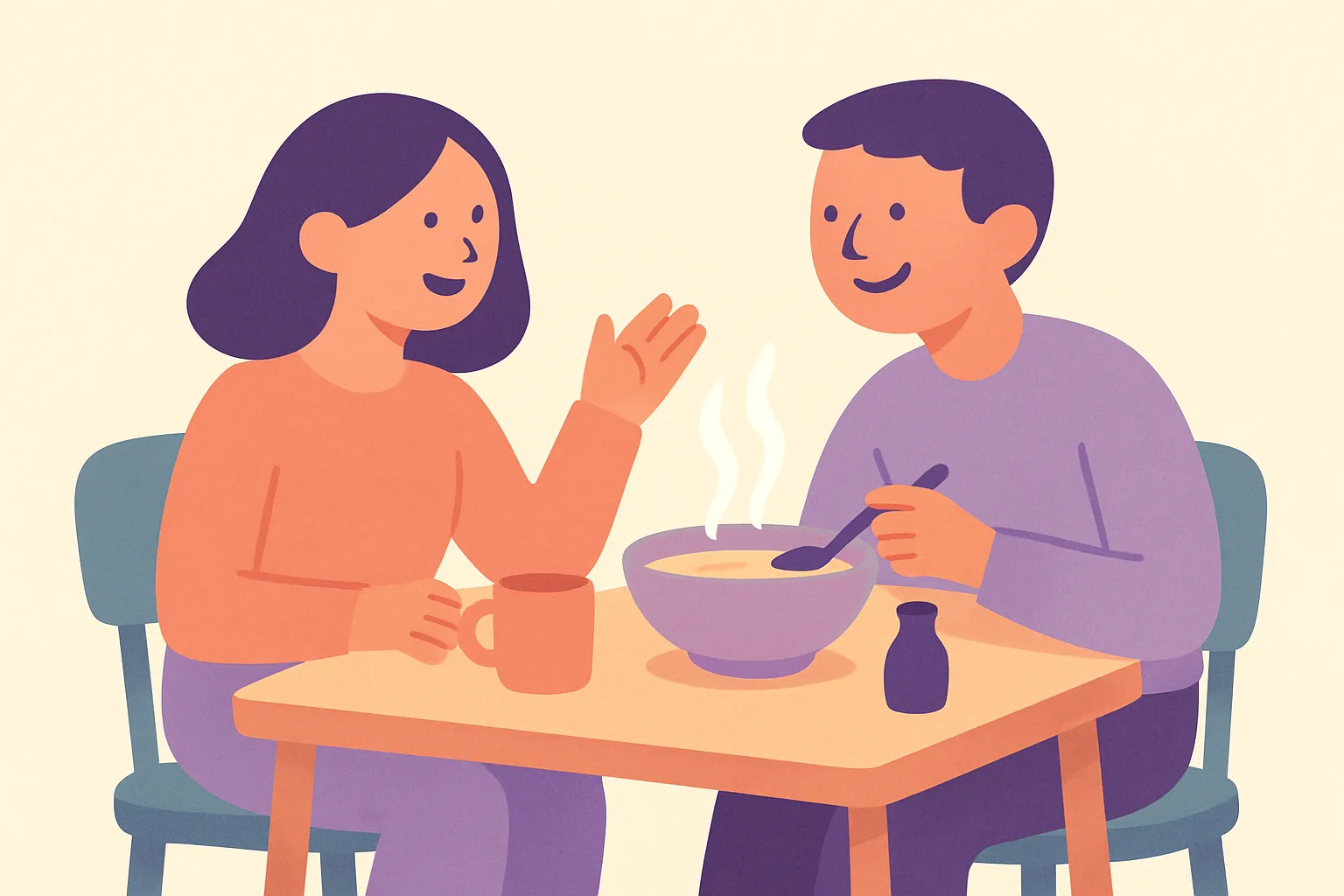
You learned Hangul in a weekend. Everyone said it was easy and logical — one letter, one sound. Then a Korean friend offered you 국물 and said something that sounded like gungmul, and you quietly wondered if you'd learned the wrong alphabet.
You didn't. Here's the one idea to take away:
**Korean spelling shows you a word's parts. Korean pronunciation smooths those parts together.** The spelling isn't lying to you — it's doing a different job. 국물 is written as 국 (soup) + 물 (water) so you can recognize 국 everywhere it appears: 국밥, 미역국, 국이 맛있어요. The mouth then does what mouths do and turns it into [궁물].
English does exactly the same thing, and you've never noticed. Say handbag at normal speed — it comes out closer to hambag. Say don't you — doncha. We keep the spelling that shows the parts and let the mouth blur them. Korean just has a shorter, more consistent list of blurs, and — this is the good news — you can learn that list in an afternoon.
The blurs, in order of how often they bite you
1. Linking (연음) — a 받침 slides into the next syllable
When a syllable ends in a consonant and the next one starts with ㅇ (a silent placeholder), the consonant jumps over.
- 한국어 → [한구거] — Korean language
- 음악 → [으막] — music
- 옷을 샀어요 → [오슬 사써요] — I bought clothes.
- 꽃이 예뻐요 → [꼬치 예뻐요] — The flowers are pretty.
This is why beginners can't find words in the dictionary. You hear [오슬], you write 오슬, you find nothing. The word is 옷 plus the particle 을.
2. Nasalization (비음화) — this is the 국물 rule
If a syllable ends in a ㄱ, ㄷ, or ㅂ sound and the next syllable starts with ㄴ or ㅁ, that final consonant turns nasal. ㄱ→ㅇ, ㄷ→ㄴ, ㅂ→ㅁ.
| Written | Said | Meaning |
|---|---|---|
| 국물 | [궁물] | soup broth |
| 한국말 | [한궁말] | Korean language |
| 작년 | [장년] | last year |
| 감사합니다 | [감사함니다] | thank you |
| 앞문 | [암문] | front door |
| 못 먹어요 | [몬 머거요] | I can't eat it |
That last one matters daily: 못 먹어요 — I can't eat that — really does come out [몬 머거요].
And 합니다 → [함니다] is the single highest-value line on this page. Every formal 합쇼체 sentence you'll ever hear — 감사합니다, 사랑합니다, 주문하시겠습니까 — has an [ㅁ] in it, not a [ㅂ]. Once your ear expects that, formal Korean suddenly sounds like words instead of mush.
3. Palatalization (구개음화) — this is the 같이 rule
When a syllable ends in ㄷ or ㅌ and the next syllable is 이 or 히, the ㄷ/ㅌ becomes ㅈ/ㅊ.
- 같이 가요 → [가치 가요] — Let's go together.
- 굳이 → [구지] — needlessly, going out of one's way
- 닫히다 → [다치다] — to be closed
- 해돋이 → [해도지] — sunrise
The condition is narrow, and the contrast proves it. Compare:
- 같이 → [가치] but 같아요 → [가타요]
- 끝이 → [끄치] but 끝을 → [끄틀]
Only 이 and 히 trigger it. 아, 어, 을 don't. Your tongue is already at the roof of your mouth for 이, so it grabs the ㅌ on the way — that's all this rule is.
4. ㅎ — it either vanishes or explodes
ㅎ is the least stable sound in Korean. When a stem-final ㅎ (or the clusters ㄶ, ㅀ) is followed by an ending that starts with a vowel, the ㅎ disappears completely:
- 좋아요 → [조아요] — it's good
- 싫어요 → [시러요] — I don't like it
- 괜찮아요 → [괜차나요] — it's fine
- 많이 → [마니] — a lot
Next to ㄱ, ㄷ, ㅂ, ㅈ, it fuses into an aspirated consonant instead:
- 축하해요 → [추카해요] — congratulations
- 좋다 → [조타] — it's good
- 어떻게 → [어떠케] — how
One thing to be careful about: a ㅎ sitting inside a word after ㄴ, ㄹ, ㅁ or ㅇ — 전화, 은행, 결혼, 영화 — is a different case. It gets weak and breathy in fast casual speech, but in careful standard pronunciation it's still there. 은행 is [은행], not [으냉]. Don't delete those.
So 괜찮아요 is four syllables of smooth vowels, not a consonant pile-up. If you've been saying it with a hard stop in the middle, [괜차나요] will feel like relief. (It's also a word that does a dozen different jobs — more on what 괜찮아요 actually means in context.)
5. Two smaller ones worth knowing
ㄴ next to ㄹ becomes ㄹㄹ (유음화): 연락 → [열락] contact, 설날 → [설랄] Lunar New Year, 편리해요 → [펼리해요] it's convenient.
Tensing (경음화): after ㄱ/ㄷ/ㅂ sounds, a following plain consonant goes tense. 학교 → [학꾜], 숙제 → [숙쩨], 있다 → [읻따]. Also after the future ending -ㄹ: 할 거예요 → [할 꺼예요], 할 수 있어요 → [할 쑤 이써요].
Why this is specifically hard for English speakers
Because Hangul is too good. It looks so transparent that we trust it completely and read letter by letter, like a code we're decoding. With English we gave up on spelling long ago and learned words by sound. With Korean we learn them by eye, and then build a mouth that produces spellings rather than words.
The second half of the problem is listening. Sound changes mean the word you hear and the word in your dictionary are different strings. Until the rules are automatic, half of your listening failures aren't vocabulary gaps at all — you know the word, you just can't map [장년] back to 작년. This is one of the real reasons Korean feels hard early on, and one of the fastest to fix, because the list is short and it never changes.
What the mistake actually sounds like
Saying [국물] with a crisp ㄱ, or [갇이] instead of [가치], isn't incomprehensible. Koreans will understand you. But it sounds effortful — like someone reading a word out one letter at a time rather than saying it. It's the same impression an English speaker gets from a very careful "hand-bag, sep-ar-ate-ly." Correct, oddly slow, clearly not a native mouth.
And unlike politeness levels or particles, this isn't a style choice. These changes are obligatory in normal speech. No native speaker pronounces the ㄱ in 국물, at any speed, at any formality level. A newsreader nasalizes just as much as a friend on the phone; the news is just slower.
There are a few genuinely optional cases — 맛있어요 is accepted as both [마시써요] and [마디써요], with [마시써요] far more common in daily life — but they're rare enough that you can ignore them until someone points one out.
The concrete fix
Three steps, fifteen minutes a day, two weeks.
1. Write the sound, not the spelling. Take five words you already know that contain a 받침, and write the pronunciation in Hangul next to them: 감사합니다 [감사함니다]. Doing it by hand forces you to apply the rule consciously, which is exactly the stage you have to pass through before it becomes automatic.
2. Read aloud, slowly, with the changes on. Slow is fine. Slow and correct beats fast and spelled-out. Pick short sentences and repeat each one until your mouth stops resisting: 연락 주세요. [열락 주세요] — Give me a call.
3. Shadow whole phrases, never single syllables. Sound changes happen between syllables, so a syllable on its own can't teach you anything. Repeat two- and three-word chunks after audio. If you're working without a partner, there are ways to drill speaking on your own that fit this perfectly.
One warning: don't judge your progress by a pronunciation score. A percentage can't tell you whether you nasalized 합니다, which is the thing that actually matters, and those scores mislead more than they help. Record yourself, listen back, and ask one question: does it sound like one word, or six letters?
Practice
Write the pronunciation of each in Hangul.
- 한국말
- 굳이
- 좋아요
- 설날
- 못 만나요
Answers
- [한궁말] — 비음화: ㄱ + ㅁ → ㅇ + ㅁ
- [구지] — 구개음화: ㄷ + 이 → 지
- [조아요] — stem-final ㅎ + vowel ending, so the ㅎ drops
- [설랄] — 유음화: ㄹ + ㄴ → ㄹ + ㄹ
- [몬 만나요] — 비음화: the ㅅ of 못 is a [ㄷ] sound, and ㄷ + ㅁ → ㄴ + ㅁ
Learn this properly, not just once
Blog posts teach one thing at a time. The HanDa books teach level 1 in order — every lesson built to be spoken, with a workbook and writing book beside it.
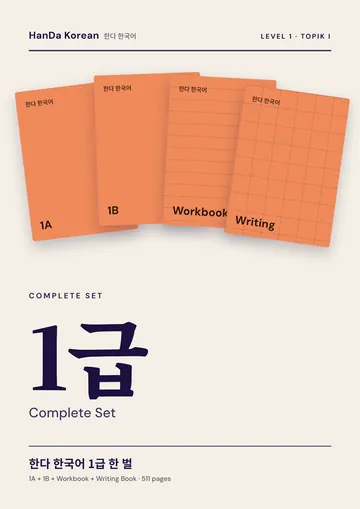 HanDa Korean Level 1 — Complete Set
Everything for level 1 — books, workbook and writing book · 511 pages
$10
HanDa Korean Level 1 — Complete Set
Everything for level 1 — books, workbook and writing book · 511 pages
$10
 Korean Grammar & Vocabulary Reference
Every pattern in one place · 216 pages
$8
Korean Grammar & Vocabulary Reference
Every pattern in one place · 216 pages
$8
Practice this with an AI tutor
HanDa corrects every sentence you write or say — in real conversation, not flashcards.