Is Korean Hard to Learn for English Speakers?
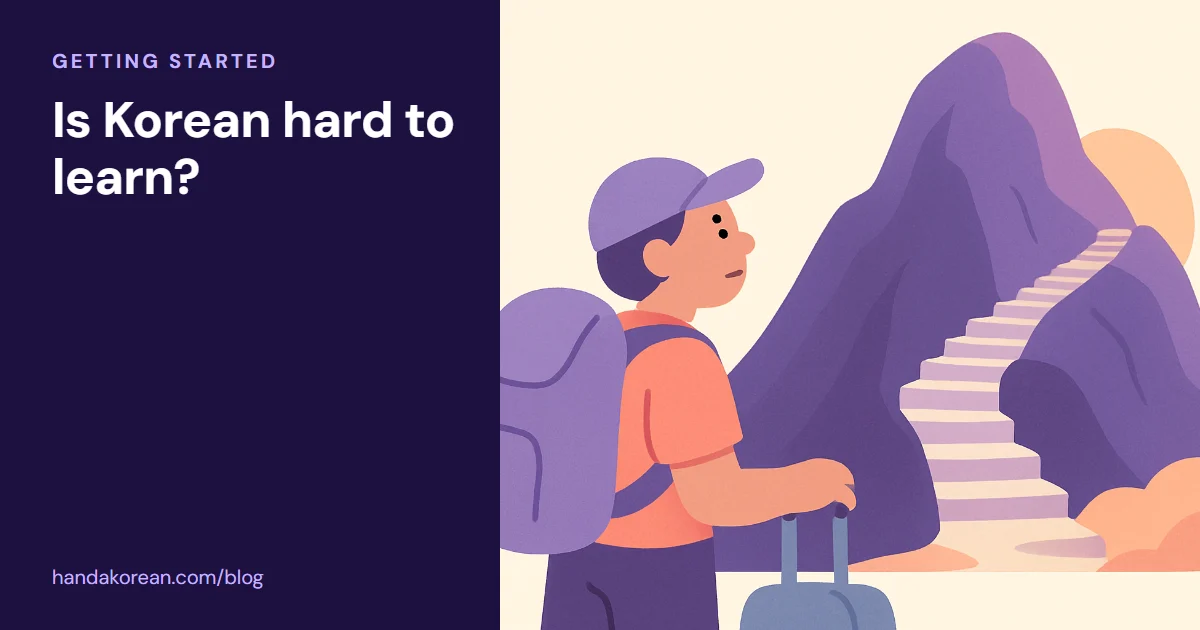
Yes, officially. The US Foreign Service Institute puts Korean in its hardest category for English speakers, alongside Japanese, Mandarin and Arabic.
But "hard" is doing a lot of work in that sentence. Korean is not uniformly difficult — it is unusually easy in two places that intimidate people, and genuinely difficult in a few places nobody warns you about. Knowing which is which changes how you plan your first year.
The parts that are easier than their reputation
The writing system. Hangul is the single friendliest alphabet a learner is likely to meet. It was designed, deliberately, in the 15th century, to be learnable quickly — and it is. Fourteen basic consonants, ten basic vowels, one consistent rule for stacking them into syllables. Most people read their first Korean word within a few hours.
Compare that to the years Chinese or Japanese demand before you can read a newspaper. Korean gives you the writing system almost for free.
No grammatical gender, no agreement, no plurals to speak of. No masculine tables. No verb that changes because the subject is plural. Korean verbs do not conjugate for person or number at all — 가요 works for I, you, he, she, we and they. After three years of French agreement rules this feels like a gift.
The parts that are genuinely hard
Word order. Korean is subject–object–verb, and the verb comes last, always. English speakers can memorise this in a second and then spend two years failing to do it, because you cannot start speaking until you have decided how the sentence ends.
Worse, modifiers come before what they modify — and a Korean relative clause can be long. "The restaurant I went to yesterday" becomes 어제 간 식당, with the whole description stacked in front. Your brain wants to parse left to right. Korean requires you to hold everything and resolve it at the end.
This is the single biggest structural obstacle, and the only cure is volume.
Speech levels. Korean grammar encodes your relationship to the listener. The same sentence has a casual form, a polite form and a formal one, and choosing wrong is not a grammar mistake — it is a social one. English has nothing equivalent; the closest analogy is the difference between "hey" and "Dear Sir," except it is baked into every verb you say.
The practical shortcut: learn 해요-form first, use it everywhere, and let the rest come later. It is polite enough for nearly every situation a learner is in, and it will never be rude.
Particles. 은/는, 이/가, 을/를, 에, 에서 — small markers that tell you what role each word is playing. English uses word order for this job, so there is nothing to map onto.
The nastiest pair is 은/는 versus 이/가. Textbooks say "topic marker" and "subject marker" and then move on, which explains nothing. Both can mark what looks like the subject, and swapping them changes what the sentence means rather than whether it is correct. We took that one apart properly in 은/는 vs 이/가.
Listening. This one ambushes people. You learn to read Hangul in a week, you build a vocabulary, and then spoken Korean arrives as an unbroken wall of sound.
Part of this is speed. Part of it is that written Korean and spoken Korean are not the same: 국물 is said [궁물], 같이 is said [가치], 좋아요 loses its ㅎ. About a dozen sound-change rules stand between the page and the ear, and if you have not studied them explicitly, you are trying to recognise words that have quietly changed shape.
Vocabulary with no hooks. This is the quiet one. In French, hôtel is hotel. In Korean, there is very little to grab. Sino-Korean roots eventually give you leverage — once you know 학 means study, 학교, 학생 and 학년 start explaining themselves — but that leverage arrives late, and the first thousand words are close to pure memorisation. It is also why so much of it refuses to stick.
So how hard is it, really?
Harder than Spanish. Easier than its reputation in the early weeks, harder than its reputation in the middle.
The shape of the difficulty is unusual: Korean front-loads its rewards. You can read the writing system in days and say useful sentences in weeks, which feels wonderful. Then you hit word order and speech levels and listening all at once, somewhere around month three, and that is where most people quit.
If you know that wall is coming, it is much easier to walk through. Our realistic timeline by level lays out what each stage actually costs, and how to practise speaking alone covers the skill that decides whether month three ends in a plateau or a breakthrough.
The honest summary: Korean is hard in ways that reward persistence rather than talent. Nothing about it is subtle or mysterious. It is a large, consistent, well-behaved system that simply takes more hours than you would like — and the hours work.
Practice this with an AI tutor
HanDa corrects every sentence you write or say — in real conversation, not flashcards.