How Long Does It Take to Learn Korean? An Honest Answer
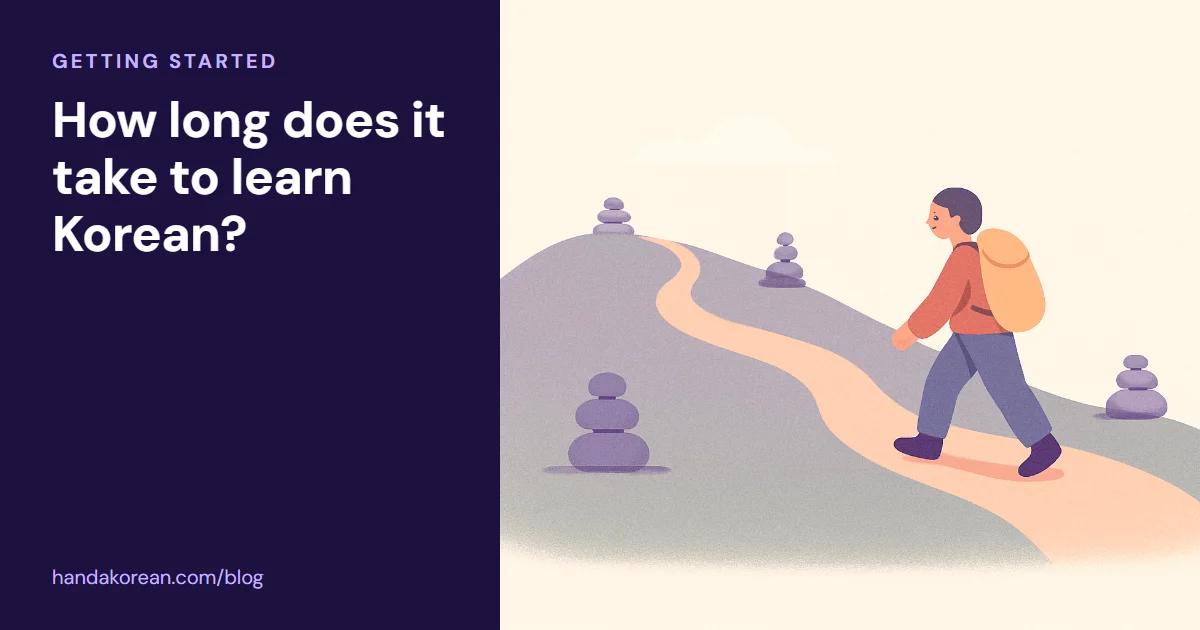
The number everyone quotes is 2,200 hours. That comes from the US Foreign Service Institute, which sorts languages into categories by how long it takes their diplomats to reach professional working proficiency. Korean sits in Category IV — the hardest group, alongside Japanese, Mandarin and Arabic.
The number is real. It is also close to useless for most people, because "professional working proficiency" means negotiating policy in Korean, and that is almost certainly not what you want.
Here is the more useful version, broken down by what you actually want to do.
Reading Hangul: 3 to 10 hours
This is genuinely fast, and it is the single best return on time in the entire language.
Hangul is an alphabet, not a character set. There are 14 basic consonants and 10 basic vowels, and they are assembled into syllable blocks by a rule that is consistent almost everywhere. Most people can sound out a Korean sign within a week of casual study.
A warning, though: being able to decode Hangul is not the same as being able to pronounce Korean. 국물 is written with ㄱ and ㅁ next to each other, and said [궁물]. 같이 is said [가치]. There are about a dozen of these sound-change rules, and they are why you can read a word perfectly and still not recognise it when someone says it.
If you have not done this step, do it first — our free Hangul course is ten lessons and uses no romanisation at all, on purpose.
Basic survival conversation: 150 to 300 hours
Ordering food, asking directions, introducing yourself, handling a shop. Roughly TOPIK level 1–2.
At an hour a day, that is five to ten months. At twenty minutes a day, closer to two years — and this is the part where most people quietly stop.
What makes this range so wide is not talent. It is whether you spend the hours speaking or only reading. Learners who do input-only study can hit 300 hours and still be unable to answer a question out loud, because recognition and production are separate skills. If your goal is conversation, speaking practice has to start in month one, badly, before you feel ready.
Comfortable daily conversation: 600 to 900 hours
You can talk about your day, your opinions, your plans. You still miss things. You can handle a conversation with a patient Korean speaker without either of you working very hard. Roughly TOPIK 3–4.
This is where the grammar actually lives. Not the particles — those you met early — but the endings that carry attitude: -잖아요, -거든요, -네요, -더라고요. They are what make Korean sound like a person rather than a textbook, and there are a lot of them.
Expect 18 months to three years at a serious but human pace.
TOPIK 5–6 and beyond: 1,500 to 2,200+ hours
News, academic text, workplace Korean, film without subtitles. This is where the FSI number becomes relevant, and where the honest answer is years, plural, for nearly everyone.
What actually changes the number
The hours matter less than these four things.
Daily beats weekly, by a lot. Thirty minutes a day beats three and a half hours on Sunday, and it is not close. Language retention is driven by the number of times you revisit something, not the total time spent.
Speaking from day one. The most common self-study failure is a learner with a 2,000-word vocabulary who has never produced a sentence under time pressure. That learner is not 60% of the way to conversation. They have most of the material and none of the skill.
Getting corrected. Uncorrected practice fossilises errors — you repeat them until they feel right, and then they are extremely expensive to remove. This is the single strongest argument for a tutor of some kind over pure self-study.
Knowing what you are aiming at. "Learn Korean" is not a goal and cannot be finished. "Order in a restaurant without switching to English" can be, in about two months.
A realistic first year
If you study 30–45 minutes a day, most days:
- Month 1 — Hangul, the sound-change rules, 해요-form, about 200 words. You can read signs and introduce yourself.
- Months 2–4 — Particles, past and future tense, numbers, 400–600 more words. You can order, shop, and answer simple questions slowly.
- Months 5–8 — Connectives, speech levels, listening that is no longer painful. Around TOPIK 2. Short conversations work.
- Months 9–12 — Opinions, reasons, the attitude endings. Conversations stop being transactions.
That is a realistic year. It is not fluency, and anyone selling you fluency in a year is selling something.
But it is the year where Korean stops being a subject you study and becomes a thing you do — and that transition is what the 2,200-hour figure completely fails to capture.
Practice this with an AI tutor
HanDa corrects every sentence you write or say — in real conversation, not flashcards.