Korean Honorific -(으)시-: Why It's 하세요 and Not 해요
Quick answer: -(으)시- (-eusi-) is an honorific piece added inside a Korean verb to show respect for the person the sentence is about. 가요 ("goes") becomes 가세요, 했어요 becomes 하셨어요. You add it when the subject is someone older or senior to you — and never when the subject is you.
This is the part of Korean politeness that English speakers almost always miss, because English has one dial and Korean has two.
Two dials, not one
Dial one is the ending: 해요체, 합쇼체, 반말. That dial is about the person you are talking to — your listener.
Dial two is -(으)시-, which sits in the middle of the verb, before the ending. That dial is about the person you are talking about — the subject of the sentence.
They move independently. Watch:
- 선생님 어디 가셨어? — "Where did the teacher go?" (asking a close friend about a teacher: 반말 ending, honorific subject)
- 저 지금 가요. — "I'm going now." (polite ending, no honorific, because the subject is me)
English collapses both into one idea called "being polite," so learners reach for 하세요 whenever they feel nervous, and drop it whenever they relax. Koreans hear those as two different errors.
What -(으)시- actually does to the verb
It goes in after the stem and before the ending. With a consonant at the end of the stem, you get 으시; otherwise just 시.
| Plain (해요체) | With -(으)시- | Meaning |
|---|---|---|
| 가요 | 가세요 | goes |
| 읽어요 | 읽으세요 | reads |
| 했어요 | 하셨어요 | did |
| 바빠요 | 바쁘세요 | is busy |
| 갈 거예요 | 가실 거예요 | will go |
| 합니다 | 하십니다 | does (합쇼체) |
Notice the last row. 하십니다 is the formal ending plus the honorific — proof that -(으)시- is a separate layer, not a politeness level of its own.
And a useful side effect: -(으)시- + 어요 contracts to -(으)세요, which is also how you make a soft polite request. 여기 앉으세요. ("Please sit here.") 들어오세요. ("Come in.") The negative command -지 마세요 has the same 세요 hiding at the end.
Five verbs that change shape completely
For a handful of extremely common verbs, Korean doesn't just add -(으)시-. It swaps in a different word. These five are worth memorizing today:
| Plain | Honorific | Meaning |
|---|---|---|
| 먹다 / 마시다 | 드시다 | eat / drink |
| 자다 | 주무시다 | sleep |
| 있다 (a person) | 계시다 | be, be present |
| 말하다 | 말씀하시다 | speak, say |
| 아프다 | 편찮으시다 | be unwell |
In use:
- 많이 드세요. — "Please eat a lot." (what a host says at the table)
- 안녕히 주무셨어요? — "Did you sleep well?" (to a grandparent in the morning)
- 사장님은 지금 사무실에 계세요. — "The boss is in the office right now."
- 부장님이 뭐라고 하셨어요? — "What did the manager say?"
- 할머니가 요즘 편찮으세요. — "Grandma hasn't been well lately."
A few nouns swap too: 생일 → 생신 (birthday), 이름 → 성함 (name), 나이 → 연세 (age), 집 → 댁 (home). You'll meet 연세 the moment you need to ask an older person's age: 연세가 어떻게 되세요?
Never about yourself
This is the mistake that makes Koreans smile. -(으)시- raises the subject. If the subject is you, you are raising yourself.
- ✗ 저는 집에 계세요.
- ✓ 저는 집에 있어요. — "I'm at home."
- ✗ 제가 먼저 가시겠습니다.
- ✓ 제가 먼저 가겠습니다. — "I'll go first."
- ✗ 저 점심 드셨어요.
- ✓ 저 점심 먹었어요. — "I ate lunch."
The test is not "am I being polite?" It's "who is doing the verb?" You can be extremely polite to your listener and still use a plain verb, because the verb belongs to you:
부장님, 제가 전화드렸는데 안 받으셨어요. "Sir, I called but you didn't pick up."
One sentence, one honorific — on 받다, because he's the one who didn't answer. 전화드리다 stays humble, because that was me.
있으세요 vs 계세요
Here's the nuance that separates intermediate learners from beginners. 계시다 is for a respected person being somewhere. 있으시다 is for a respected person having something.
- 어머니는 지금 댁에 계세요. — "My mother is at home right now." (she is there)
- 질문 있으세요? — "Do you have a question?" (you possess a question)
- 시간 있으세요? — "Do you have time?"
Saying 질문 계세요? would elevate the question itself, which is not how it works. Same logic behind a thing you will hear in cafés — 주문하신 커피 나오셨습니다 — where staff accidentally honor the coffee. Koreans notice it, and it's officially considered incorrect. When you order at a café, don't copy it.
When natives skip it
-(으)시- is not automatic with every polite sentence. Two things to know:
Among people the same age or younger, it's off. Talking about a friend to another friend, 민수 지금 와요 is normal. 민수 지금 오세요 sounds like you've mistaken your friend for a department head.
The subject marker 께서 is mostly written. Textbooks pair -(으)시- with 께서 (할아버지께서 오셨어요). In everyday speech people usually say 할아버지가 오셨어요 or just 할아버지 오셨어요 and keep the -(으)시- only. Keep 께서 for writing, announcements and very formal speech.
Service workers aim it at you constantly. 봉투 필요하세요? ("Do you need a bag?"), 주문하시겠어요? ("Would you like to order?"), 여기 앉으세요. You don't need to answer in kind — a simple 네, 괜찮아요 is fine. The same thing happens with greetings that aren't really questions, like 식사하셨어요?
A default that works
When you're not sure, run this:
- Ending: 해요체 with every adult you don't know well. It is polite enough for almost every situation a learner is in.
- Honorific: look at who is doing the verb. Older than you, your boss, your teacher, a stranger you're addressing directly, anyone you'd call 님 → add -(으)시-. Yourself, your friend, your younger sibling → don't.
- Irregulars: 드시다, 주무시다, 계시다, 말씀하시다. Learn these four as whole words now; they cover most of what you'll need.
That's it. Over-using -(으)시- about a friend sounds a bit odd. Leaving it off when talking to your 선생님 sounds cold. Neither is a disaster — but getting the subject test right makes you sound like someone who understands how the language is built.
FAQ
What does 세요 mean in Korean?
세요 is the honorific -(으)시- plus the polite 해요 ending, fused together. On a statement it means "[respected person] does X" — 어디 가세요? is "Where are you going?" On a command it softens into "please do X" — 앉으세요 is "please sit." Same form, and context tells you which one it is.
What is the difference between 해요 and 하세요?
Both are polite to your listener. 해요 says nothing about the subject; 하세요 adds respect for whoever is doing the action. So you say 저는 숙제해요 about yourself, but 선생님은 뭐 하세요? about your teacher. 하세요 is not "more polite 해요" — it's a different piece of information.
Do I use honorifics when talking about myself in Korean?
No. -(으)시- always raises the subject, so applying it to yourself sounds self-important or just funny. Instead Korean lowers you with humble words: 저 instead of 나, 드리다 instead of 주다, 뵙다 instead of 보다. Raise them, lower yourself.
Practice
Rewrite or fix each one.
- Make it honorific: 사장님이 지금 사무실에 있어요.
- Say "Did you sleep well?" to your grandmother (해요체).
- Fix the mistake: 저는 지금 가세요.
- Ask a senior colleague "Do you have time?"
- Say "What did the teacher say?" (asking a classmate, 해요체)
Answers
- 사장님이 지금 사무실에 계세요. (있다 → 계시다 for a person's presence)
- 안녕히 주무셨어요? — or 잘 주무셨어요?
- 저는 지금 가요. (The subject is you, so no -(으)시-.)
- 시간 있으세요? (Possession → 있으시다, not 계시다.)
- 선생님이 뭐라고 하셨어요? — 말씀하셨어요? is also natural and a touch more respectful.
Learn this properly, not just once
Blog posts teach one thing at a time. The HanDa books teach level 1 in order — every lesson built to be spoken, with a workbook and writing book beside it.
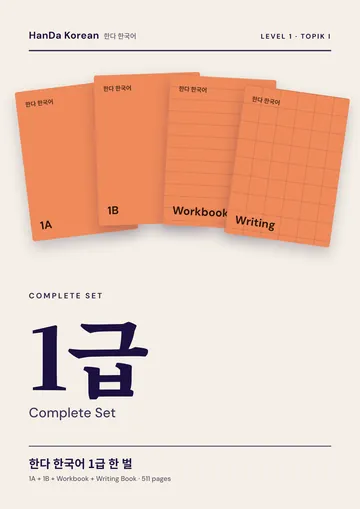 HanDa Korean Level 1 — Complete Set
Everything for level 1 — books, workbook and writing book · 511 pages
$10
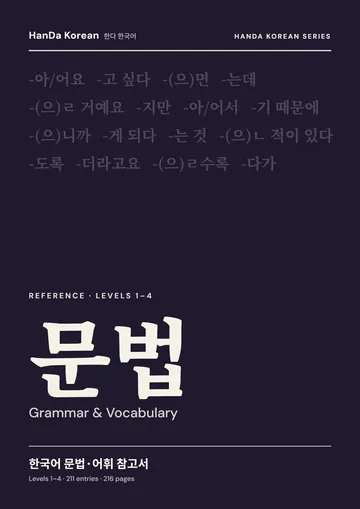 Korean Grammar & Vocabulary Reference
Every pattern in one place · 216 pages
$8
Practice this with an AI tutor
HanDa corrects every sentence you write or say — in real conversation, not flashcards.