10 Korean Phrases for Sharing Food from the Same Pot
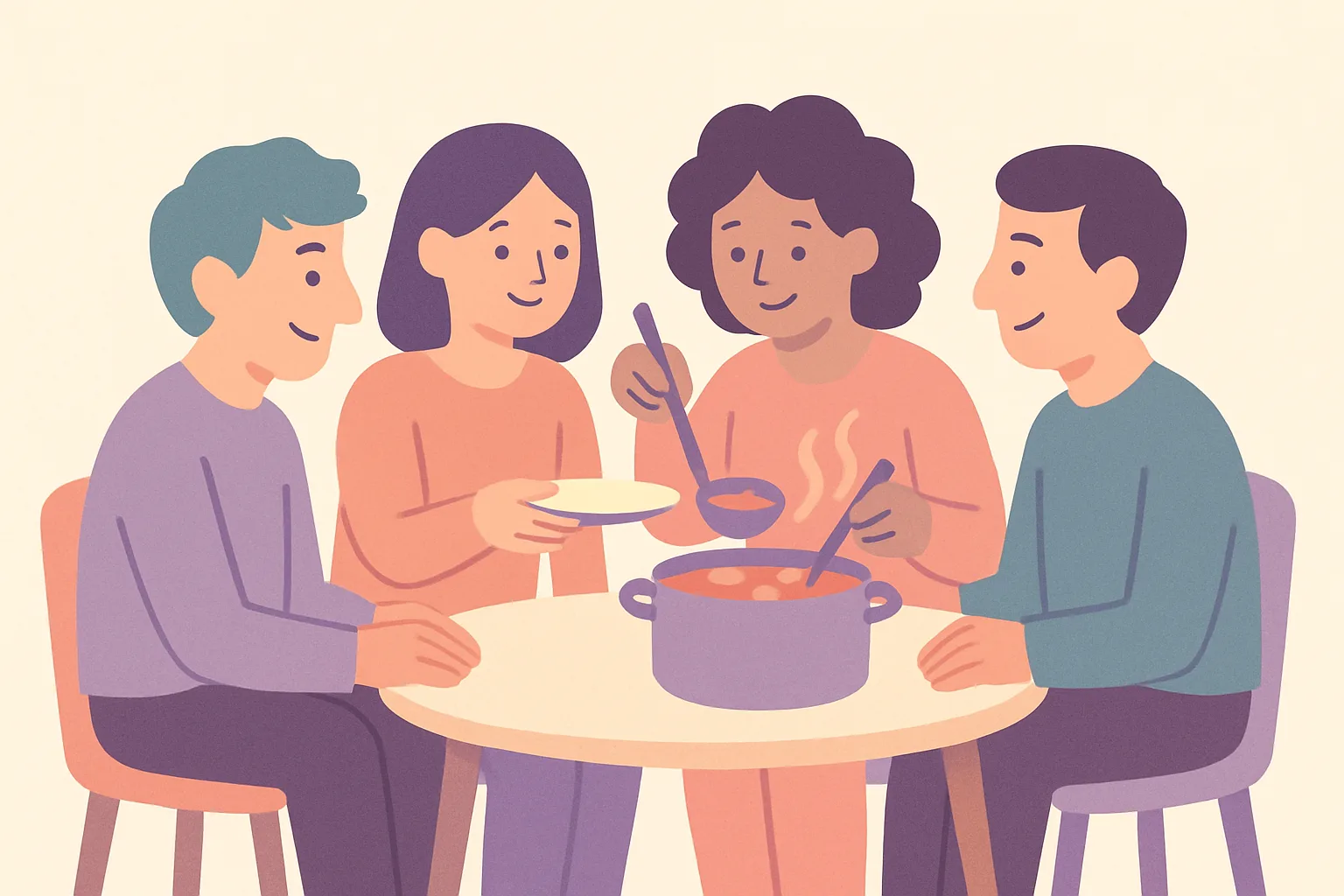
You sit down at a Korean restaurant with three other people, and only one thing arrives in the middle: a bubbling pot of 김치찌개. There is no "your portion." The pot is everyone's, the side dishes are everyone's, and the meat on the grill belongs to whoever is holding the tongs.
Here's the one idea to take away: in Korean, almost all the table language is about other people, not about you. You offer, you serve, you check if someone wants more. Saying "I'll have some" is fine, but what makes you sound like you belong at the table is saying "shall I dish some out for you?" Below are ten phrases that do that work, each one usable on its own.
All of these are in 해요체 or 합쇼체 — the polite levels you want with strangers, servers, coworkers and anyone older than you.
1. 같이 먹어요
같이 먹어요. — Let's eat together. / Help yourself.
You say this when you've ordered something and want to make it clear it's for the table, not just for you. With someone older or a senior at work, raise it to 같이 드세요 ("please eat with me"). It's a small sentence, but leaving it out can make you look like you're guarding your plate.
2. 앞접시 좀 주세요
앞접시 좀 주세요. — Could I get a small plate, please?
앞접시 is the little plate in front of you for food you've taken from the shared dishes. Ask for one by saying 저기요 first to get the server's attention — there are other ways to call a server, like 사장님 or 이모. These days many Koreans 덜어 먹어요 — they portion food onto their own plate before eating — so asking for 앞접시 is completely normal and nobody will read it as you being squeamish.
3. 제가 덜어 드릴게요
제가 덜어 드릴게요. — I'll dish some out for you.
덜다 means to take a portion out of a bigger dish. If you're the youngest at the table, this is practically your job: pick up the 국자 (ladle) and serve the others first. You can also ask first — 덜어 드릴까요? ("Shall I dish some out for you?") — which is softer and gives the other person a choice.
4. 이거 한번 드셔 보세요
이거 한번 드셔 보세요. — Try this, give it a go.
Use this to push a dish toward someone who hasn't touched it yet. 한번 here doesn't mean "one time" — it softens the suggestion to something like "just give it a try." With a close friend, 이거 한번 먹어 봐 is the 반말 version, and it's what you'll hear most often between people the same age.
5. 제가 구울게요
제가 구울게요. — I'll do the grilling.
At a 삼겹살 or 갈비 restaurant, someone has to run the grill: turning the meat, cutting it with scissors, moving the cooked pieces to the cool edge. Offering to do it is a quiet way of showing respect, especially if you're the youngest or the host. If someone beats you to it, 제가 자를게요 ("I'll cut it") is the next job to volunteer for.
6. 다 익었어요
다 익었어요. 드세요. — It's cooked through. Go ahead and eat.
익다 is "to be cooked / to ripen," and this is the line that opens the meat for the table. Until someone says it, people hover. The opposite is just as useful: 아직 안 익었어요 ("it's not done yet") — a gentle way to stop someone from grabbing a pink piece of pork.
7. 반찬 좀 더 주세요
반찬 좀 더 주세요. — Could we get more side dishes, please?
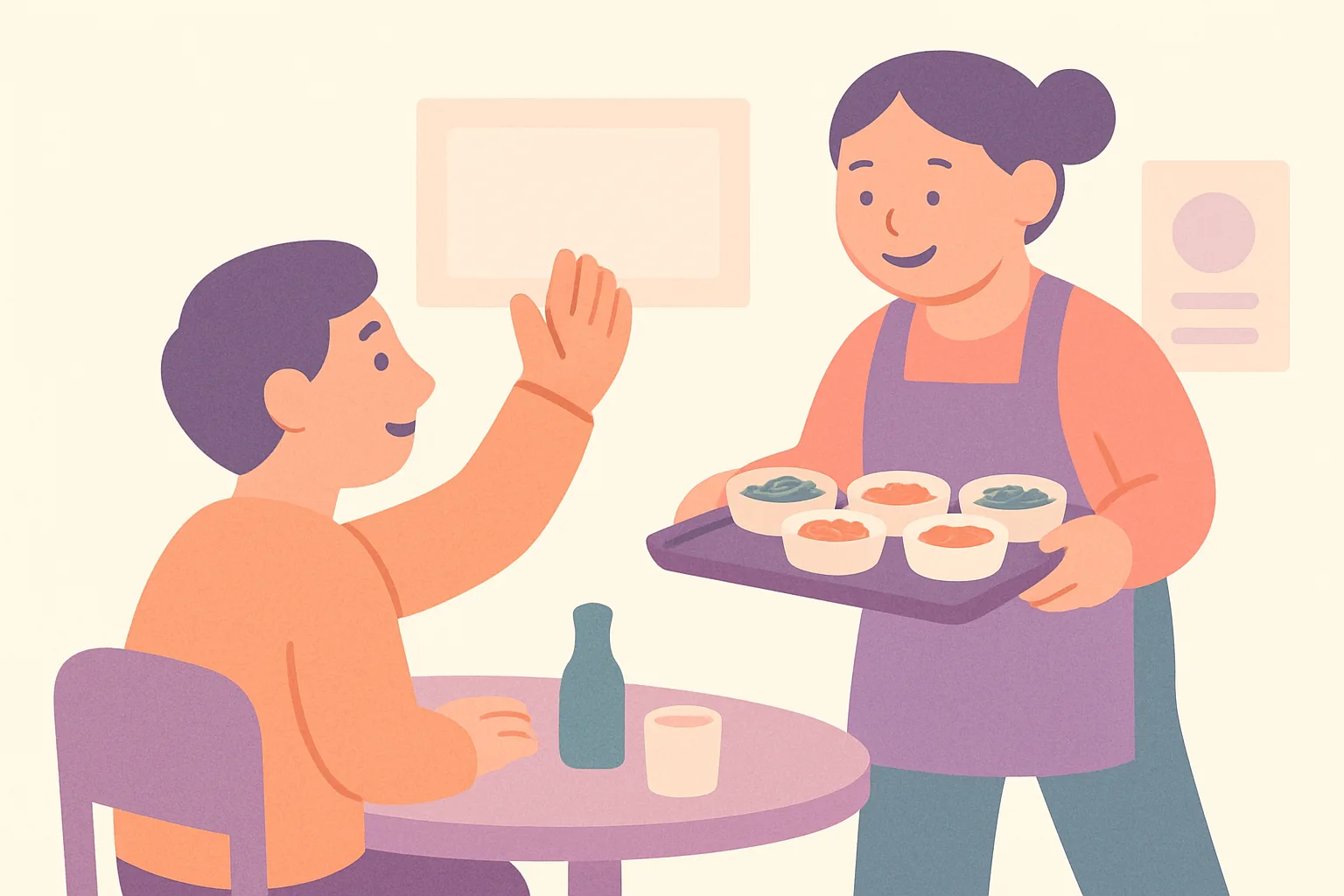
At almost any Korean restaurant, 반찬 refills are free, and asking is expected rather than cheeky. You can name the one you want: 김치 좀 더 주세요 or 콩나물 좀 더 주세요. 좀 is doing a lot of work here — it softens the request from a demand into a polite ask, so don't drop it.
8. 하나 더 시킬까요?
하나 더 시킬까요? — Shall we order one more?
시키다 is the everyday verb for ordering food, more common in speech than 주문하다. Notice the -(으)ㄹ까요 ending: you're asking the group to decide together, not announcing your own plan. If you want to say "I'll order it, don't worry about it," that's 제가 시킬게요 — and the difference between those two endings is worth knowing: -(으)ㄹ까요? throws the decision to the group, while -(으)ㄹ게요 commits you to doing it (see also -(으)ㄹ게요 vs -(으)ㄹ래요).
9. 많이 드세요
많이 드세요. — Please eat a lot.
This is what a host says, and what anyone says when someone else has barely eaten. It sounds strange translated literally into English, but in Korean it's warmth: I want you full. Mid-meal, 더 드세요 ("have some more") works the same way, and the natural answer is 네, 잘 먹고 있어요 ("yes, I'm enjoying it") or 배불러요 ("I'm full") if you really can't.
10. 잘 먹었습니다
잘 먹었습니다. — Thank you for the meal. (lit. I ate well.)
Say this at the end to whoever paid, or to the restaurant owner on the way out. Before you start, the matching phrase is 잘 먹겠습니다 ("I'll eat well") — said to the person treating you, not to nobody in particular. Skipping 잘 먹었습니다 when someone has bought you dinner is one of those small silences a Korean ear notices immediately.
Three table habits worth knowing
- Don't pick up the rice bowl. In Korea, bowls stay on the table and you eat with a spoon. Lifting the bowl to your mouth looks off.
- The pouring rule. Never fill your own glass if someone else's is empty — fill theirs first, and they'll fill yours. Catching that moment is pure 눈치.
- Pace yourself to the table. Finishing far ahead of everyone else, or standing up first, feels abrupt. The meal ends together.
Practice
What would you say?
- You and three friends ordered one pot of 부대찌개. You want a small plate of your own.
- The 삼겹살 on the grill is finally done and everyone is waiting.
- The 김치 dish is empty and you'd like more.
- Your coworker, who is older than you, has an empty bowl in front of her. You pick up the ladle.
- Translate: 하나 더 시킬까요?
Answers
- 앞접시 좀 주세요. (Get the server's attention first with 저기요.)
- 다 익었어요. 드세요.
- 김치 좀 더 주세요.
- 제가 덜어 드릴게요. (Or, asking first: 덜어 드릴까요?)
- "Shall we order one more?"
Pick two of these to use the next time you eat Korean food with other people — 앞접시 좀 주세요 and 잘 먹었습니다 are the easiest wins. They're short, they're always correct, and they say you understand that the pot in the middle is shared.
Learn this properly, not just once
Blog posts teach one thing at a time. The HanDa books teach level 1 in order — every lesson built to be spoken, with a workbook and writing book beside it.
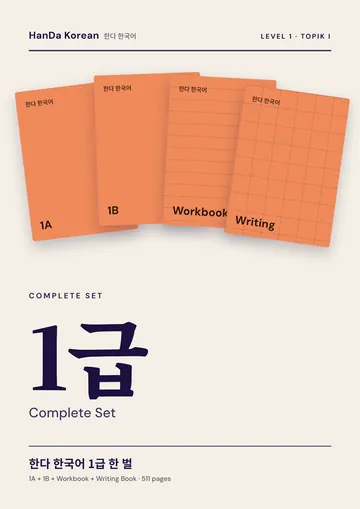 HanDa Korean Level 1 — Complete Set
Everything for level 1 — books, workbook and writing book · 511 pages
$10
HanDa Korean Level 1 — Complete Set
Everything for level 1 — books, workbook and writing book · 511 pages
$10
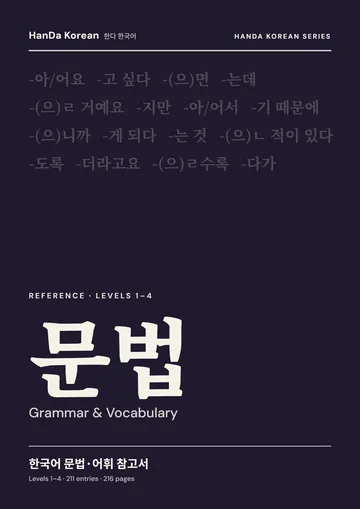 Korean Grammar & Vocabulary Reference
Every pattern in one place · 216 pages
$8
Korean Grammar & Vocabulary Reference
Every pattern in one place · 216 pages
$8
Practice this with an AI tutor
HanDa corrects every sentence you write or say — in real conversation, not flashcards.