10 Korean Phrases for Ordering Food at a Restaurant
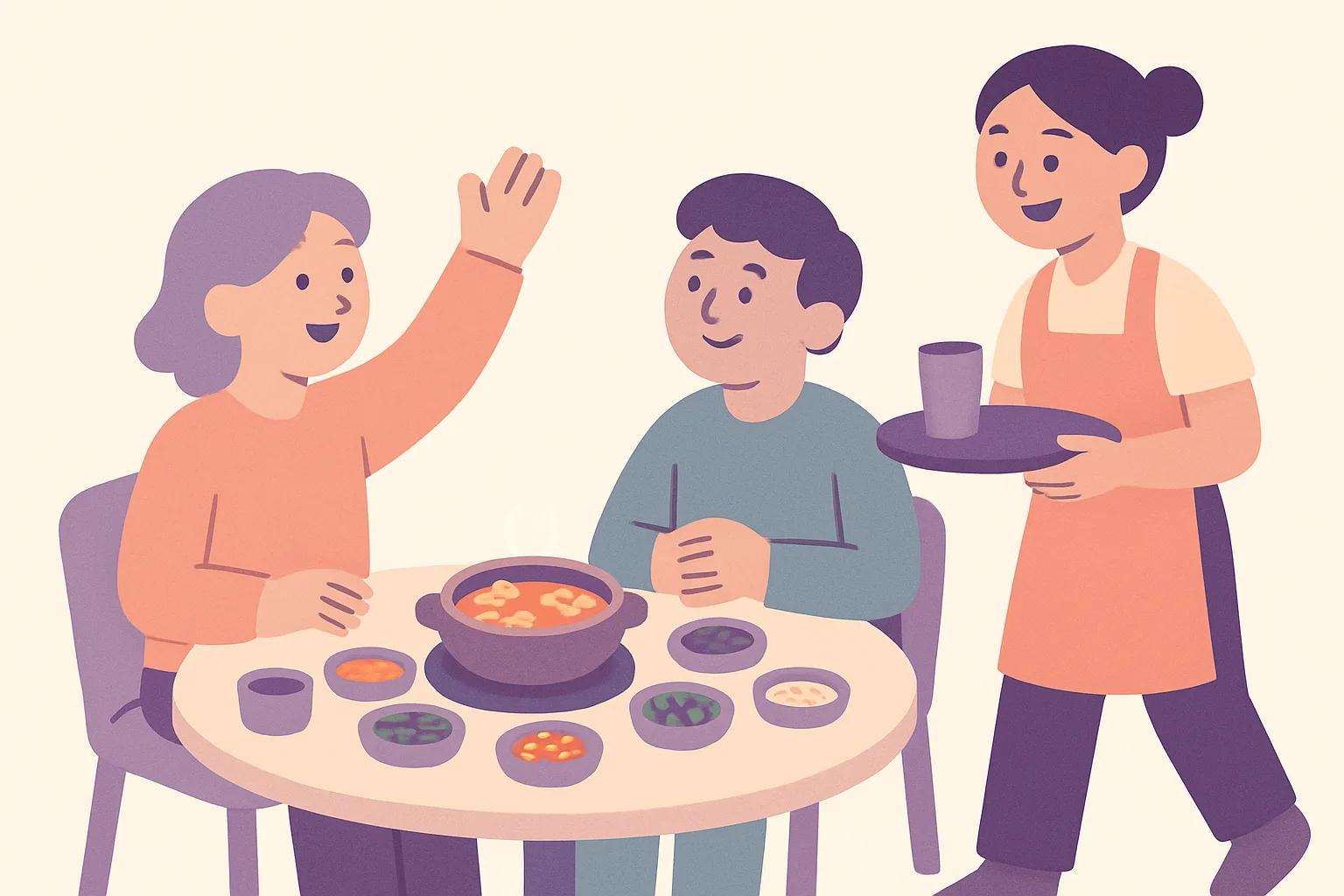
Quick answer: To order food in a Korean restaurant, call the server with 저기요 (jeogiyo, "excuse me"), order with the dish name plus 하나 주세요 (hana juseyo, "one, please"), and pay by saying 계산할게요 ("I'll pay now"). Everything else is variations on those three.
Here's the whole thing as it usually goes, in about forty seconds of real Korean:
직원: 몇 분이세요? — How many people? 손님: 두 명이요. — Two. 직원: 주문하시겠어요? — Would you like to order? 손님: 된장찌개 하나랑 비빔밥 하나 주세요. — One doenjang stew and one bibimbap, please. 직원: 네, 잠시만 기다려 주세요. — Okay, just a moment please.
That's it. Korean restaurants run on short, repeated lines, which is great news for a beginner — you can learn the whole script. Below are the ten phrases that cover ordering, asking for more, special requests, and paying, plus what to say when something goes off script.
1. 저기요 — "Excuse me."
저기요. — Excuse me.
This is how you call a server across a room, and it is completely normal and polite. Koreans say it at a clear, carrying volume — not a shout, but not an apologetic mumble either. 여기요 ("over here") works the same way and is slightly more common when you want someone to come to your table. Many restaurants also have a call button on the table; press it and someone comes, no words needed.
2. 두 명이요 — "Two people."
두 명이요. — Two, please. (Table for two.)
The first thing you'll hear at the door is 몇 분이세요? ("How many of you are there?"). Answer with a native number plus 명: 한 명이요, 두 명이요, 세 명이요, 네 명이요. You can also just hold up fingers and say the number — nobody will mind. If you're alone, 혼자예요 ("I'm by myself") is the natural answer.
3. 주문할게요 — "I'd like to order."
주문할게요. — I'd like to order now.
Use this once you've decided and want the server to come over. The server's version of this line is 주문하시겠어요? ("Are you ready to order?"). If you need another minute, say 잠시만요 ("just a moment") — short, polite, used constantly.
4. 이거 주세요 — "This one, please."
이거 주세요. — I'll have this one.
The single most useful restaurant sentence in Korean. Point at what you want and say it. Add a number if you need more than one: 이거 두 개 주세요 ("two of these, please"). This also saves you when you can't read or pronounce the dish name yet — pointing plus 주세요 is not lazy, it's what Koreans do too.
5. 된장찌개 하나 주세요 — "One doenjang stew, please."
된장찌개 하나 주세요. — One doenjang stew, please.
The pattern is [dish] + [number] + 주세요, using native Korean numbers with the counter 개 (하나/한 개, 둘/두 개, 셋/세 개). For grilled meat, the counter is 인분 (portions) with Sino-Korean numbers: 삼겹살 2인분 주세요 ("two portions of pork belly, please"). Mixing those up — saying 두 인분 instead of 2인분 — is the classic learner slip, and it's covered in more depth in this round-up of common learner mistakes.
6. 물 좀 주세요 — "Could I get some water?"
물 좀 주세요. — Could I get some water, please?
That little 좀 is the difference between a demand and a request; drop it and 물 주세요 sounds a bit blunt to a Korean ear. Swap in whatever you need: 숟가락 좀 주세요 (a spoon), 앞접시 좀 주세요 (a small plate for sharing). Note that water is free in Korea, and in many places it's self-serve from a dispenser near the door.
7. 반찬 좀 더 주세요 — "Could I get more side dishes?"
반찬 좀 더 주세요. — Could I have more side dishes, please?
Refills of 반찬 are free at most Korean restaurants, and asking is expected rather than cheeky. Name the one you want if you only want one: 김치 좀 더 주세요. The same pattern covers rice (밥 좀 더 주세요) — though an extra bowl of rice (공깃밥) usually costs a little extra.
8. 안 맵게 해 주세요 — "Please make it not spicy."
안 맵게 해 주세요. — Please make it not spicy.
Use this when you order, not after the food arrives. A gentler version is 덜 맵게 해 주세요 ("less spicy, please"), which kitchens can usually manage. Be ready for 그건 좀 어려워요 ("that's a bit difficult") — many dishes are pre-made, and the honest answer is no. If you have an allergy, say it plainly: 저 땅콩 알레르기 있어요 ("I have a peanut allergy").
9. 계산할게요 — "I'll pay now. / Check, please."
계산할게요. — I'd like to pay.
In most Korean restaurants you pay at the counter on your way out, not at the table. Say this as you stand up, or just say 계산이요 at the register. Useful follow-ups: 카드 돼요? ("Do you take card?") and 따로 계산해 주세요 ("Separate checks, please"). You'll often hear 영수증 드릴까요? — "Shall I give you the receipt?" Answer 네 or 괜찮아요.
10. 포장해 주세요 — "Please pack it to go."
포장해 주세요. — To go, please. / Please wrap this up.
Say it at the start if you're ordering takeout, or at the end for leftovers: 남은 거 포장해 주세요 ("please pack up what's left"). To check first, ask 포장되나요? ("Can I get this to go?"). Soups and stews are often packed too, so don't assume the answer is no.
When it goes off script
Three lines rescue most situations. 이거 어떻게 먹어요? — "How do I eat this?" — is genuinely common; Koreans ask it about unfamiliar dishes too, and if the 어떻게 / 어떡해 difference trips you up, this breakdown sorts it out. 이거 안 시켰는데요 — "I didn't order this" — is the polite way to flag a wrong dish; the -는데요 ending softens it into something closer to "um, about this..." than an accusation. And 잠시만요 buys you time for anything.
One address note: you may hear Korean customers call an older woman server 이모님 or the owner 사장님. Both are warm and normal from a regular, but 저기요 is never wrong, and that's the safe choice for a visitor. There's more on choosing the right word for people in this guide to Korean titles.
FAQ
How do you say "excuse me" to a waiter in Korean?
Say 저기요 or 여기요. Both mean "excuse me / over here" and are the standard way to call a server in a Korean restaurant. Say it clearly and loud enough to carry — Koreans do, and it isn't considered rude. If the table has a call button, pressing it is just as normal.
How do you say "check, please" in Korean?
계산할게요 ("I'll pay now") or 계산이요 at the counter. In most Korean restaurants you pay at the register by the door rather than at your table, so you usually say it while standing up to leave. Add 카드 돼요? to ask whether they take cards.
Is 주세요 polite enough for ordering food?
Yes. 주세요 is the 해요체 polite form and is exactly what adults use with servers and shop staff. Adding 좀 (물 좀 주세요) makes a request softer and friendlier. You don't need anything fancier unless you're in a very formal setting.
Practice
Say these in Korean.
- Call the server over.
- "Table for three." (answering 몇 분이세요?)
- "Two of these, please."
- "Could I get more side dishes?"
- "Please pack up what's left."
Answers
- 저기요. (or 여기요.)
- 세 명이요.
- 이거 두 개 주세요.
- 반찬 좀 더 주세요.
- 남은 거 포장해 주세요.
Learn this properly, not just once
Blog posts teach one thing at a time. The HanDa books teach level 1 in order — every lesson built to be spoken, with a workbook and writing book beside it.
 HanDa Korean Level 1 — Complete Set
Everything for level 1 — books, workbook and writing book · 511 pages
$10
 Korean Grammar & Vocabulary Reference
Every pattern in one place · 216 pages
$8
Practice this with an AI tutor
HanDa corrects every sentence you write or say — in real conversation, not flashcards.