Q1
이번
What does this word mean?
last week
public holiday
this time
minute
이번 — this time (time)
Q2
window
How do you say this in Korean?
계단
부엌
냉장고
창문
창문 — window (house)
Q3
담백하다
What does this word mean?
to be flat
to be salty
to be plain/light
to be noisy
담백하다 — to be plain/light (adjectives)
Q4
to wander around
How do you say this in Korean?
인정하다
돌아다니다
낫다
변경하다
돌아다니다 — to wander around (verbs)
Q5
경기장
What does this word mean?
city
monthly rent
toothpaste
stadium
경기장 — stadium (daily_life)
Q6
job/occupation
How do you say this in Korean?
직업
한국
게임
욕조
직업 — job/occupation (daily_life)
Q7
토론
What does this word mean?
notebook
school vacation
debate/discussion
physical education
토론 — debate/discussion (school)
Q8
exit
How do you say this in Korean?
주차하다
출구
편도
왕복
출구 — exit (transport)
Q9
Say that you eat rice.
Which sentence says this correctly?
저는 밥을 먹어요.
저는 남동생이 있어요.
꽃이 예뻐요.
저는 커피를 마셔요.
을/를 (object marker) — object marker — marks the direct object. 받침O → 을, 받침X → 를
Q10
there is / have
Which Korean grammar pattern expresses this?
네 / 아니요
-아/어요
있어요
어디
있어요 — there is / have. e.g. 책상 위에 노트북이 있어요. (There is a laptop on the desk.)
Q11
Say that you exercise at the park.
Which sentence says this correctly?
저는 커피를 마셔요.
저는 미국 사람이에요.
저는 시간이 없어요.
공원에서 운동해요.
에서 (action location) — at / in (place where an action happens). 장소 + 에서 + 동사
Q12
Say that you meet a friend.
Which sentence says this correctly?
저 사람은 누구예요?
친구를 만나요.
네, 저는 학생이에요.
저는 미국 사람이에요.
-아/어요 (present polite) — present tense polite ending. 만나다 → 만나요 (ㅏ 모음 → -아요, 받침 없으면 줄임)
Q13
-이에요/예요
What does this grammar pattern mean?
to be (A is B) — identifying nouns
topic marker — introduces or contrasts a topic
at / in / to (static location, destination, or time)
to not be (A is not B)
-이에요/예요 — to be (A is B) — identifying nouns. e.g. 저는 의사예요. (I am a doctor.)
Q14
언제
What does this grammar pattern mean?
Is there / Do you have? — question
subject marker — marks the grammatical subject
when — asking about time
topic marker — introduces or contrasts a topic
언제 (question word) — when — asking about time. e.g. 생일이 언제예요? (When is your birthday?)
Q15
수영장은 오전 6시부터 오후 9시까지 이용할 수 있어요.
What does this sentence from the passage mean?
The swimming pool can be used from 6 AM to 9 PM.
Children bow to elders and receive New Year money.
Next time, I want to go with my friend.
There are two major holidays in Korea.
수영장은 오전 6시부터 오후 9시까지 이용할 수 있어요. = The swimming pool can be used from 6 AM to 9 PM.
Q16
어린이는 보호자와 함께 와야 해요.
What does this sentence from the passage mean?
Today I went to a Korean restaurant for the first time.
It is a really fun day.
Children must come with a guardian.
Two people. Do you have a table?
어린이는 보호자와 함께 와야 해요. = Children must come with a guardian.
Q17
음식이나 음료는 반입할 수 없어요.
What does this sentence from the passage mean?
The tiger wore the mother's clothes and came to the house.
Food or drinks cannot be brought in.
If you buy twenty thousand won worth, we give a gift.
Please be quiet inside the library.
음식이나 음료는 반입할 수 없어요. = Food or drinks cannot be brought in.
Q18
수영장
What does this word mean in the passage?
photo
color
swimming pool
to be surprised
수영장 (su-yeong-jang) — swimming pool
Q19
보호자
What does this word mean in the passage?
guardian
topic marker (after consonant)
sunflower
butterfly
보호자 (bo-ho-ja) — guardian
Q20
Which sentence does NOT appear in the passage above?
수영장은 오전 6시부터 오후 9시까지 이용할 수 있어요.
직원분이 도와줘서 불고기를 시켰어요.
문의 사항은 프론트에 물어보세요.
어린이는 보호자와 함께 와야 해요.
"직원분이 도와줘서 불고기를 시켰어요." (A staff member helped me, so I ordered bulgogi.) is from a different passage.
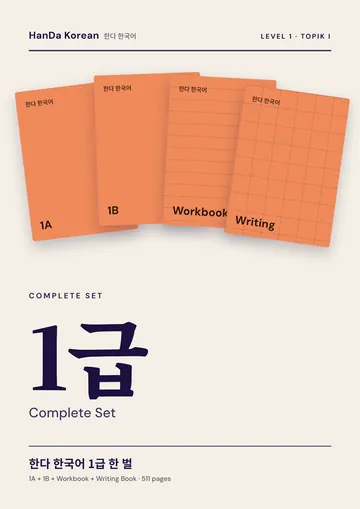 HanDa Korean Level 1 — Complete Set
Complete level 1 — student books, workbook and writing book · 511 pages
$10
HanDa Korean Level 1 — Complete Set
Complete level 1 — student books, workbook and writing book · 511 pages
$10
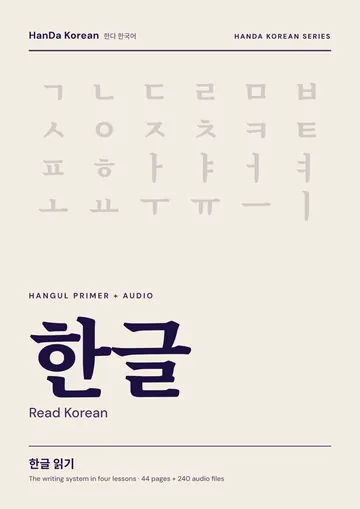 Read Korean
If reading is still slow, start here · 44 pages
$5
Read Korean
If reading is still slow, start here · 44 pages
$5
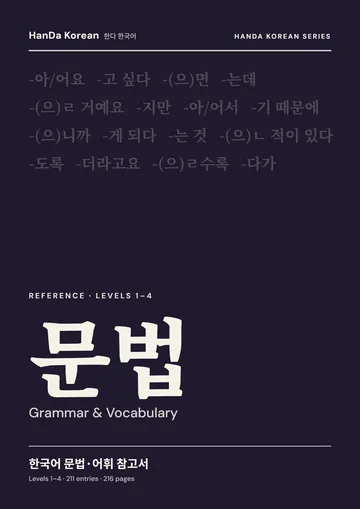 Korean Grammar & Vocabulary Reference
Every pattern from level 1 to 6 in one book · 216 pages
$8
Korean Grammar & Vocabulary Reference
Every pattern from level 1 to 6 in one book · 216 pages
$8
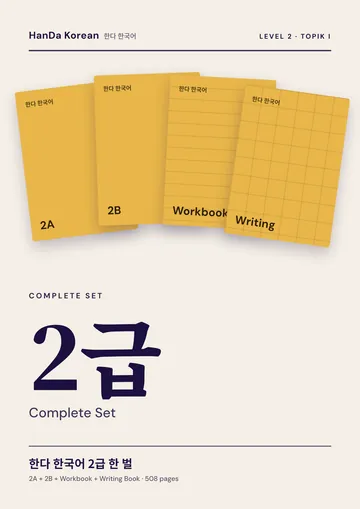 HanDa Korean Level 2 — Complete Set
Complete level 2 — student books, workbook and writing book · 508 pages
$10
HanDa Korean Level 2 — Complete Set
Complete level 2 — student books, workbook and writing book · 508 pages
$10