How to Learn Korean With a Friend (Without Paying Twice)
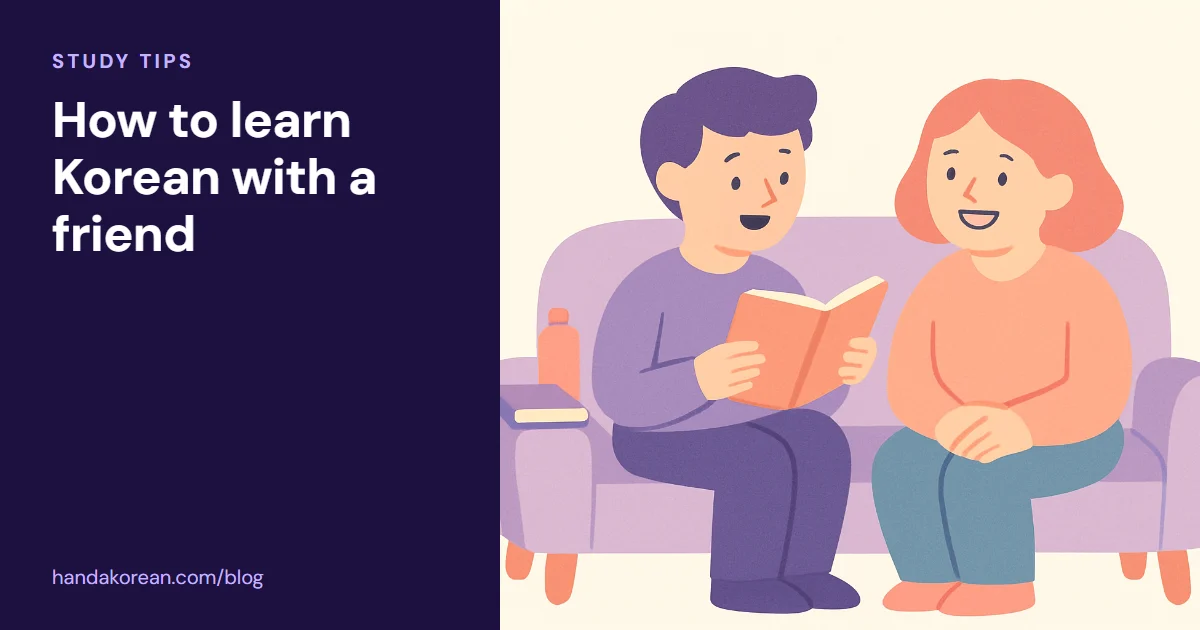
Short answer: almost all AI Korean apps are single-player by design — one login, one subscription, one learner. To study with a friend you either buy two subscriptions, or use an app with a shared plan. HanDa's Host plan is one of the few: one subscriber creates a Friend Room and invites two friends, who each get 50 free conversation turns without their own subscription.
Why studying with someone else works
The reason most people quit a language app isn't difficulty. It's that nothing happens when you stop. Nobody notices. There's no cost to missing a day, and then a week, and then it's been a month.
A second person changes the arithmetic. Not because they teach you anything, but because skipping becomes visible. The research on this is unglamorous and consistent: accountability outperforms motivation, because motivation is a mood and accountability is a structure.
Korean adds a second reason. Korean grammar is heavily context-dependent — the correct form of a sentence changes based on who you're speaking to and how well you know them. Practising alone with an AI, you only ever occupy one social role. Practising with someone you actually know gives you a real relationship to model 반말 against, which is the exact thing most self-taught learners get wrong for years.
The problem: these apps are built for one
Language apps price per seat because that's how subscription software works. Two learners means two subscriptions, which for most AI Korean apps means $20–60/month for a pair. For a couple or two friends casually curious about Korean, that's usually where the idea dies.
There are three workarounds, and only one of them is good.
Sharing one login. Don't. Beyond the terms-of-service problem, it actively breaks these apps: they build a model of your level, your mistakes and your weak phonemes. Two people on one account produce a blended profile that describes neither of you, so the difficulty targeting and mistake tracking — the main things you're paying for — stop working.
Two subscriptions. Works fine. Costs double. If you can both justify it, this is the simplest path and you get two clean learner profiles.
A plan built for more than one person. Rare in this category, but it exists.
Shared plans that actually exist
HanDa's Host plan ($25/month) creates one Friend Room and invites up to two friends. Invited friends don't need their own subscription — each gets 50 free conversation turns inside the room. Three people, one bill. Each person still keeps their own learner profile, so mistake tracking and level matching stay accurate.
It isn't unlimited — 50 turns is enough to find out whether your friend is serious, not enough to reach fluency on. Think of it as a shared trial rather than three full accounts, and expect a friend who sticks with it to eventually want their own plan.
Family plans on general apps. Duolingo and some multi-language products offer family pricing. These cover more people, but you're getting a general language app rather than Korean-specific instruction — no speech-level enforcement, no TOPIK mapping.
How to actually run it with a partner
Whatever app you pick, a few things make the difference between a study habit and two people who both downloaded something in March.
- Pick a fixed time, not a daily goal. "Tuesdays and Thursdays after dinner" survives; "20 minutes a day" doesn't.
- Practise separately, review together. Do your own conversations, then spend ten minutes comparing corrections. You'll find you make different mistakes, and explaining someone else's error is the fastest way to stop making it yourself.
- Use each other for 반말. This is the one thing an app genuinely can't give you. With a friend you have a real relationship where casual speech is appropriate — use it, and save 존댓말 for the AI role-plays with strangers, shopkeepers and bosses.
- Don't sync your levels. One of you will move faster. That's fine and expected. Trying to stay level with each other turns study into a competition and the slower person quits.
Related reading
Learn this properly, not just once
Blog posts teach one thing at a time. The HanDa books teach level 1 in order — every lesson built to be spoken, with a workbook and writing book beside it.
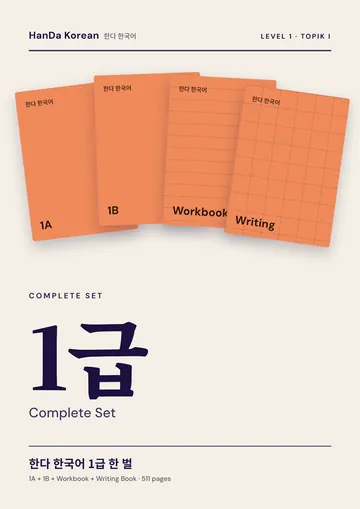 HanDa Korean Level 1 — Complete Set
Everything for level 1 — books, workbook and writing book · 511 pages
$10
HanDa Korean Level 1 — Complete Set
Everything for level 1 — books, workbook and writing book · 511 pages
$10
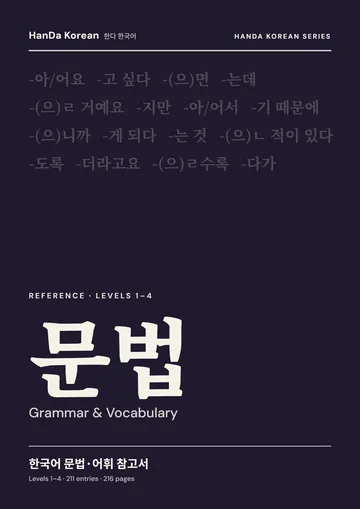 Korean Grammar & Vocabulary Reference
Every pattern in one place · 216 pages
$8
Korean Grammar & Vocabulary Reference
Every pattern in one place · 216 pages
$8
Practice this with an AI tutor
HanDa corrects every sentence you write or say — in real conversation, not flashcards.