9 Korean Spacing Rules (띄어쓰기) That Trip Up Learners
Korean spacing (띄어쓰기) feels unfair. In English you learn a word, you put spaces around it, done. In Korean, the thing that sounds like a separate word — 에, 를, 는 — has to be glued on, and the thing that sounds glued on — 수, 것, 때 — has to be pushed apart.
Here is the one idea to carry with you: Korean spaces mark word boundaries, not sound boundaries. You cannot hear where the spaces go. Korean is spoken in smooth chunks, and the sounds even change across the seams (that's why 국물 comes out as 궁물). So spacing is something you learn by rule and by eye, not by ear.
The good news: Korean spacing has famously fiddly edge cases that native speakers argue about, but learners get tripped by the same nine things over and over. Fix these nine and your writing stops looking foreign.
1. Particles glue onto the noun — never a space
저는 학교에 가요. — I'm going to school.
은/는, 이/가, 을/를, 에, 에서, 도, 만, 까지, 부터, 처럼, 하고 — all of these are endings, not words. They attach with no space: 친구하고 영화를 봤어요 (I watched a movie with a friend). Writing ✗저는 학교 에 가요 looks to a Korean reader the way "to day I go to school" looks to you — readable, clearly wrong.
2. Verb and adjective endings glue onto the stem too
지금 밥 먹는데 이따가 전화할게요. — I'm eating right now, I'll call you later.
-아요/어요, -습니다, -는데, -지만, -으니까, -을게요 are all part of the verb. Never ✗전화 할게요, never ✗먹는 데. One caution: 데 meaning place is a separate word and takes a space — 갈 데가 없어요 (I have nowhere to go). Same syllable, different job.
3. Nouns like 수, 것, 지 (and 때) take a space before them
한국어를 조금 할 수 있어요. — I can speak a little Korean.
수, 것 and 지 are bound nouns — they can never stand alone — and 때 is a full noun, so all of them get their own space: 먹을 거 없어요? (Is there anything to eat?), 시간 있을 때 연락 주세요 (Contact me when you have time), 한국에 온 지 일 년 됐어요 (It's been a year since I came to Korea). ✗할수있어요 is the single most common learner mistake in this whole list.
4. 안 and 못 stand alone
오늘은 학교에 안 가요. — I'm not going to school today.
안 and 못 are adverbs, so they sit apart from the verb: 매운 건 못 먹어요 (I can't eat spicy food). But watch this pair: 노래를 못해요 (written together) means I'm bad at singing, while 노래를 못 해요 (with a space) means I can't sing — something is stopping me. 잘하다 works the same way: 한국어를 잘해요 means I'm good at Korean.
5. Numbers and counters are two words
커피 두 잔 주세요. — Two coffees, please.
When you write the number in Hangul, the number and the counter each get a space: 사과 세 개 주세요 (Three apples, please), 세 시간 걸려요 (It takes three hours). With Arabic numerals, Koreans normally write them joined — 3개, 2시간 — and that's accepted. If you're still deciding between 하나, 둘 and 일, 이 in the first place, the rules for Korean numbers sort that out.
6. 하다 verbs are one word — until a particle appears
한국어를 공부해요. — I study Korean.
공부하다, 운동하다, 요리하다, 사랑하다 are single verbs: 공부해요, never ✗공부 해요. But the moment a particle or another word comes between the noun and 하다, they split: 한국어 공부를 해요 (I do Korean study) and 지금 뭐 해요? (What are you doing now?) — because 뭐 is its own word. Rule of thumb: nothing between them, join them; anything between them, space them.
7. Helper verbs like 주다, 보다, 있다 take a space
사진 좀 찍어 주세요. — Please take a photo for me.
After -아/어, helper verbs are written apart by the standard rule: 이거 한번 먹어 보세요 (Try this), 뭐 하고 있어요? (What are you doing?). Joining them — 찍어주세요, 먹어보세요 — is also officially allowed for the -아/어 forms, so you'll see both from natives. -고 있다 always takes a space, though. The space is never wrong, so make the space your default.
8. 씨 and 님 come off the name; the name itself stays joined
민수 씨, 이거 드세요. — Minsu, please have this.
Surname and given name are written together (김민수), and the polite tag comes off: 김민수 씨, 김 선생님. 선생님 and 사장님 are single words, so those stay joined. In careful writing, -님 after a name is spaced too — 민수 님 — though online you'll see it attached constantly. If you're unsure what to call someone in the first place, here are the ways to address strangers in Korean.
9. 때문에, 동안, 후에, 전에 take a space after the noun
비 때문에 늦었어요. — I was late because of the rain.
These are all nouns in their own right, so they sit apart from whatever comes before: 3일 동안 서울에 있었어요 (I was in Seoul for three days), 밥을 먹은 후에 커피를 마셔요 (I drink coffee after eating), 수업 전에 만나요 (Let's meet before class). ✗비때문에 is a very visible mistake — this one shows up in learner writing constantly.
How to actually fix your spacing
Don't try to memorize the rulebook. Do this instead: take any sentence you write and ask two questions in order.
- Is this piece a particle or an ending? If yes, glue it on. (Rules 1 and 2 cover maybe half of all errors.)
- Could this piece be a noun, adverb, or verb of its own? If yes, give it a space — even tiny ones like 수, 것, 때, 안, 못, 씨.
And one habit that beats all the drilling: when you copy a Korean sentence from a subtitle, a caption, or a textbook, copy the spaces exactly, out loud in your head as gaps. Your eye learns the shape of 할 수 있어요 as one picture, and after a few dozen sightings ✗할수있어요 starts to look misspelled to you too. That's the goal — not remembering the rule, but flinching at the wrong version.
Last thing: nobody will misunderstand you over a space. Spacing errors don't confuse Korean readers, they just mark your writing as non-native, the way missing apostrophes do in English. So fix these nine, then stop worrying and go speak.
Practice
Rewrite each sentence with correct spacing.
- 저는 학교 에 가요.
- 한국어를 할수있어요.
- 오늘은 안가요.
- 커피 한잔 주세요.
- 민수씨, 비때문에 늦었어요.
Answers
- 저는 학교에 가요. — I'm going to school. (particle 에 attaches)
- 한국어를 할 수 있어요. — I can speak Korean. (수 is a bound noun)
- 오늘은 안 가요. — I'm not going today. (안 stands alone)
- 커피 한 잔 주세요. — One coffee, please. (number + counter)
- 민수 씨, 비 때문에 늦었어요. — Minsu, I was late because of the rain. (씨 and 때문에 both take a space)
Learn this properly, not just once
Blog posts teach one thing at a time. The HanDa books teach level 1 in order — every lesson built to be spoken, with a workbook and writing book beside it.
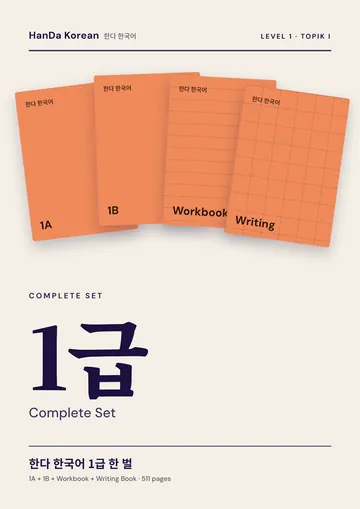 HanDa Korean Level 1 — Complete Set
Everything for level 1 — books, workbook and writing book · 511 pages
$10
HanDa Korean Level 1 — Complete Set
Everything for level 1 — books, workbook and writing book · 511 pages
$10
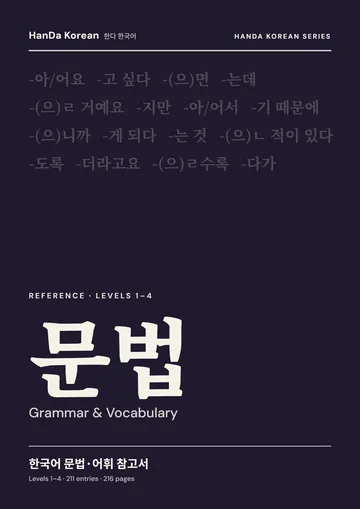 Korean Grammar & Vocabulary Reference
Every pattern in one place · 216 pages
$8
Korean Grammar & Vocabulary Reference
Every pattern in one place · 216 pages
$8
Practice this with an AI tutor
HanDa corrects every sentence you write or say — in real conversation, not flashcards.