Sound Changes in Korean Songs: Singing as Pronunciation Practice
If you can sing along to a Korean song, you have already done the hardest part of Korean pronunciation. You just may not know what you did.
Here is the one idea: Korean is not spelled the way it is said. Hangul writes the shape of a word — the stem keeps its spelling so you can recognise it — and then a small set of rules changes the sound when syllables bump into each other. That gap between spelling and sound is where most learners sound foreign.
Singing closes the gap for you. A sung line is slow, repeated fifty times, and pitched — a held note has nowhere to hide. If you learned a line by ear and then looked at the written lyrics and thought wait, that's not what they're singing, you have already found a sound change. Let's name them.
1. Linking: the final consonant jumps right
The biggest one. When a syllable ends in a consonant and the next one starts with ㅇ (a vowel), the consonant slides over.
| Written | Sounds like |
|---|---|
| 음악 | [으막] |
| 한국어 | [한구거] |
| 눈물이 | [눈무리] |
| 없어요 | [업써요] |
| 꽃이 | [꼬치] |
노래 가사를 한 줄씩 들어요. — I listen to the lyrics one line at a time. (들어요 → [드러요])
Singers stretch these, so you hear it clearly: 눈물이 comes out as three leisurely beats, [눈] [무] [리]. If you say [눈물 이] with a hard stop, a Korean hears a textbook, not a person.
2. ㅎ quietly disappears
When a stem ends in ㅎ, ㄶ or ㅀ and a vowel follows, the ㅎ is simply not pronounced.
- 좋아해요 → [조아해요] — I like it.
- 싫어요 → [시러요] — I don't like it.
- 많이 → [마니] — a lot
- 괜찮아요 → [괜차나요] — It's okay.
저는 이 노래가 제일 좋아요. — I like this song the best. (좋아요 → [조아요])
This is the one beginners get wrong most often, because the ㅎ is sitting right there on the page. Pronouncing it sounds like someone reading aloud rather than talking.
3. ㅂ, ㄷ, ㄱ go nasal before ㄴ and ㅁ
A stop consonant followed by a nasal becomes a nasal itself: ㅂ→ㅁ, ㄷ→ㄴ, ㄱ→ㅇ.
- 입니다 → [임니다]
- 감사합니다 → [감사함니다]
- 믿는 → [민는]
- 끝나다 → [끈나다]
- 한국말 → [한궁말]
감사합니다. 정말 감사합니다. — Thank you. Thank you so much. ([감사함니다])
Every idol says this into a microphone and nobody says [감사합니다] with a crisp ㅂ. If you do, it reads as over-careful, a bit robotic. This rule is not optional or casual — it is the standard pronunciation.
4. ㄴ next to ㄹ becomes ㄹㄹ
- 연락 → [열락] — contact
- 일 년 → [일련] — one year
- 설날 → [설랄] — Lunar New Year
연락 줄게요. — I'll get in touch. (연락 → [열락], 줄게요 → [줄께요])
5. Tense sounds: 갈게요 is [갈께요]
After a stop sound, or after the future-tense -(으)ㄹ, a plain consonant tightens up into its tense twin (ㄱ→ㄲ, ㄷ→ㄸ, ㅂ→ㅃ, ㅅ→ㅆ, ㅈ→ㅉ).
- 학교 → [학꾜]
- 듣고 → [듣꼬]
- 갈게요 → [갈께요]
- 할 수 있어요 → [할 쑤 이써요]
제가 할게요. — I'll do it. ([할께요])
Note the spelling trap: we write 할게요 with a plain ㄱ but say [할께요]. Learners who write 할께요 are spelling what they hear — understandable, but it's wrong on paper. Those -(으)ㄹ forms show up constantly in song titles written in 반말, so you have heard the tense sound hundreds of times.
6. ㅎ + ㄱ/ㄷ/ㅈ = aspirated
When ㅎ meets one of those, they fuse into ㅋ, ㅌ, ㅊ.
- 축하해요 → [추카해요] — Congratulations.
- 좋다 → [조타] — It's good.
- 못해요 → [모태요] — I can't do it.
- 어떻게 → [어떠케] — how
생일 축하해요! — Happy birthday! ([추카해요])
This is also why 어떡해 sounds the way it does — [어떠캐], the squished-together form of 어떻게 해. If those two words still blur together for you, the difference between 어떡해 and 어떻게 is worth ten minutes.
7. ㄷ/ㅌ + 이 → 지/치
- 같이 → [가치] — together
- 굳이 → [구지] — needlessly, if you insist
- 해돋이 → [해도지] — sunrise
같이 가요. — Let's go together. ([가치 가요])
And notice the contrast: 같은 is just [가튼]. The change only happens before 이 or 히.
How to actually practise with a song
- Pick a slow one. A ballad or a mid-tempo chorus. Rap verses are great listening practice but terrible pronunciation practice — too fast to copy accurately.
- Learn one line by ear first. Sing it before you read it. Whatever your ear produces is the real pronunciation.
- Then read the written line and find the mismatches. Every mismatch is one of the seven rules above. Label it.
- Say the line as speech, not song. Same sounds, normal rhythm. This is the step people skip, and it's the one that transfers.
- Record yourself once. Painful, fast, effective.
Two honest cautions
Don't learn intonation from singing. Melody overrides the natural rise and fall of a Korean sentence, and singers stretch vowels wherever the note is long. Take the consonants and the linking from songs; take the sentence melody from interviews, variety shows and live streams.
Singers sometimes over-enunciate on purpose. For emphasis a vocalist may pop a final consonant or separate two syllables that would normally link. If something sounds unusually crisp, assume it's a stylistic choice, not the rule.
And one encouragement: pronunciation practice through singing is low-stakes in a way that conversation is not. Nobody is waiting for your answer. If the moment of freezing up is what stops you from speaking, singing a line out loud in your own room is a real way to get your mouth used to Korean shapes before a person is standing in front of you.
Practice
Write how each word is actually pronounced, in Hangul, and name the rule.
- 음악
- 같이
- 감사합니다
- 갈게요
- 축하해요
- 괜찮아요
Answers
- [으막] — linking (연음)
- [가치] — ㅌ + 이 becomes 치 (구개음화)
- [감사함니다] — ㅂ becomes ㅁ before ㄴ (비음화)
- [갈께요] — tensing after future -(으)ㄹ (경음화)
- [추카해요] — ㄱ + ㅎ fuse into ㅋ (격음화)
- [괜차나요] — ㅎ drops before a vowel
Learn this properly, not just once
Blog posts teach one thing at a time. The HanDa books teach level 1 in order — every lesson built to be spoken, with a workbook and writing book beside it.
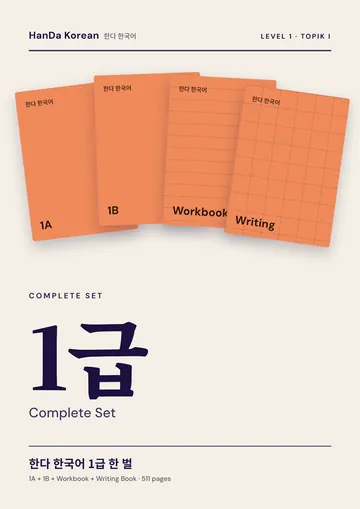 HanDa Korean Level 1 — Complete Set
Everything for level 1 — books, workbook and writing book · 511 pages
$10
HanDa Korean Level 1 — Complete Set
Everything for level 1 — books, workbook and writing book · 511 pages
$10
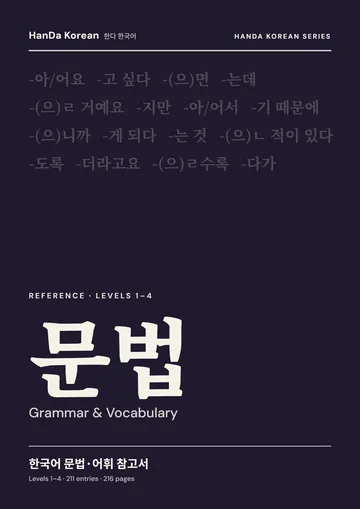 Korean Grammar & Vocabulary Reference
Every pattern in one place · 216 pages
$8
Korean Grammar & Vocabulary Reference
Every pattern in one place · 216 pages
$8
Practice this with an AI tutor
HanDa corrects every sentence you write or say — in real conversation, not flashcards.