9 Korean Grammar Endings in K-pop Song Titles (반말 Explained)

You've probably noticed it without naming it: K-pop song titles are almost never polite. No 요, no 습니다 — just short, bare verb forms. That's 반말, and it's not laziness. It's the song telling you who it's talking to: one person, close enough that no politeness is needed.
That's the whole trick. A title in 해요체 would sound like a message to a coworker. A title in 반말 sounds like something said to a lover, a best friend, or yourself at 2 a.m. And once you can read the ending, you know what the singer is actually doing — begging, promising, asking, confessing. The ending carries the drama.
Below are nine endings that show up in Korean song titles constantly. Each comes with its polite equivalent, because the 반말 versions are for songs and close friends only — not for an idol at a fansign. (More on that at the end.)
1. 보고 싶어 — "I miss you."
The plainest 반말 statement there is: verb stem + -아/어, nothing after it. 보고 싶어요 is the polite version, and that one extra syllable puts a wall between two people. Dropped, the line lands like a thought said out loud to someone right in front of you. This -아/어 ending is the single most common shape for a Korean song title.
2. 가지 마 — "Don't go."
-지 마 is the 반말 negative command; the polite form is 가지 마세요. As a title it's pure begging — you only say 가지 마 to someone you're close to, so the title has already told you the relationship before you hear a note. Note the spacing: 가지 마, two words.
3. 안아 줘 — "Hold me."
-아/어 줘 is a request: do this for me. The polite version is 안아 주세요. 줘 is what makes it a request rather than an order — without it, 안아 is just "hug," flat and strange. You'll see it written both 안아 줘 and 안아줘; both are accepted, and the spaced version is the safer one to copy.
4. 기다릴게 — "I'll wait."
-(으)ㄹ게 is a promise made to a listener. You can't use it alone in an empty room — it only makes sense if someone is there to receive it, so a title like this quietly implies a "you" that's never written. Polite: 기다릴게요. Careful with the spelling — it's 기다릴게, never 기다릴께, even though that's how it sounds.
5. 다시 만나자 — "Let's meet again."
-자 is the 반말 version of "let's," the casual cousin of 만나요 or 만납시다. In a title it sounds like a hand held out — a proposal, not a statement of fact. Among friends, 밥 먹자 ("let's eat") is one of the most-used sentences in Korean, so this ending will serve you far beyond song titles.
6. 괜찮아? — "Are you okay?"
Here's where the question mark does real work. 괜찮아 and 괜찮아? are spelled identically; only the mark (and, in speech, the rising tone) separates "it's okay" — comfort — from "are you okay?" — worry. Korean 반말 questions usually have no special ending at all, so when you see a title ending in -아/어?, read it as a question aimed straight at one person.
7. 같이 갈래? — "Wanna come with me?"
-(으)ㄹ래? asks about the listener's own wish: do you feel like it? Polite: 같이 갈래요? It's lighter and more tempting than 같이 가요, which is closer to "let's go" — 갈래? leaves the door genuinely open, which is exactly the mood a title wants. Said to an elder it would be too casual, so stick to friends.
8. 몰랐어 — "I didn't know."
Past tense 반말: -았/었어, polite 몰랐어요. In titles this ending almost always signals a confession or a regret discovered too late — the song is looking backward. If you want the same realization feeling in conversation, compare how -네요 and -군요 react to something you just noticed.
9. 네가 없어서 — "Because you're not here…"
Some titles stop in the middle of a sentence. -아/어서 means "because," so the grammar promises a result that never arrives, and you're left to finish it yourself. That unfinished feeling is the point. If you're not sure when Korean picks -아서 over -(으)니까, the difference between the two "because" endings is worth twenty minutes of your life — it changes how natural your reasons sound.
Why not just use 요?
Three reasons, and they stack.
Intimacy. Korean marks relationships in every sentence. 보고 싶어요 is warm but spoken across a small distance. 보고 싶어 has no distance at all. A love song with 요 on the end would sound like it's addressed to a polite acquaintance.
Direction. Most of these endings — -ㄹ게, -아 줘, -자, -ㄹ래? — require a listener. The 반말 ending builds a "you" into the title without wasting a word on 너.
Length. Titles and melodies both reward short. 요 is one syllable of nothing.
The part fans get wrong
These lines are beautiful and completely unusable toward an idol. An idol is a stranger and, in the Korean sense of the word, older or senior to you in that moment regardless of age — so 가지 마 shouted at a fansign sounds less like devotion and more like a child talking back. The fan versions are 가지 마세요, 기다릴게요, 보고 싶었어요.
Same rule in writing: a fan letter goes entirely in 해요체. If you want the structure for that, see how to write a K-pop fan letter in Korean. And if the whole 반말 / 해요체 / 합쇼체 split is still foggy, the three speech levels explained side by side is the foundation everything here sits on.
So: learn these endings for reading. Learn their 요 versions for speaking. That's the deal.
Practice
- Make this title-style 반말: 기다려 주세요 → ?
- What's the polite version of 가지 마?
- What is the only difference between 괜찮아 and 괜찮아?
- Turn the invitation 같이 가요 into the casual "wanna go?" form.
- A title ends in -아서 and stops. What is it making you do?
Answers
- 기다려 줘 (also written 기다려줘). The polite -아/어 주세요 becomes 반말 -아/어 줘.
- 가지 마세요. The 반말 command -지 마 takes -지 마세요 in polite speech.
- The question mark — and in speech, rising intonation. 괜찮아 = "it's okay," 괜찮아? = "are you okay?"
- 같이 갈래? -(으)ㄹ래? asks whether the listener feels like it, instead of proposing it outright.
- Finish the sentence yourself. -아/어서 means "because," so the result is left hanging on purpose.
Learn this properly, not just once
Blog posts teach one thing at a time. The HanDa books teach level 1 in order — every lesson built to be spoken, with a workbook and writing book beside it.
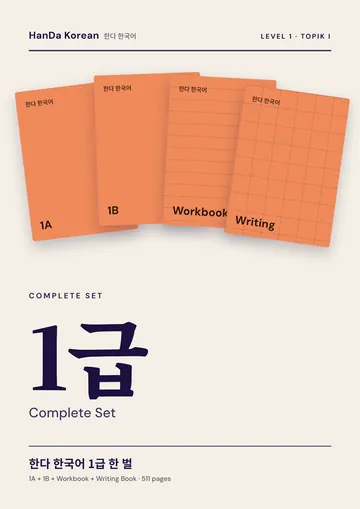 HanDa Korean Level 1 — Complete Set
Everything for level 1 — books, workbook and writing book · 511 pages
$10
HanDa Korean Level 1 — Complete Set
Everything for level 1 — books, workbook and writing book · 511 pages
$10
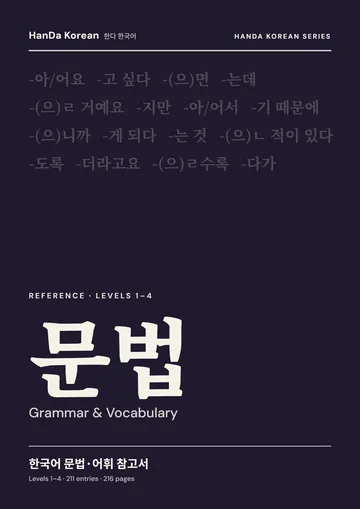 Korean Grammar & Vocabulary Reference
Every pattern in one place · 216 pages
$8
Korean Grammar & Vocabulary Reference
Every pattern in one place · 216 pages
$8
Practice this with an AI tutor
HanDa corrects every sentence you write or say — in real conversation, not flashcards.