9 Korean Words for Noona Romance K-Dramas: 누나, 연하, 썸

In an older-woman/younger-man K-drama, the big romantic turning points often aren't speeches. They're small changes in what the two people call each other and how formally they speak. He stops saying 누나. She drops 존댓말. Subtitles can't show any of that — "noona" becomes her name, or just "hey," and the whole beat disappears.
So here are nine words and lines that carry the noona-romance plot, with what each one actually signals to a Korean ear. All examples are mine, not from any drama.
1. 누나 — "older sister" (said by a male speaker)
누나, 저 진심이에요. — "Noona, I'm serious."
누나 is what a boy or man calls a slightly older woman: his own sister, a friend's sister, a coworker a few years ahead. Note that only male speakers use it — a woman says 언니. In romance, 누나 is the whole problem in two syllables: it's warm and close, but it also files him under "little brother," which is exactly where he doesn't want to be. Like other Korean age-and-rank titles such as 선배 and 후배, it's not optional politeness — it's the default way to refer to her at all.
2. 연하 — someone younger than you (and 연상, someone older)
그 사람 저보다 세 살 연하예요. — "He's three years younger than me."
연하 and 연상 are the neutral, slightly grown-up words for "younger" and "older" in a dating context. You'll hear 연하남 (younger guy), 연상녀 (older woman), and 연상연하 커플 for the pair. Saying 저는 연하가 좋아요 ("I like younger guys") sounds like an adult stating a preference — a bit more self-aware than just saying he's young.
3. 나이 차 — age gap
우리 나이 차가 많이 나요. — "There's a big age gap between us."
The verb is 나다: 나이 차가 나다, "an age gap exists." To ask, Koreans say 몇 살 차이예요? — "How many years apart are you?" When a character says 나이 차가 많이 나서... and trails off, she's not talking about numbers; she's talking about what people will say. That's usually the real obstacle in these dramas.
4. 누나 동생 사이 — "just an older-sister-and-younger-brother thing"
우리 그냥 누나 동생 사이잖아. — "We're just like an older sister and a younger brother."
This is the classic keep-him-in-his-place line. 사이 means "relationship, the space between two people," and 잖아 means "you know this already" — so it lands as come on, you know what we are. To a Korean ear it's not cold, it's evasive: she's using the safe label to avoid naming the other thing.
5. 동생 같아 — "you feel like a little brother to me"
난 네가 그냥 동생 같아. — "To me you're just like a younger brother."
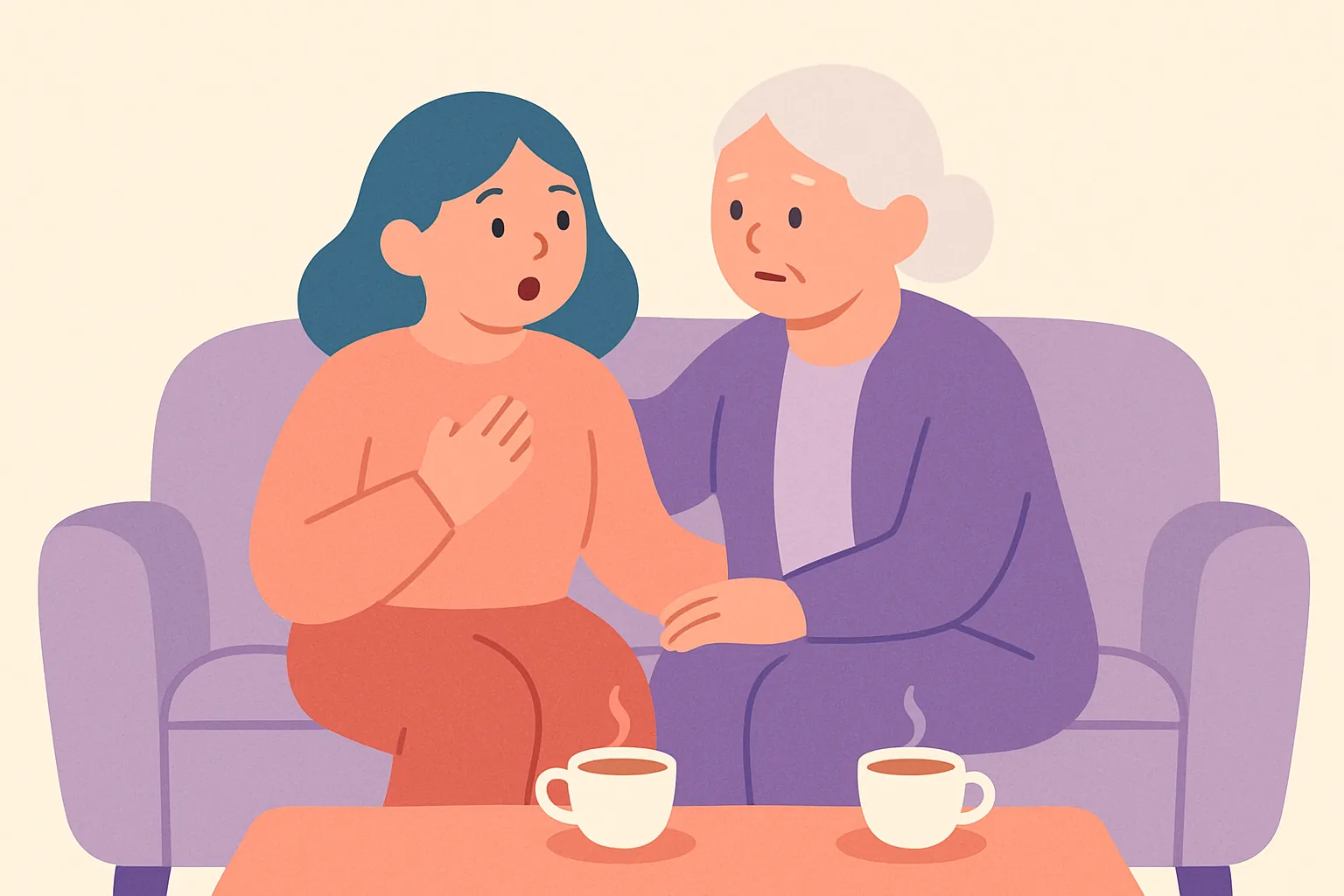
Said after a confession, this is a rejection — a gentle one, because it praises the closeness while refusing the romance. Notice 네가: she's speaking 반말 (casual speech) to him, as an older person normally would, while he's likely still on 존댓말. That mismatch is audible in every line they exchange, and it's the thing that changes if they get together.
6. 말 편하게 하세요 — "speak casually with me"
저한테 말 편하게 하세요. — "Please speak casually to me."
Literally "speak comfortably," this is how you invite someone to drop 존댓말 and use 반말. The older person can also announce it: 이제 말 놓을게 ("I'll speak casually to you from now on"). In a noona romance, watch who offers this and when — permission to use 반말 is permission to be close, and if he suddenly uses 반말 without being offered it, that's a deliberate move, not a mistake.
7. 이름 불러도 돼요? — "can I call you by your name?"
누나 말고 이름 불러도 돼요? — "Can I call you by your name instead of 누나?"
This is the single most loaded question in the genre. Dropping 누나 for her name removes the sibling frame and puts them on level ground — which is intimate enough in Korean that asking is a kind of confession. English can't carry it, because in English he was calling her by her name the whole time anyway. For more of these gaps, see Korean words with no real English equivalent.
8. 썸 타다 — to be in the almost-dating stage
너희 둘 썸 타는 거 아니야? — "Aren't you two kind of a thing?"
썸 (from English "something") is that stretch where you text every night and nobody has said anything out loud. The verb is 타다, "to ride": 썸을 타다. The people involved are 썸남 and 썸녀. It's casual, everyday speech — friends tease you with it, and it works in this genre because a 누나 and a 동생 can spend a long time there without admitting anything.
9. 고백하다 / 사귀다 — to confess, and to date
어제 고백했어. — "I told her I like her yesterday."
우리 사귀는 거예요? — "So... are we dating?"
고백 sounds dramatic in translation ("confession"), but in Korean it's the ordinary word for telling someone you have feelings for them — a high schooler and a thirty-year-old both use it. 사귀다 is "to go out with, to be a couple," and asking 우리 사귀는 거예요? is the moment the relationship gets a name. Two notes: the polite form is 사귀어요 (you'll hear it shortened to 사겨요 in fast speech, but write 사귀어요), and Koreans really do ask this out loud — a Korean couple usually has a clear start date, so the question isn't awkward the way it can feel in English.
How the whole arc sounds in Korean
Put together, the progression is roughly: he says 누나 + 존댓말 → she says 우리 누나 동생 사이잖아 → 썸 → 고백 → he asks 이름 불러도 돼요? → 반말 both ways. If you can hear which stage a scene is at from the 호칭 and the speech level alone, you're listening to the drama the way a Korean viewer does. The same trick works in drinking scenes, where who pours for whom says everything.
Practice
- A man wants to address a woman two years older than him. 누나 or 언니?
- Fill in: 우리 ___ 많이 나요. ("We have a big age gap.")
- Someone says 저한테 말 편하게 하세요. What are they asking you to do?
- How do you ask "How many years apart are you?" in Korean?
- Which line is a gentle rejection: 우리 사귀는 거예요? or 난 네가 그냥 동생 같아?
Answers
- 누나 — male speakers say 누나, female speakers say 언니.
- 나이 차가 (우리 나이 차가 많이 나요.)
- To stop using 존댓말 and speak to them in 반말.
- 몇 살 차이예요?
- 난 네가 그냥 동생 같아 — "you're like a little brother to me."
Practice this with an AI tutor
HanDa corrects every sentence you write or say — in real conversation, not flashcards.