10 Korean Animal Words and the Sounds They Make
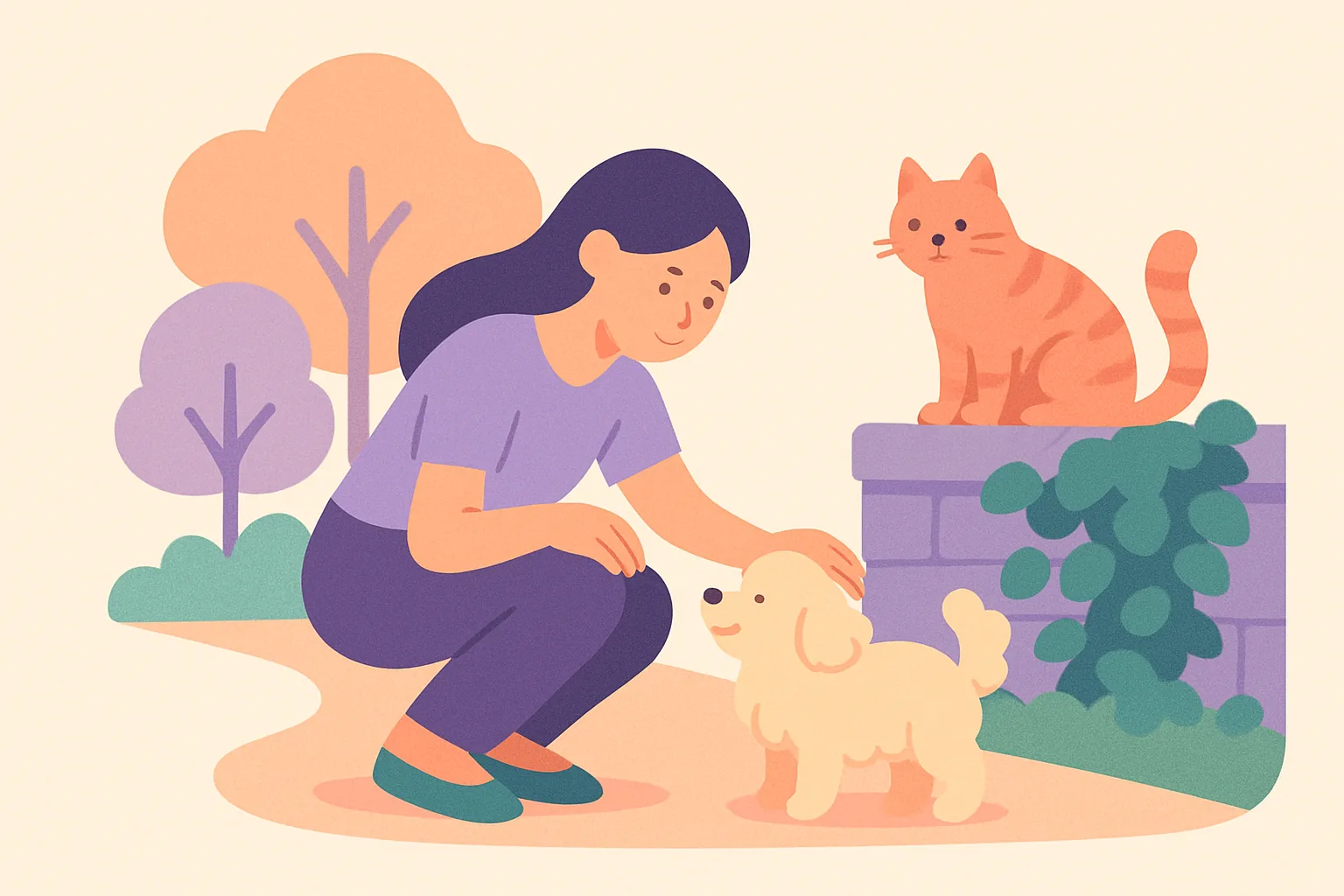
Quick answer: Dog in Korean is 강아지 (gangaji) and cat is 고양이 (goyangi). Korean dogs say 멍멍, cats say 야옹, pigs say 꿀꿀, and tigers say 어흥 — the sounds are different from English ones, and Koreans use them constantly when talking to children, pets, or just being playful.
Animal words are some of the first nouns learners pick up, partly because they show up everywhere: in pet talk, in idioms, in the way parents speak to kids, in teasing between friends. But a dictionary will tell you 개 = dog and stop there, which is how learners end up saying something a little off. Below are ten animal words, the sound each one makes in Korean, and the nuance that comes with them. If you're brand new to the language, it may help to have the very first Korean phrases under your belt first.
1. 강아지 — dog (멍멍!)
강아지가 멍멍 짖어요. — The dog is barking.
Technically 강아지 means "puppy" and 개 means "dog," but in real life Koreans call almost any pet dog 강아지, even a large elderly one. 개 is the neutral dictionary word and sounds blunt when you're talking about someone's beloved pet — and calling a person 개 is a serious insult, so keep 강아지 as your default. The bark itself is 멍멍, and a cute nickname for a dog is 멍멍이.
2. 고양이 — cat (야옹!)
고양이가 야옹 하고 울어요. — The cat is meowing.
Note that Korean uses 울다 (to cry) for animal sounds, not a separate verb like "meow" — 새가 울어요, 고양이가 울어요. Affectionate nicknames include 냥이 and 야옹이, and cat owners jokingly call themselves 집사 ("butler"), because the cat is clearly the boss. To ask if someone has a pet: 고양이 키워요? — Do you have a cat? The verb 키우다 (to raise) is what Koreans use for pets.
3. 토끼 — rabbit (깡충깡충)
토끼가 깡충깡충 뛰어요. — The rabbit is hopping along.
Korean doesn't really give rabbits a voice — instead it gives them a movement word. 깡충깡충 is the sound-feel of light hopping, and it's one of the most beloved little words in the language. You can use it for a child skipping happily too: 아이가 깡충깡충 뛰어요.
4. 호랑이 — tiger (어흥!)
옛날 옛날에 호랑이가 살았어요. — Long, long ago, there lived a tiger.
Every Korean kid grows up hearing 어흥, the tiger's roar, and 옛날 옛날에 is how folk tales open. 호랑이 also lives on in daily speech: a 호랑이 선생님 is a strict, scary teacher, and 호랑이 같다 describes someone frightening to be around. 우리 담임 선생님은 호랑이 선생님이에요. — Our homeroom teacher is a real tiger.
5. 돼지 — pig (꿀꿀)
돼지저금통에 동전을 모아요. — I save coins in a piggy bank.
The oink is 꿀꿀. Culturally, pigs are lucky in Korea — dreaming of a pig is considered a good-fortune dream, and a 돼지저금통 is the standard piggy bank. But be careful with people: calling someone 돼지 is a real insult about their weight, and even as a joke between close friends it can sting. Don't try it on a Korean ear you don't know well.
6. 소 — cow (음메)
할머니 댁에서 소를 키워요. — They keep cows at my grandmother's house.
The moo is 음메. One useful habit: Korean puts 고기 (meat) after the animal, so 소고기 is beef, 돼지고기 is pork, and 닭고기 is chicken meat. Korean-raised beef is called 한우, and you'll see that word on restaurant signs constantly.
7. 닭 — chicken (꼬끼오)
오늘 저녁에 치킨 시킬까요? — Shall we order fried chicken tonight?
The rooster crows 꼬끼오, and a chick says 삐약삐약. Here's the distinction that trips learners up: 닭 is the bird and the raw meat (닭갈비, 삼계탕), while 치킨 means fried chicken, the delivery kind. Ordering "닭 시킬까요?" sounds like you want a live bird. Also, 닭 is pronounced [닥] — the ㄹ is silent, and 닭고기 comes out [닥꼬기], which is the kind of thing Korean spelling hides from you.
8. 새 — bird (짹짹)
아침에 새소리가 들려요. — I can hear birdsong in the morning.
짹짹 is the little chirp of a sparrow, and it's the default bird sound. 새소리 (bird + sound) is a normal everyday noun — Koreans build a lot of words this way: 빗소리 (the sound of rain), 발소리 (footsteps).
9. 개구리 — frog (개굴개굴)
저는 우물 안 개구리였어요. — I was a frog in a well.
개굴개굴 is the croak, and 개구리 shows up in one of the most-used Korean sayings: 우물 안 개구리, a frog in a well — someone who thinks their small world is the whole world. Koreans often say it about themselves after traveling or meeting people more experienced than them, so it lands as modest rather than rude.
10. 여우 and 곰 — fox and bear (the personality pair)
그 사람은 좀 곰 같아요. — He's a bit of a bear.
These two have no famous sound, but they have famous meanings. 곰 같다 means slow on the uptake — especially someone who can't tell that another person likes them. 여우 같다 means clever and a little calculating, usually said about a woman, sometimes playfully and sometimes not. Both are teasing words, so use them only with friends; with a stranger, they sound like a judgment.
A few more animal sounds
| Animal | Korean | Sound |
|---|---|---|
| mouse | 쥐 | 찍찍 |
| duck | 오리 | 꽥꽥 |
| horse | 말 | 히힝 |
| chick | 병아리 | 삐약삐약 |
One more thing about 우리 강아지
Koreans say 우리 강아지 — "our puppy" — to real dogs, but also to small children, the way English speakers might say "sweetie." A grandmother saying 우리 강아지, 밥 먹었어? to a five-year-old is being tender, not confused. This 우리 ("our") instead of "my" is the same instinct you see in Korean family words like 우리 엄마 and 우리 집 — Korean prefers the shared version of a thing.
FAQ
How do you say "dog" in Korean?
강아지 is what Koreans actually say for a pet dog, no matter its age. 개 is the technical word for "dog" and appears in compounds and writing, but calling a person 개 is an insult, so stick with 강아지 in conversation.
What sound does a dog make in Korean?
멍멍. A bigger or sharper bark can be 왈왈. The verb for barking is 짖다, so a full sentence would be 강아지가 멍멍 짖어요 — "the dog is barking."
What's the difference between 닭 and 치킨?
닭 is the bird itself and the meat used in Korean dishes like 삼계탕 and 닭갈비. 치킨 is the loanword and means fried chicken — the delivery-and-beer kind. If you want to order fried chicken, say 치킨.
Practice
Fill in the blank with a word from this article.
- 고양이가 ______ 하고 울어요. (meow)
- 토끼가 ______ 뛰어요. (hopping)
- 우리 반 선생님은 ______ 선생님이에요. (strict teacher)
- 오늘 저녁에 ______ 시킬까요? (order fried chicken)
- 저는 ______ 안 개구리였어요. (a frog in a well)
Answers
- 야옹 — 고양이가 야옹 하고 울어요.
- 깡충깡충 — 토끼가 깡충깡충 뛰어요.
- 호랑이 — 우리 반 선생님은 호랑이 선생님이에요.
- 치킨 — 오늘 저녁에 치킨 시킬까요?
- 우물 — 저는 우물 안 개구리였어요.
Learn this properly, not just once
Blog posts teach one thing at a time. The HanDa books teach level 1 in order — every lesson built to be spoken, with a workbook and writing book beside it.
 HanDa Korean Level 1 — Complete Set
Everything for level 1 — books, workbook and writing book · 511 pages
$10
 Korean Grammar & Vocabulary Reference
Every pattern in one place · 216 pages
$8
Practice this with an AI tutor
HanDa corrects every sentence you write or say — in real conversation, not flashcards.