Q1
부교수
What does this word mean?
lifelong education
Office of Education
competency education
associate professor
부교수 — associate professor (education)
Q2
extraordinary loss
How do you say this in Korean?
주주
플랫폼
특별손실
에이전시
특별손실 — extraordinary loss (business)
Q3
평가혁신
What does this word mean?
doctorate
assessment innovation
private tutoring
curriculum
평가혁신 — assessment innovation (education)
Q4
exclusive
How do you say this in Korean?
싱글
보도
단독
시청률
단독 — exclusive (media)
Q5
옥상정원
What does this word mean?
blue hydrogen
downcycling
hydropower
rooftop garden
옥상정원 — rooftop garden (environment)
Q6
motivation
How do you say this in Korean?
봉사
소개
비전
동기부여
동기부여 — motivation (relationships_social)
Q7
촉진하다
What does this word mean?
to break ground
to cause
to advertise
to promote/facilitate
촉진하다 — to promote/facilitate (verbs)
Q8
cellphone
How do you say this in Korean?
핸드폰
가구점
정육점
대형마트
핸드폰 — cellphone (shopping_money)
Q9
Say that because the weather was bad, the flight was cancelled.
Which sentence says this correctly?
선생님이 기말시험이 다음 주라고 하셨어요.
날씨가 나빴기 때문에 비행기가 취소됐어요.
저한테는 반말해도 돼요.
가족을 위해 저녁을 만들어 줬어요.
-기 때문에 — because (of) — formal reason. 동사/형용사 어간 + 기 때문에
Q10
-냐고 하다
What does this grammar pattern mean?
used to; would habitually
reported speech – question
while / simultaneously
formal polite imperative
-냐고 하다 (간접화법 의문) — reported speech – question. e.g. 선생님이 숙제를 다 했냐고 물어보셨어요. (The teacher asked whether I had finished all my homework.)
Q11
-(으)ㄹ 거예요
What does this grammar pattern mean?
reported speech (say that)
be doing (now)
while / simultaneously
will / be going to
-(으)ㄹ 거예요 — will / be going to. e.g. 내일 친구를 만날 거예요. (I'm going to meet a friend tomorrow.)
Q12
can / cannot
Which Korean grammar pattern expresses this?
보이다
-(으)려면
-는데
-(으)ㄹ 수 있다/없다
-(으)ㄹ 수 있다/없다 — can / cannot. e.g. 저는 수영을 할 수 있어요. (I can swim.)
Q13
-다고 하다
What does this grammar pattern mean?
reported speech (past)
future/prospective noun modifier
go in order to
lexical passive
-다고 하다 — reported speech (past). e.g. 뉴스에서 그 회사가 문을 닫았다고 했어요. (The news said that company closed down.)
Q14
Point out the child playing near the fountain to your friend.
Which sentence says this correctly?
친구가 오늘 늦는다고 했어요.
저기 분수 근처에서 놀고 있는 아이 보여요?
시험 전날이니까 오늘 밤에 충분히 자야 해요.
한국 음식이 일본 음식보다 매워요.
-는 관형형 복습 (현재 진행 강조) — present progressive modifier. -고 있는: 진행 강조; -는: 일반 현재 수식 모두 관형형 가능
주말에 한 일
What I Did on the Weekend
지난 주말에 저는 친구를 만났어요. 우리는 같이 영화를 봤어요. 영화를 보고 나서 커피를 마셨어요. 저녁에는 맛있는 불고기를 먹었어요. 집에 오면서 이야기를 많이 했어요. 정말 즐거운 하루였어요. 주말 weekend · 만나다 to meet · 영화 movie · 마시다 to drink · 불고기 bulgogi · 이야기 talk, story · 즐겁다 to be enjoyable
Q15
집에 오면서 이야기를 많이 했어요.
What does this sentence from the passage mean?
Nolbu imitated him, but bugs came out of his gourd and he was punished.
We talked a lot while coming home.
This line is convenient because you can go from Gangnam to Incheon directly.
In Korean, there are polite speech and casual speech.
집에 오면서 이야기를 많이 했어요. = We talked a lot while coming home.
Q16
우리는 같이 영화를 봤어요.
What does this sentence from the passage mean?
I'm excited because they say the new neighborhood's environment is nice.
The price was cheap too, so there was no burden.
We watched a movie together.
It takes about five minutes on foot.
우리는 같이 영화를 봤어요. = We watched a movie together.
Q17
저녁에는 맛있는 불고기를 먹었어요.
What does this sentence from the passage mean?
These days, Koreans use the internet a lot.
In the evening we ate delicious bulgogi.
The government announced various policies to expand tourism infrastructure.
After listening to my friend, my heart felt much lighter.
저녁에는 맛있는 불고기를 먹었어요. = In the evening we ate delicious bulgogi.
Q18
마시다
What does this word mean in the passage?
charging
High Court
hardware
to drink
마시다 (ma-si-da) — to drink
Q19
주말
What does this word mean in the passage?
guesthouse
to be tacky/unsophisticated
weekend
groundbreakingly
주말 (ju-mal) — weekend
Q20
Which sentence does NOT appear in the passage above?
영화를 보고 나서 커피를 마셨어요.
뜨거울 때 밥과 함께 먹으면 정말 맛있어요.
우리는 같이 영화를 봤어요.
집에 오면서 이야기를 많이 했어요.
"뜨거울 때 밥과 함께 먹으면 정말 맛있어요." (When it's hot, eating it with rice is really delicious.) is from a different passage.
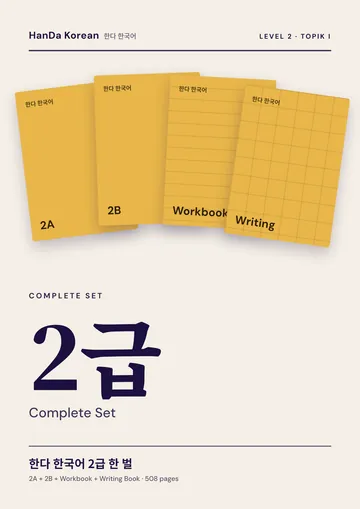 HanDa Korean Level 2 — Complete Set
Complete level 2 — student books, workbook and writing book · 508 pages
$10
HanDa Korean Level 2 — Complete Set
Complete level 2 — student books, workbook and writing book · 508 pages
$10
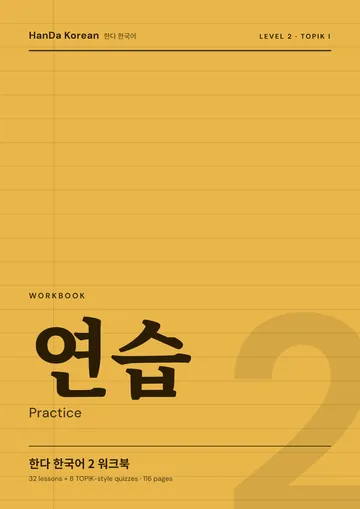 HanDa Korean 2 Workbook
Extra drilling on the same lessons · 116 pages
$6
HanDa Korean 2 Workbook
Extra drilling on the same lessons · 116 pages
$6
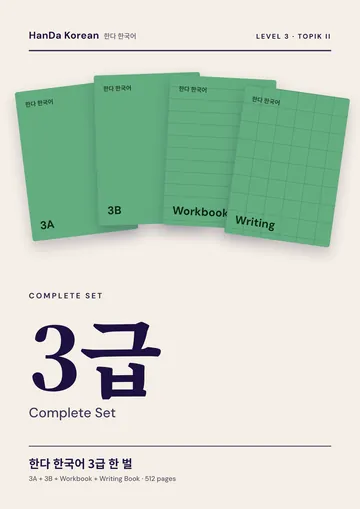 HanDa Korean Level 3 — Complete Set
Complete level 3 — student books, workbook and writing book · 512 pages
$10
HanDa Korean Level 3 — Complete Set
Complete level 3 — student books, workbook and writing book · 512 pages
$10
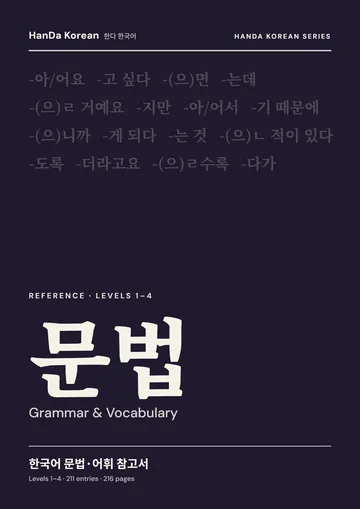 Korean Grammar & Vocabulary Reference
Every pattern from level 1 to 6 in one book · 216 pages
$8
Korean Grammar & Vocabulary Reference
Every pattern from level 1 to 6 in one book · 216 pages
$8
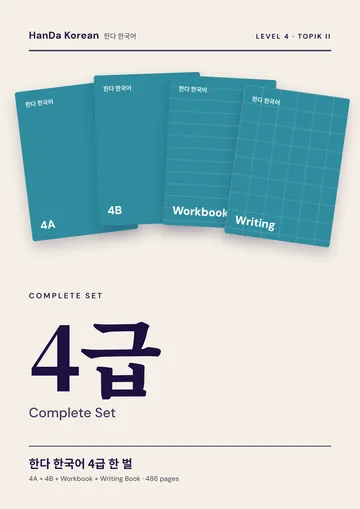 HanDa Korean Level 4 — Complete Set
Complete level 4 — student books, workbook and writing book · 486 pages
$10
HanDa Korean Level 4 — Complete Set
Complete level 4 — student books, workbook and writing book · 486 pages
$10