What Is a Fan Chant (응원법)? K-pop Korean Explained

If you've watched a concert clip and wondered how ten thousand people all knew to shout the same thing at the same half-second — that's 응원법.
Here's the one idea to walk away with: 응원법 is not spontaneous cheering. It's a script. It gets written down, published, practiced at home, and performed. Korean fans treat it the way a choir treats sheet music. Once you understand that, a lot of fan behavior — and a lot of fan vocabulary — suddenly makes sense.
Breaking the word apart
응원 means cheering, rooting for someone, support. 법 here means method, the way of doing something.
So 응원법 is literally the method of cheering — the official, agreed-on way to support a song.
That 법 is a useful little piece. It attaches to nouns all over the language:
| Word | Method of… | Meaning |
|---|---|---|
| 사용법 | using | instructions, how to use |
| 공부법 | studying | study method |
| 요리법 | cooking | recipe |
| 응원법 | cheering | fan chant |
One pronunciation note: in words like these, 법 comes out tense — 응원법 sounds like [응원뻡], 사용법 like [사용뻡]. If that surprises you, it's the same family of changes covered in why 국물 sounds like 궁물.
And 응원하다 on its own is an everyday verb, not a fandom word. You can say it to a friend before a job interview:
응원할게요! — I'll be rooting for you!
No shouting involved. It just means I'm on your side.
What's actually inside an 응원법
A typical fan chant has a few standard parts. You don't need to memorize the structure — you need the words fans use to talk about the parts.
1. 이름 콜 (the name call). Near the start of the song, fans shout the members' names in a fixed order. The order is set, everyone follows it, and getting it wrong is the classic rookie mistake.
팬들이 멤버 이름을 순서대로 외쳐요. — Fans shout the members' names in order.
2. 구호 (the chant lines). Short shouted phrases dropped into gaps in the music. The verb that goes with 구호 is 외치다 (to shout out), not 부르다:
다 같이 구호를 외쳐요. — Everyone shouts the chant together.
3. 떼창 (the mass singalong). 떼 means a crowd, a swarm; 창 is singing. It's the part where the whole hall sings the chorus with the artist.
어제 콘서트 떼창 소리가 진짜 컸어요. — The crowd singalong at yesterday's concert was really loud.
4. 응원봉 (the light stick). 봉 means stick, rod. Not decoration — the colors are often synced, so it's part of the same coordinated system.
응원봉 챙겼어요? — Did you bring your light stick?
The Korean fans actually say about it
The verb you'll hear most with 응원법 is 외우다 (to memorize). Not learn, not practice — memorize. That tells you everything about how it's treated.
응원법 외웠어요? — Have you memorized the fan chant?
저는 아직 다 못 외웠어요. — I haven't memorized all of it yet.
이 노래는 응원법이 좀 어려워요. — The fan chant for this song is a bit hard.
콘서트 가기 전에 연습했어요. — I practiced before going to the concert.
어제 너무 소리 질러서 목이 쉬었어요. — I shouted so much yesterday that my voice went hoarse.
A few word choices worth getting right:
- 응원법 vs 응원가. 응원가 is a cheer song — the kind a sports crowd sings. For K-pop, the word is 응원법. Using 응원가 for an idol chant sounds slightly off, like calling a recipe a cookbook.
- 공식 응원법 means the official fan chant — the version released by the company or the fan club, as opposed to whatever a crowd makes up on its own. 공식 = official.
- 팬송 is a fan song — a song written for fans. Different thing entirely.
Why chants are in 반말
Here's the bit that confuses polite learners. Fan chants are almost always in the plainest form of Korean — 사랑해 rather than 사랑해요, 최고 rather than 최고예요.
That's not rudeness. Two reasons:
Rhythm. A chant has to land in a gap of maybe half a second. 사랑해 is three beats. 사랑합니다 is five and arrives late. Shouted Korean strips endings the same way English chants drop words.
Distance. A stadium chant isn't a conversation with one person. It's a crowd making noise toward a stage, so the usual calculation about politeness levels doesn't really apply. If you're unclear on why that calculation exists in the first place, the three speech levels is the piece to read.
The flip side matters more for you: when you actually speak to a Korean person about any of this, go back to 해요체. Shouting 사랑해 into a crowd is normal. Saying 사랑해 to a fan you just met at the merch line is not.
(to a stranger at a concert) 응원법 좀 알려 주세요. — Could you teach me the fan chant?
That's the polite version, and it's the one that will get you a friendly answer.
What fans shout when there's no chant
Outside the scripted parts, crowds still make noise — and these are the short exclamations you'll hear, all of them ordinary Korean compliments turned up loud:
잘한다! — You're so good! (literally does it well)
최고! — The best!
진짜 예쁘다! — So pretty!
Notice 잘한다 and 예쁘다 in that plain 한다 form — that's the shape Korean takes when you're reacting out loud rather than talking to someone. The same words in a normal conversation would be 잘하네요, 예쁘네요. If you want the polite, one-on-one versions of these, Korean compliment phrases has the full set.
And 파이팅 — yes, from English fighting — is the all-purpose Korean shout of encouragement. 파이팅 is the standard spelling; you'll see 화이팅 constantly too. Both are said.
One learner mistake to avoid
Don't say 응원법을 불러요. 부르다 is for singing songs, and an 응원법 isn't a song — it's a set of shouts layered over someone else's song. Use these instead:
| ✗ Awkward | ✓ Natural |
|---|---|
| 응원법을 불러요 | 응원법을 외워요 (memorize it) |
| 응원법을 말해요 | 구호를 외쳐요 (shout the chant) |
| 노래를 외쳐요 | 노래를 따라 불러요 (sing along) |
That last one is worth keeping: 따라 부르다 = to sing along. 따라 means following.
후렴은 다 같이 따라 불러요. — For the chorus, everyone sings along.
Practice
- Translate: Have you memorized the fan chant?
- What's the Korean word for a light stick?
- A crowd all singing the chorus together — one word?
- Fix this: 응원법을 불렀어요.
- 사용 + 법 = ? What does it mean?
Answers
- 응원법 외웠어요? (or fuller: 응원법 다 외웠어요? / more polite: 응원법 외우셨어요?)
- 응원봉
- 떼창
- 응원법을 외웠어요. (memorized it) or 구호를 외쳤어요. (shouted the chant) — 부르다 is for singing actual songs.
- 사용법 — instructions, how to use something. Same 법 as in 응원법: the method of doing X.
Learn this properly, not just once
Blog posts teach one thing at a time. The HanDa books teach level 1 in order — every lesson built to be spoken, with a workbook and writing book beside it.
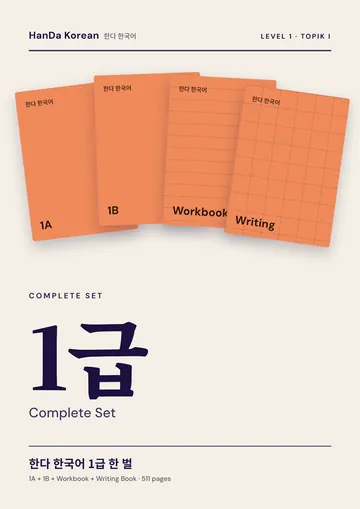 HanDa Korean Level 1 — Complete Set
Everything for level 1 — books, workbook and writing book · 511 pages
$10
HanDa Korean Level 1 — Complete Set
Everything for level 1 — books, workbook and writing book · 511 pages
$10
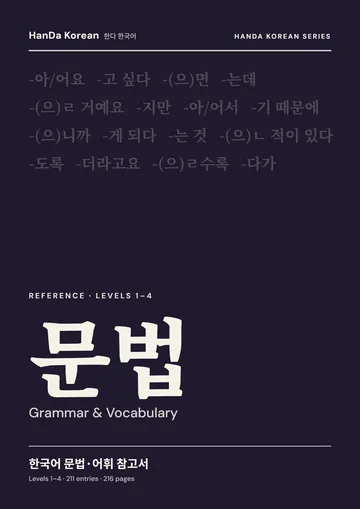 Korean Grammar & Vocabulary Reference
Every pattern in one place · 216 pages
$8
Korean Grammar & Vocabulary Reference
Every pattern in one place · 216 pages
$8
Practice this with an AI tutor
HanDa corrects every sentence you write or say — in real conversation, not flashcards.