9 Korean Food Words on Every Menu: 밥, 국, 찌개, 반찬
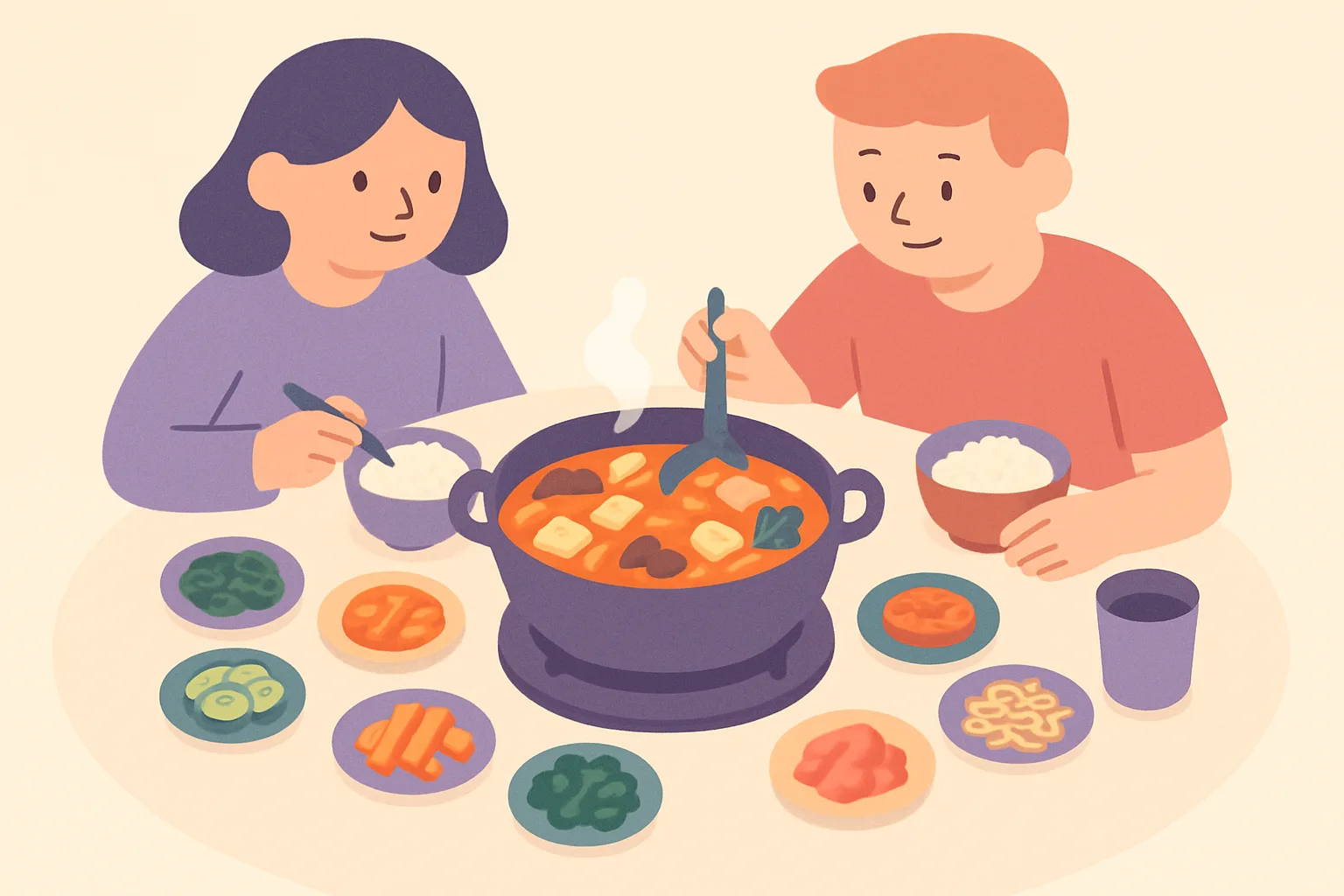
Quick answer: 밥 (bap) is cooked rice and also the word for "a meal." 국 is a light soup served in your own bowl, 찌개 (jjigae) is a thicker, saltier stew the whole table shares, 반찬 are the small side dishes that come free with your meal, and 김치 is a whole family of fermented vegetables, not one single dish. Korean menus are usually grouped by cooking method — 구이 (grilled), 볶음 (stir-fried), 찜 (braised), 탕 (soup) — rather than by appetiser and main.
The one idea to take away: a Korean meal is not one plate. It's rice plus something wet plus a spread of small dishes, and the menu is written for people who already assume that. Once you know these nine words, almost any Korean menu becomes readable — even the handwritten ones on the wall.
1. 밥 — cooked rice, and also "a meal"
밥 먹었어요? — "Have you eaten?"
밥 is white rice in a small metal bowl, but it also means food in general, the way "bread" once did in English. That's why the most common Korean greeting between friends and family isn't about the weather — it's 밥 먹었어요? It's not really a question about rice. It means are you okay, are you looking after yourself, and a simple 네, 먹었어요 is a complete answer.
2. 반찬 — the small side dishes that come with the meal
반찬 좀 더 주세요. — "Some more side dishes, please."
반찬 are the little plates that appear before you've ordered anything: kimchi, seasoned spinach, braised potatoes, pickled radish. At most ordinary restaurants they're free and refillable, and asking for more is completely normal — no one will think you're being greedy. Add 좀 to soften the request; 반찬 좀 더 주세요 sounds friendly, while 반찬 더 주세요 alone can land a bit blunt.
3. 김치 — a category, not one dish
김치 좀 더 주시겠어요? — "Could I have a little more kimchi?"
English treats 김치 as a single food. Korean treats it as a genus. 배추김치 is the napa cabbage one everyone pictures, 깍두기 is cubed radish kimchi (the standard partner for soup dishes), and 물김치 is a cold, watery, barely spicy version that works like a palate cleanser. If someone asks 무슨 김치예요? they are asking which kind, not whether it's kimchi.
4. 국 — light soup, and you get your own bowl
국물이 시원해요. — "The broth is refreshing."
국 is the thin soup that arrives beside your rice: 미역국 (seaweed), 콩나물국 (bean sprout), 된장국. Each person gets their own bowl, and it's there to make the rice go down, not to be the star. Note that Koreans call a hot, clear broth 시원하다 — literally "cool," but used for the clean, lets-out-a-sigh feeling a good broth gives. If you want more ways to react to food, these taste words go well beyond 맛있어요.
5. 찌개 — thick, salty stew that the table shares
김치찌개 2인분 주세요. — "Kimchi stew for two, please."
찌개 has less liquid than 국, more salt, and more stuff in it — tofu, pork, kimchi, chilli paste. It comes in one pot in the middle of the table and everyone eats from it with their own spoon. Because it's shared, you usually order it by the portion (2인분, 3인분) rather than one per person. If you'd rather not share a pot, say 따로 주실 수 있어요? ("Could we have it separately?") — some places will, some won't.
6. 탕 and 전골 — the big soup dishes that are the meal
삼계탕 한 그릇 주세요. — "One ginseng chicken soup, please."
When 탕 is in the name — 삼계탕, 설렁탕, 감자탕, 매운탕 — the soup is the main event, not a side. 전골 is the one cooked on a burner at your table, where raw ingredients arrive and come to a boil in front of you. A useful rule of thumb for menus: 국 comes with rice, 탕 is ordered as the dish, and 전골 is ordered for the table.
7. 구이 · 볶음 · 찜 · 튀김 — how the menu is grouped
이 집은 제육볶음이 맛있어요. — "This place's spicy stir-fried pork is good."
Korean menu headings are usually cooking methods stuck to an ingredient. 구이 is grilled, 볶음 is stir-fried, 찜 is steamed or braised, 튀김 is deep-fried, 무침 is tossed with seasoning. So 고등어구이 is grilled mackerel, 오징어볶음 is stir-fried squid, 갈비찜 is braised short ribs. Learn these five endings and you can decode a dish you've never seen.
8. 정식 and 백반 — the set meal
생선구이 정식 하나 주세요. — "One grilled fish set meal, please."
정식 means a set: a main dish plus rice, soup and a full row of 반찬, for one fixed price. 백반 is the homier, cheaper version — essentially "today's home cooking with rice," often with no choice of main at all. Ordering 정식 or 백반 is the single easiest thing to do in a small neighbourhood restaurant, and it's how you get the widest spread of side dishes.
9. 1인분 and 공깃밥 — ordering by portion, adding rice
공깃밥 하나 추가해 주세요. — "One more bowl of rice, please."
인분 means "portion per person," and grilled meat and stew are priced that way. Many places have a minimum, so it's worth asking 1인분도 되나요? ("Can I order just one portion?") if you're eating alone. 공깃밥 is a bowl of rice ordered separately — at barbecue places rice is almost never included, and you order it at the end. When you want anything extra, the word is 추가: 공깃밥 추가, 고기 추가, 라면 사리 추가. More restaurant lines are in these 10 phrases for ordering food.
One more thing about menu layout
Many restaurants split the menu into 식사 (rice-based meals) and 안주 (dishes meant to go with drinks). If you sit down at lunchtime and order from the 안주 column, nobody will stop you, but you may get a plate of fried chicken and no rice. Look for 식사 when you want a proper meal. And if a price column says 시가, it means market price — ask before ordering. For getting to the restaurant in the first place, these travel phrases cover the basics.
FAQ
What is the difference between 국 and 찌개 in Korean?
국 is a thin soup served in an individual bowl alongside your rice, mild enough to drink on its own. 찌개 is thicker, saltier and comes in one pot for the whole table to share. As a rough guide, you drink 국 and you eat 찌개 with rice.
Are Korean side dishes (반찬) free?
At most everyday Korean restaurants, yes — 반찬 come automatically with your meal and refills are free. Just say 반찬 좀 더 주세요. A few items, like extra meat or a special dish, may be charged; the menu will say so.
What does 1인분 mean on a Korean menu?
1인분 means "one portion," the amount intended for one person. Meat and stew are usually priced per 인분, and some dishes have a two-portion minimum. To check, ask 1인분도 되나요?
Practice
- You want one more bowl of rice at a barbecue place. What do you say?
- Your table wants kimchi stew for two people. Say it in Korean.
- The side dishes are gone and you'd like more. Ask politely.
- A menu says 갈비찜. What cooking method is that?
- You're eating alone and the stew seems to be for two. Ask if one portion is possible.
Answers
- 공깃밥 하나 추가해 주세요. — "One more bowl of rice, please."
- 김치찌개 2인분 주세요. — "Kimchi stew for two, please."
- 반찬 좀 더 주세요. — "Some more side dishes, please."
- 찜 = steamed or braised, so 갈비찜 is braised short ribs.
- 1인분도 되나요? — "Can I order just one portion?"
Learn this properly, not just once
Blog posts teach one thing at a time. The HanDa books teach level 1 in order — every lesson built to be spoken, with a workbook and writing book beside it.
 HanDa Korean Level 1 — Complete Set
Everything for level 1 — books, workbook and writing book · 511 pages
$10
 Korean Grammar & Vocabulary Reference
Every pattern in one place · 216 pages
$8
Practice this with an AI tutor
HanDa corrects every sentence you write or say — in real conversation, not flashcards.