좋아해 vs 사랑해: Saying "I Like You" in Korean

Here is the one thing to take away: in Korean, the big confession is 좋아해 — not 사랑해.
Subtitles render 좋아해 as "I like you," which in English sounds like a warm-up, something you'd say about a coworker. In Korean it is the whole declaration. When a character stands there in the rain, breathes in, and says 좋아해, they are not easing into anything. That is the moment. 사랑해 comes later — weeks later, sometimes a whole season later.
좋아해 is the confession
좋아하다 is a verb meaning "to like," and when its object is a person, it means romantic feelings. Not "you seem nice." Feelings.
나 너 좋아해. I like you. (= I have feelings for you.) — 반말
저 수진 씨 좋아해요. Sujin, I like you. — 해요체
Notice the second one. Adults in dramas often confess while still using 존댓말 with each other — a coworker, a 선배, someone they've only ever spoken politely to. 좋아해요 in that situation is more nerve-wracking, not less, because the politeness makes the feeling land harder. Repeating the person's name (수진 씨) instead of saying "you" is also normal Korean; a learner who reaches for 당신 here will sound like a subtitle. 당신 is for married couples and song lyrics, not for the person you're confessing to.
And the most formal version:
좋아합니다. 저랑 사귀어 주세요. I like you. Please go out with me. — 합쇼체
합쇼체 in a confession sounds earnest and a little old-fashioned — someone steeling themselves and making a proper declaration. It's a real style choice, not a mistake.
네가 좋아 — the softer one
There's a second pattern that trips learners up, because the particle changes:
나는 너를 좋아해. — verb 좋아하다, object particle 를 그냥 네가 좋아. — adjective 좋다, subject particle 가
Both mean "I like you." The difference in feel: 너를 좋아해 is a statement of fact, the sentence you'd say if you'd been rehearsing. 네가 좋아 is more like a feeling escaping — "you're just… good to me." That's why it shows up in the quieter scenes, often with 그냥 ("just, for no reason") in front.
One pronunciation note: 네가 is the correct spelling, but almost everyone says it as [니가]. You'll hear 니가 좋아 and see 네가 좋아 written. Both are the same word.
Also: nobody actually says 나는 너를 좋아해 out loud with all the particles in place. It's grammatically perfect and emotionally stiff. Real speech drops them: 나 너 좋아해.
The speech-level map
| Form | Level | Who says it, when |
|---|---|---|
| 좋아해 | 반말 | Friends, same age, someone you're already close to |
| 좋아해요 | 해요체 | Adults still on polite terms — coworker, 선배, neighbor |
| 좋아합니다 | 합쇼체 | A serious, formal confession; sounds very sincere |
| 사랑해 | 반말 | Couples who are already together; parents and kids |
| 사랑해요 | 해요체 | To someone older you're close to — mom, dad, grandma |
| 사랑합니다 | 합쇼체 | Public, ceremonial: to an audience, at a wedding |
That last row is why performers say 여러분, 사랑합니다 ("everyone, I love you") to a crowd — it's a formal, generous to all of you. You'll hear the same 합쇼체 register in the way groups introduce themselves to fans.
So when does 사랑해 actually come out?
Between a couple, 사랑해 usually arrives after they're already dating — sometimes much later. It's weightier than English "I love you," and Korean couples don't necessarily say it daily. Saying it at the first confession isn't ungrammatical; it just sounds like someone skipped four chapters. To a Korean ear it's intense, a bit overwhelming, the kind of thing that makes the other person take a step back.
Where 사랑해 is completely everyday is family:
엄마, 사랑해요. Mom, I love you.
우리 딸, 사랑해. I love you, sweetheart. (a parent to their daughter)
And notice you would never say 좋아해 to your mother. 좋아해 aimed at a person means romance, full stop.
Don't 사랑해 your coffee
English uses "love" for everything — I love this song, I love pizza, I love your jacket. Korean doesn't. For things, it's always 좋아하다:
저는 커피 좋아해요. I like coffee.
이 노래 진짜 좋아해요. I really love this song.
피자를 사랑해요 is the kind of sentence a Korean friend would laugh at — it's not wrong so much as theatrical, the register of advertising. If you want more force, don't upgrade the verb; add an intensifier. 진짜 좋아해요, 너무 좋아해요, 완전 좋아해요 — there's a whole family of words for "very" that do this job. The same trick works on a confession: 나 너 많이 좋아해 ("I like you a lot") is a real step up from 좋아해.
The hedge, and what comes after
Dramas love the half-confession, because it lets a character say it without quite saying it:
나… 너 좋아하는 것 같아. I think… I like you.
-는 것 같다 ("I think / it seems") turns a declaration into something the speaker is still discovering. It's a softener, and it's everywhere.
Then comes the actual ask. 좋아해 states a feeling; it doesn't propose anything. The proposal is 사귀다, "to date":
우리 사귈까? Should we go out?
나랑 사귈래? Do you want to go out with me?
That -(으)ㄹ래 ending is the one that offers a choice rather than making a promise — perfect here, because you're handing the decision to the other person. And the act itself has a name: 고백하다, to confess. 오늘 고백할 거야. ("I'm going to confess today.") If you like drama vocabulary, 고백 sits right next to 썸 and the rest of the dating words.
Accepting? The answer is simply 나도. ("Me too.") Or 나도 좋아해.
Practice
Translate or fix. Korean answers below.
- Tell a close friend, in 반말, that you have feelings for them.
- Say "Mom, I love you" in 해요체.
- Fix this sentence: 나는 피자를 사랑해요.
- Fill the blank with the right particle: 그냥 ___ 좋아. ("I just like you.")
- Ask someone casually, in 반말, if they want to date you.
Answers
- 나 너 좋아해. (Adding 많이 or 진짜 makes it stronger: 나 너 많이 좋아해.)
- 엄마, 사랑해요.
- 저는 피자 좋아해요. — 사랑하다 doesn't go with food; use 좋아하다, and drop 를 in casual speech. For emphasis: 피자 진짜 좋아해요.
- 그냥 네가 좋아. — 좋다 is an adjective and takes 이/가, not 을/를. (Spoken as [니가].)
- 나랑 사귈래? or 우리 사귈까?
Learn this properly, not just once
Blog posts teach one thing at a time. The HanDa books teach level 1 in order — every lesson built to be spoken, with a workbook and writing book beside it.
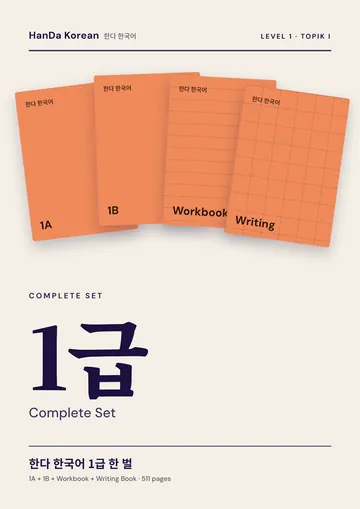 HanDa Korean Level 1 — Complete Set
Everything for level 1 — books, workbook and writing book · 511 pages
$10
HanDa Korean Level 1 — Complete Set
Everything for level 1 — books, workbook and writing book · 511 pages
$10
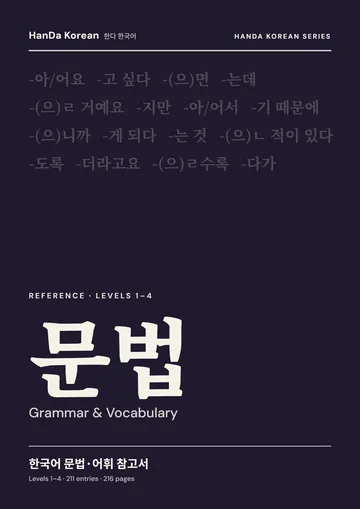 Korean Grammar & Vocabulary Reference
Every pattern in one place · 216 pages
$8
Korean Grammar & Vocabulary Reference
Every pattern in one place · 216 pages
$8
Practice this with an AI tutor
HanDa corrects every sentence you write or say — in real conversation, not flashcards.