Chuseok (추석): What Happens and What to Say in Korean
Here is the one thing to take away: **Korean doesn't wish you a happy Chuseok — it wishes you a well-spent one.** The standard greeting is 추석 잘 보내세요, literally "send Chuseok well." Not 축하해요, not 행복하세요. A holiday in Korean is a stretch of time you pass, not an event you get congratulated for.
That single verb, 보내다, tells you a lot about what Chuseok actually is: three days of travel, cooking, sitting on the floor with relatives, and travelling back. Let's do the greeting first, then the words for everything around it.
The greeting: 보내다, not 축하하다
추석 잘 보내세요. Have a good Chuseok. (before or during the holiday)
즐거운 추석 보내세요. Have a joyful Chuseok.
연휴 잘 보내세요. Enjoy the long holiday. (연휴 = consecutive holiday days — useful when you're not sure someone celebrates)
And once the holiday is over — which is what you'd say today, on the last day, or at work on Monday:
추석 잘 보내셨어요? Did you have a good Chuseok?
연휴 잘 보내셨어요? Did you have a good long weekend?
That past-tense question is one of the most-used sentences in a Korean office the day after any holiday. It works as small talk the way "How was your weekend?" does in English, and it saves you from having to invent anything.
Why not 축하해요?
축하해요 is for things a person achieved or something that happened to them: 생일 축하해요, 졸업 축하해요, 결혼 축하해요. A date on the calendar isn't an achievement. 추석 축하해요 lands on a Korean ear roughly like "Congratulations on Tuesday" — understandable, clearly foreign, slightly funny.
One famous exception is Lunar New Year, which has its own fixed blessing: 새해 복 많이 받으세요 (receive lots of luck in the new year). Chuseok has no equivalent fixed formula, which is exactly why 잘 보내세요 does all the work.
You will also hear 행복한 추석 되세요. It's extremely common on posters and in ads, but 되다 means "become," so strictly it says "become a happy Chuseok" — language teachers flag it as sloppy. Stick with 보내세요 and you're never wrong.
One more you'll hear from older speakers: 명절 잘 쇠세요. 쇠다 is an old verb meaning "to observe a holiday." It's correct and warm, just a generation up from 보내세요. 명절 is the general word for a traditional holiday — Chuseok and Lunar New Year are the two big ones.
What actually happens
Chuseok falls on the 15th day of the eighth lunar month, so it moves around the September–October window each year, and the holiday runs three days: the day before, the day itself, the day after. The shape of it is simple — people go to where their family is from, eat, and come back.
이번 추석에 고향에 내려가세요? Are you going down to your hometown this Chuseok?
Notice 내려가다, "to go down." Koreans say 내려가다 for leaving Seoul and 올라가다 ("go up") for returning to it, regardless of the map. If you live in Seoul, everyone goes down and comes back up.
저는 이번엔 안 내려가요. 서울에 있어요. I'm not going down this time. I'm staying in Seoul.
길이 많이 막혔어요. The roads were really jammed.
막히다 (to be blocked) is the verb for traffic. On Chuseok it's practically a national sport to compare how long the drive took, so 많이 막혔죠? (The traffic was bad, wasn't it?) is safe, easy small talk.
On the morning of Chuseok many families hold 차례, a memorial rite for ancestors, with food set out on a table in a set order. Some families then go to 성묘, visiting the graves to tidy them and bow. Plenty of families now skip both and simply eat together — don't assume either way, and don't ask a new acquaintance about it in detail.
Here's the vocabulary in one place:
| Korean | What it means |
|---|---|
| 추석 | Chuseok, the autumn harvest holiday |
| 한가위 | the native Korean name for 추석 |
| 명절 | a traditional holiday |
| 연휴 | consecutive days off |
| 고향 | hometown |
| 차례 | ancestral rite held on the holiday morning |
| 성묘 | visiting the family graves |
| 송편 | half-moon shaped rice cakes |
| 전 | savoury pan-fried fritters |
| 보름달 | full moon |
| 귀성길 | the journey home to the hometown |
| 귀경길 | the journey back to the city |
| 용돈 | spending money, often given to children |
| 잔소리 | nagging remarks (from relatives, usually) |
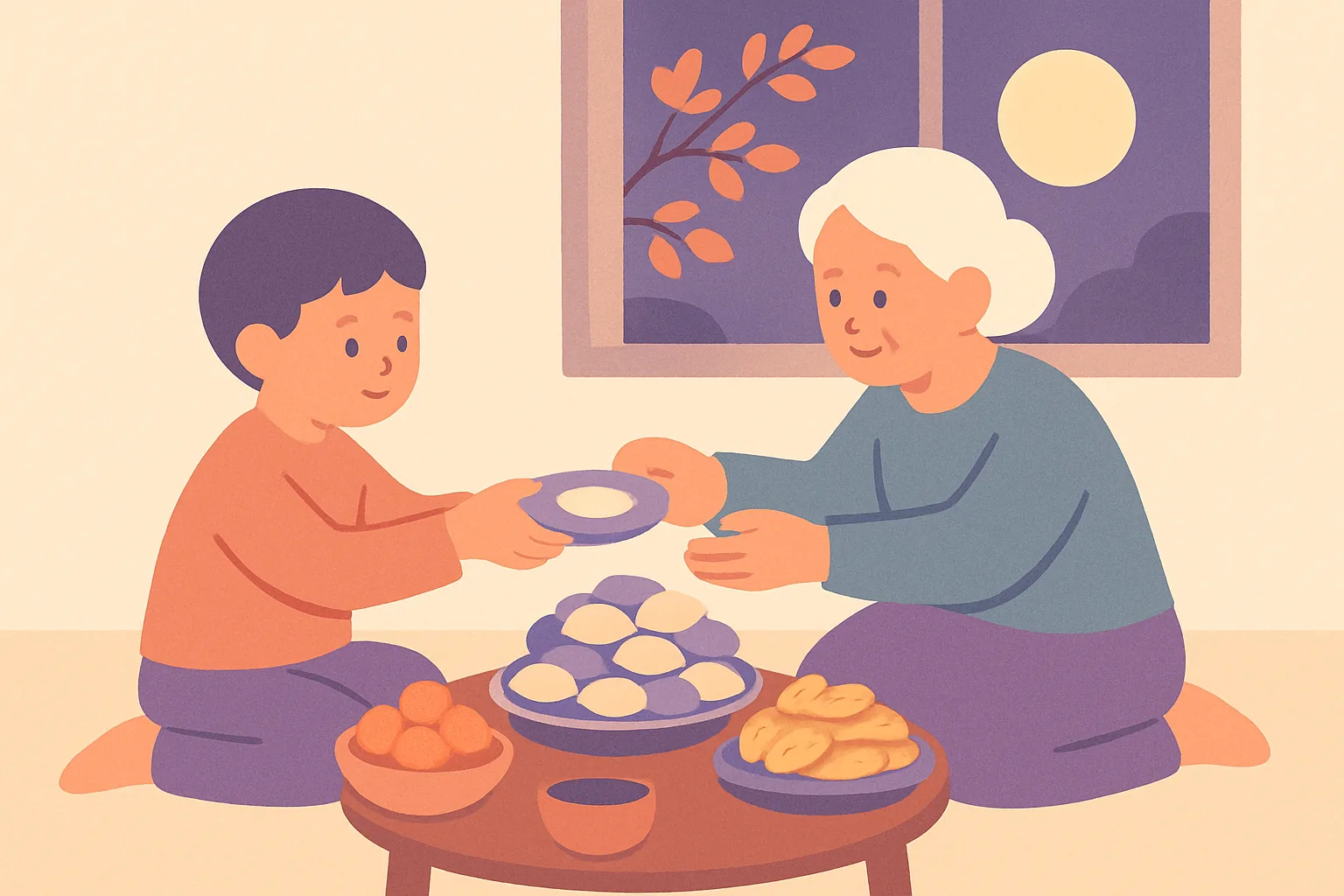
송편 is the food of the holiday: rice-flour cakes folded into a half-moon around sesame, sweet beans or chestnut, steamed on pine needles. Families that make them by hand do it the night before, everyone sitting around the table pinching them shut.
송편 만들어 보셨어요? Have you ever made songpyeon?
저는 깨 송편이 제일 좋아요. I like the sesame ones best.
At someone's family table
If you get invited to a Korean family's Chuseok, the invitation itself is a large gesture. Two things make you look like you were raised right.
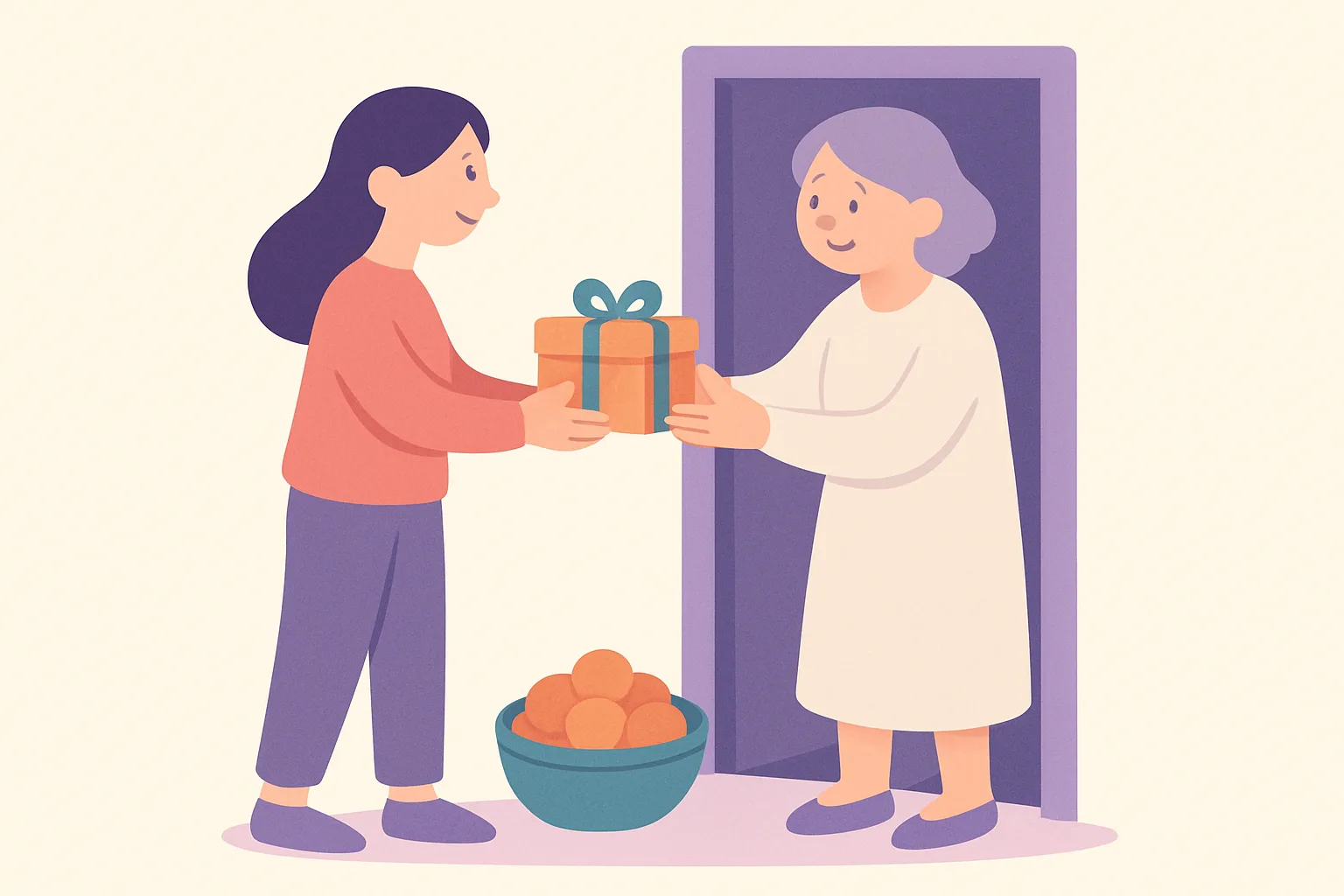
First, arrive with something. Fruit, a boxed gift set, anything — this is the season for it, and how you hand it over matters more than what's inside. If you've never done it, the phrases in our guide to Korean gift-giving etiquette are exactly the ones you need here.
Second, thank the person who cooked. Say it to the host, usually the aunt or grandmother who has been in the kitchen since dawn:
음식 준비하시느라 고생하셨어요. Thank you for going to all that trouble with the food.
잘 먹겠습니다. / 잘 먹었습니다. I'll eat well. / I ate well. (before and after the meal, 합쇼체 — the standard polite register at a family table)
And you will be fed past the point of comfort. The refusal has to be soft:
아니에요, 정말 많이 먹었어요. 진짜 배불러요. No really, I've eaten plenty. I'm so full.
Saying a flat 안 먹어요 sounds curt. If you want the fuller toolkit for turning things down without sounding cold, see how to say no politely in Korean.
The other Chuseok tradition is 잔소리 — relatives asking when you'll get a job, get married, have a baby. It's such a fixture that Koreans joke about it every year. As a guest you'll mostly be spared, but you'll see younger family members go quiet and deflect with a laugh. That skill of reading the temperature of a room is 눈치, and Chuseok is where it gets its annual workout.
Leaving
The last day — today — is the 귀경길, everyone driving back at once. What you say at the door:
조심히 올라가세요. Get back safely. (to someone heading back to the city)
조심히 가세요. Go safely. (works anywhere)
또 뵐게요. 감사합니다. I'll see you again. Thank you.
And the proverb everyone trots out this week: 더도 말고 덜도 말고 한가위만 같아라 — no more, no less, let it always be like Chuseok. Full harvest, full moon, everyone fed. That's the whole feeling of the holiday in one line.
Practice
- Your Korean coworker comes back to the office after the holiday. What do you ask?
- Fill in: 이번 추석에 고향에 ______? (Are you going down to your hometown this Chuseok?)
- Why does 추석 축하해요 sound wrong to a Korean ear?
- An aunt keeps putting food on your plate. Turn it down politely in Korean.
- What's the difference between 귀성길 and 귀경길?
Answers
- 추석 잘 보내셨어요? (or 연휴 잘 보내셨어요?) — "Did you have a good Chuseok / long weekend?"
- 이번 추석에 고향에 내려가세요? — 내려가다, "go down," is the standard verb for leaving the city for your hometown.
- 축하하다 is for achievements and personal events — birthdays, graduations, weddings. A date on the calendar isn't something you congratulate. Use 추석 잘 보내세요 instead.
- 아니에요, 정말 많이 먹었어요. 진짜 배불러요. — "No really, I've eaten plenty. I'm so full."
- 귀성길 is the trip to your hometown at the start of the holiday; 귀경길 is the trip back to the city at the end of it.
Learn this properly, not just once
Blog posts teach one thing at a time. The HanDa books teach level 1 in order — every lesson built to be spoken, with a workbook and writing book beside it.
 HanDa Korean Level 1 — Complete Set
Everything for level 1 — books, workbook and writing book · 511 pages
$10
HanDa Korean Level 1 — Complete Set
Everything for level 1 — books, workbook and writing book · 511 pages
$10
 Korean Grammar & Vocabulary Reference
Every pattern in one place · 216 pages
$8
Korean Grammar & Vocabulary Reference
Every pattern in one place · 216 pages
$8
Practice this with an AI tutor
HanDa corrects every sentence you write or say — in real conversation, not flashcards.