Blue and Green in Korean: 파랗다, 푸르다, 초록색
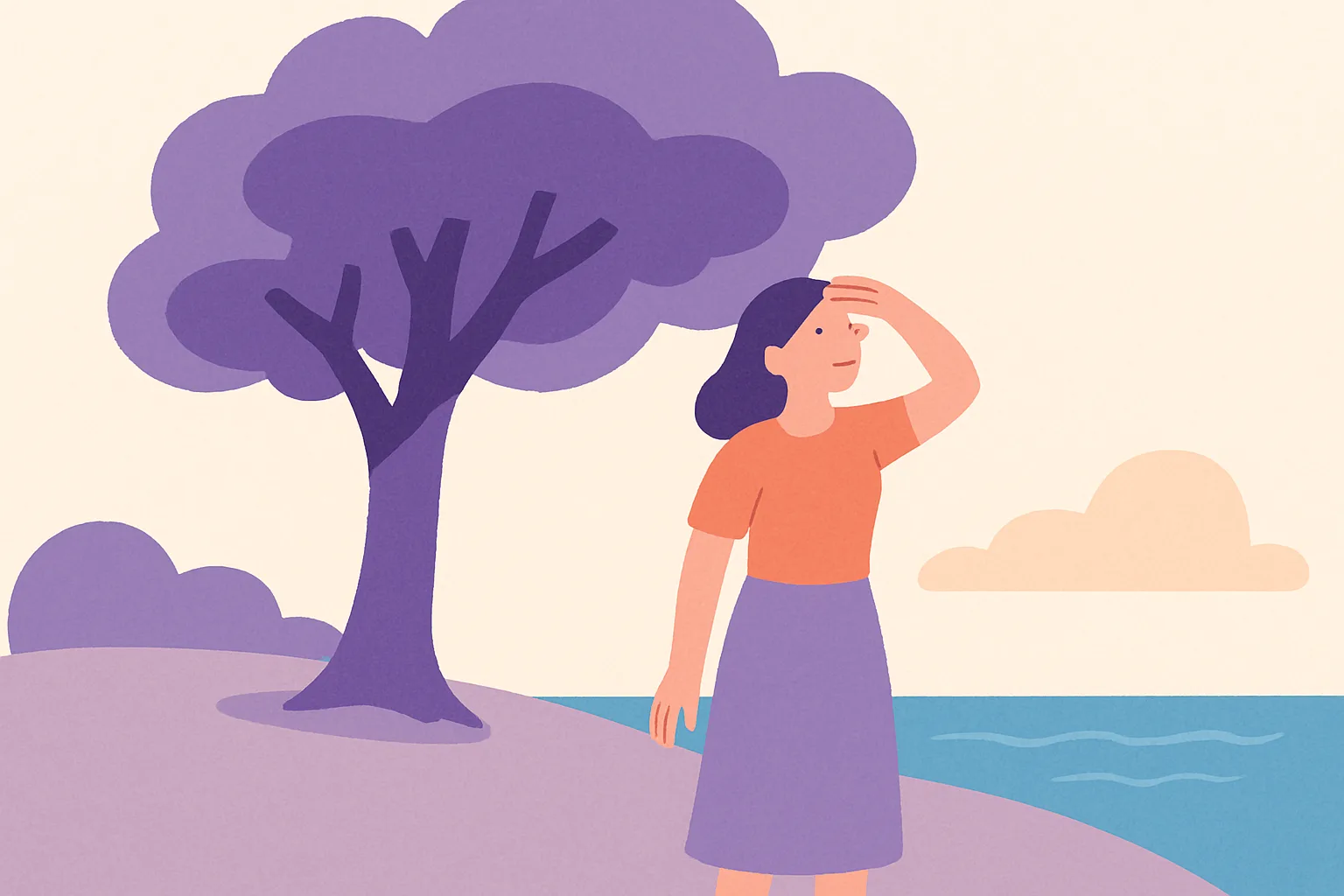
You learn 파란색 = blue and 초록색 = green, and everything is fine until a Korean friend stands at a crosswalk and says 파란불이야, 건너자 — while the light in front of you is clearly green.
Here's the one idea: 파랗다 and 푸르다 cover a band of color that English chops into two. They lean blue, but they stretch over grass, forests, mountains and traffic lights without anyone blinking. 초록색 is the word that means only green — and it's a noun, not an adjective, which changes how you use it.
Once you see the split that way, the whole system stops being confusing. Let's go word by word.
파랗다 — the everyday one
파랗다 is the plain, spoken word. Sky, sea, ink, a blue shirt.
- 오늘 하늘이 정말 파래요. — The sky is really blue today.
- 파란색 볼펜 있어요? — Do you have a blue pen?
- 바다가 파랗고 깨끗해요. — The sea is blue and clean.
파랗다 belongs to the ㅎ-irregular color family — 빨갛다, 노랗다, 하얗다, 까맣다 — so the ㅎ drops before endings:
| Form | 파랗다 |
|---|---|
| 해요체 | 파래요 |
| Past | 파랬어요 |
| Before a noun | 파란 하늘 |
| And / but | 파랗고, 파란데 |
Note that 파랗다 itself is pronounced [파라타] — the ㅎ merges with the following ㄷ. If that surprises you, the same thing happens all over Korean; it's worth knowing the handful of sound change rules that make written Korean and spoken Korean line up.
푸르다 — the one for landscapes
푸르다 means roughly the same color, but it feels wider, calmer and more written. It's the word of mountains, oceans, fields and poems. You'll meet it constantly in song titles, book titles and descriptions of nature, and almost never when someone is describing their socks.
- 창밖으로 푸른 바다가 보여요. — You can see the blue sea out the window.
- 푸른 하늘 아래에서 사진을 찍었어요. — We took photos under the blue sky.
- 비가 온 뒤라 잔디가 더 푸르러요. — The grass is greener now that it's rained.
That last form catches people out. 푸르다 is a 러-irregular verb, so it doesn't become 푸러요 — it becomes 푸르러요, past 푸르렀어요. Before a noun it's simply 푸른.
And notice: in the first two sentences 푸른 is blue water and blue sky; in the third it's green grass. Same word, no contradiction. Koreans aren't being vague — the category genuinely includes both.
Why the green light is 파란불
Traditional Korean color vocabulary didn't draw the blue/green line where English does. One word covered the fresh, living end of the spectrum: new leaves, pine needles, deep water, clear sky. 초록 and 녹색 came in later from Chinese characters as a specific "green," but the older habit stayed in fixed phrases.
The traffic light is the most famous survivor:
- 파란불이 들어왔어요. — The light turned green.
- 파란불에 건너세요. — Cross on the green.
- 신호등이 초록색으로 바뀌었어요. — The light changed to green.
All three are fine. 파란불 is what you'll hear on the street; 초록색 is what you'll see in a driving manual. Nobody will correct you either way, but saying 파란불 makes you sound like you live here.
You'll also hear older speakers say 나뭇잎이 파랗다 (the leaves are blue/green) about trees in summer. That's not a mistake — it's the older, wider 파랗다 doing its job.
This is the kind of place where Korean and English simply don't map one word to one word. If you enjoy that, Korean has plenty of words that refuse to translate cleanly.
When only 초록색 works
For an object that is green — a bag, a dress, a crayon, a car — use 초록색. If you say 파란 원피스 about a green dress, a Korean listener pictures a blue one.
- 저는 초록색 옷을 자주 입어요. — I often wear green clothes.
- 이 가방 초록색도 있어요? — Does this bag come in green too?
- 신호등 초록색은 '가도 된다'는 뜻이에요. — Green on the traffic light means "you may go."
One structural point that saves you a lot of trouble: 초록색 is a noun. There's no adjective 초록하다. So you can't say 가방이 초록해요. You say 가방이 초록색이에요, or put it straight in front of the noun: 초록색 가방.
녹색 is the same color in a more formal register — signs, documents, 녹차 (green tea), 녹색 채소. In casual speech, 초록색 wins.
| Word | Feels like | Typical use |
|---|---|---|
| 파랗다 / 파란색 | plain, spoken | sky, sea, pens, 파란불 |
| 푸르다 / 푸른 | wide, literary | mountains, forests, ocean, writing |
| 초록색 | precise, everyday | clothes, objects, "this exact green" |
| 녹색 | formal, technical | official language, 녹차 |
청 — green hiding in plain sight
The Chinese character 청(靑) is the same blue-green category, and it's frozen inside common words:
- 청바지 — jeans (literally "blue trousers")
- 청포도 — green grapes
- 청사과 — green apple
- 청신호 — a green light, usually figurative: a good sign
오늘은 청바지에 흰 티셔츠를 입었어요. — Today I wore jeans and a white T-shirt.
청포도 주스 있어요? — Do you have green grape juice?
So 청포도 is unmistakably green, and 청바지 is unmistakably blue. Same character. That tells you everything about how the old category worked.
Faces, bruises and baby leaves
Korean color adjectives take intensifying prefixes, and they carry feeling rather than just shade.
- 그 얘기를 듣고 얼굴이 새파랗게 질렸어요. — He went white as a sheet when he heard that. (Korean "goes blue," English "goes white.")
- 너무 추워서 입술이 파래졌어요. — It was so cold my lips turned blue.
- 봄이 되니까 새싹이 파릇파릇 돋아났어요. — Now that it's spring, green shoots are coming up.
새파랗다 is "deep, vivid blue," 시퍼렇다 is its darker, rougher cousin (a bad bruise: 멍이 시퍼렇게 들었어요 — the bruise came up dark blue), and 파릇파릇 is the small, fresh green of new growth. These prefixes are doing emphasis work, the same job as the various words for "very" — but baked into the color word itself.
The short version
- Describing an object's color in daily life: 파란색 for blue, 초록색 for green.
- Describing nature, or writing something with a bit of weight: 푸른 / 푸르러요.
- Traffic light: 파란불 in speech, 초록색 if you want to be literal.
- Don't try to "fix" 파랗다 when a Korean uses it for leaves or a signal. It isn't broken.
Practice
- Fill in: 신호등에 ___불이 들어왔어요. (the light turned green, as a friend would say it)
- Say "I bought a green bag" in 해요체.
- Put 푸르다 into 해요체: 산이 ___.
- Say "The sky was very blue yesterday" in 해요체.
- Which word is green grapes: 청포도 or 파란 포도?
Answers
- 신호등에 파란불이 들어왔어요. (초록색으로 바뀌었어요 also works, but 파란불 is what you'll hear.)
- 초록색 가방을 샀어요. (Not 파란 가방 — that's blue. And never 가방이 초록해요; 초록색 is a noun.)
- 산이 푸르러요. (푸르다 is 러-irregular — not 푸러요.)
- 어제 하늘이 정말 파랬어요. (파랗다 → 파래요 → 파랬어요.)
- 청포도. 청(靑) is the old blue-green category, which is why the same character gives you 청바지 (jeans) and 청사과 (green apple).
Learn this properly, not just once
Blog posts teach one thing at a time. The HanDa books teach level 1 in order — every lesson built to be spoken, with a workbook and writing book beside it.
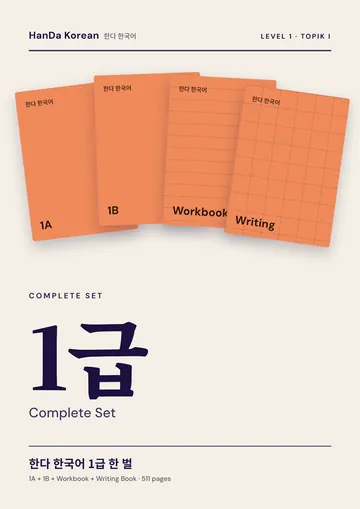 HanDa Korean Level 1 — Complete Set
Everything for level 1 — books, workbook and writing book · 511 pages
$10
HanDa Korean Level 1 — Complete Set
Everything for level 1 — books, workbook and writing book · 511 pages
$10
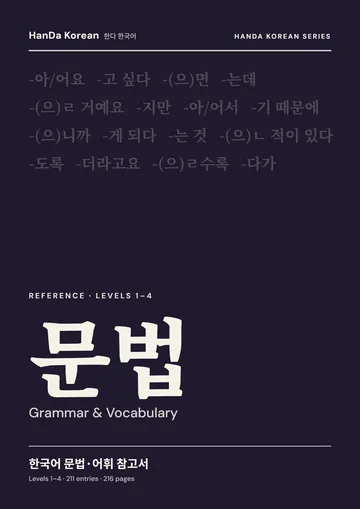 Korean Grammar & Vocabulary Reference
Every pattern in one place · 216 pages
$8
Korean Grammar & Vocabulary Reference
Every pattern in one place · 216 pages
$8
Practice this with an AI tutor
HanDa corrects every sentence you write or say — in real conversation, not flashcards.