Q1
다음에 또 만나요
What does this word mean?
in contrast
let's meet again next time
rather
please wait a moment
다음에 또 만나요 — let's meet again next time (expressions)
Q2
unavoidably
How do you say this in Korean?
역시나
그런가 하면
가령
어쩔수없이
어쩔수없이 — unavoidably (connective)
Q3
배구
What does this word mean?
foul/violation
volleyball
canoe
weightlifting
배구 — volleyball (sports)
Q4
b-boy
How do you say this in Korean?
한류
국악
탈춤
비보이
비보이 — b-boy (culture)
Q5
진언하다
What does this word mean?
to withdraw (suit)
to sort
to postpone
to advise (to superior)
진언하다 — to advise (to superior) (verbs)
Q6
sequel
How do you say this in Korean?
숏폼
시민저널리즘
알고리즘추천
시퀄
시퀄 — sequel (media)
Q7
시장조사
What does this word mean?
market research
preferred stock
cost of goods sold
reshoring
시장조사 — market research (business)
Q8
motto
How do you say this in Korean?
좌우명
멘토
토론
발표
좌우명 — motto (relationships_social)
Q9
-(으)면서
What does this grammar pattern mean?
while / simultaneously
before (doing)
have experience of (doing)
if you want to / in order to
-(으)면서 — while / simultaneously. e.g. 버스를 기다리면서 책을 읽었어요. (I read a book while waiting for the bus.)
Q10
Explain that you turned down the invitation because you already had another appointment.
Which sentence says this correctly?
다른 약속이 있어서 초대를 거절했어요.
학교에 오면서 단어를 복습했어요.
기숙사에 살았을 때 매일 친구들이랑 식당에서 밥을 먹었어요.
예약을 하려고 하는데 토요일 저녁에 자리가 있나요?
-기 위해(서) vs -아/어서 구분 사용 — because vs in order to – contrast. -아/어서: 이유 (앞뒤 주어 같을 때 주로); 청유/명령문 앞엔 -아/어서 불가
Q11
Say after taking this class you came to enjoy studying Korean.
Which sentence says this correctly?
저는 한국어를 조금 할 수 있어요.
학교에 오면서 단어를 복습했어요.
이 수업을 들은 후에 한국어 공부를 즐기게 됐어요.
시간이 날 때 부모님께 전화하고, 출퇴근하는 동안 팟캐스트를 들어요.
-게 되다 — come to know / realize. 즐기다 + 게 됐다: 감정 변화의 자연스러운 결과
Q12
reported speech (past)
Which Korean grammar pattern expresses this?
-고
-는 명사 수식
-다고 하다
-곤 하다
-다고 하다 — reported speech (past). e.g. 뉴스에서 그 회사가 문을 닫았다고 했어요. (The news said that company closed down.)
Q13
-게 되다
What does this grammar pattern mean?
reported speech – suggestion
come to / end up (situation change)
reported speech – indirect question
must / have to
-게 되다 — come to / end up (situation change). e.g. 한국 음식을 좋아하게 됐어요. (I came to like Korean food.)
Q14
do and leave in that state
Which Korean grammar pattern expresses this?
-아/어 두다/놓다
-아/어서
만들어지다
보다
-아/어 두다/놓다 — do and leave in that state. e.g. 내일을 위해 재료를 미리 썰어 놓았어요. (I cut the ingredients in advance and left them ready for tomorrow.)
Q15
재활용을 하면 환경을 지킬 수 있어요.
What does this sentence from the passage mean?
If you recycle, you can protect the environment.
It's because many people move at the same time.
Those interested, please apply by this week.
Traffic during commute hours in Seoul is really complicated.
재활용을 하면 환경을 지킬 수 있어요. = If you recycle, you can protect the environment.
Q16
종이, 플라스틱, 병은 각각 다른 곳에 버려요.
What does this sentence from the passage mean?
Paper, plastic, and bottles go in different places.
But seeing it greet me when I come home relieves my fatigue.
Grandmother makes tteokguk, and its taste is truly unique.
If you order comfortably at home, it arrives the very next day.
종이, 플라스틱, 병은 각각 다른 곳에 버려요. = Paper, plastic, and bottles go in different places.
Q17
쓰레기를 버릴 때는 잘 나누어서 버려야 해요.
What does this sentence from the passage mean?
Looking at the photos, I recall the memories of that day.
When such small actions gather, they create a big change.
When throwing away trash, you have to separate it well.
From shopping to food orders, everything is done online.
쓰레기를 버릴 때는 잘 나누어서 버려야 해요. = When throwing away trash, you have to separate it well.
Q18
씻다
What does this word mean in the passage?
work schedule
delisting
to wash
question/doubt
씻다 (ssit-da) — to wash
Q19
환경
What does this word mean in the passage?
foreigner
latte
environment
segmentation
환경 (hwan-gyeong) — environment
Q20
Which sentence does NOT appear in the passage above?
앞으로 잘 부탁드립니다.
재활용을 하면 환경을 지킬 수 있어요.
종이, 플라스틱, 병은 각각 다른 곳에 버려요.
작은 습관이 지구를 건강하게 만들어요.
"앞으로 잘 부탁드립니다." (Please take care of me from now on.) is from a different passage.
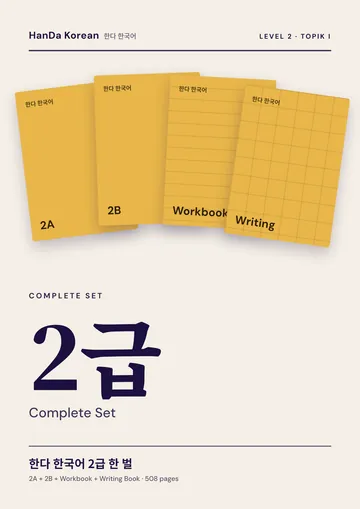 HanDa Korean Level 2 — Complete Set
Complete level 2 — student books, workbook and writing book · 508 pages
$10
HanDa Korean Level 2 — Complete Set
Complete level 2 — student books, workbook and writing book · 508 pages
$10
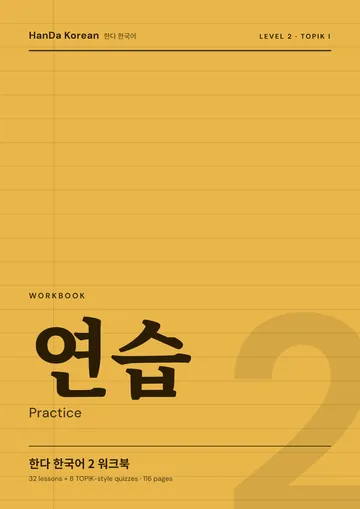 HanDa Korean 2 Workbook
Extra drilling on the same lessons · 116 pages
$6
HanDa Korean 2 Workbook
Extra drilling on the same lessons · 116 pages
$6
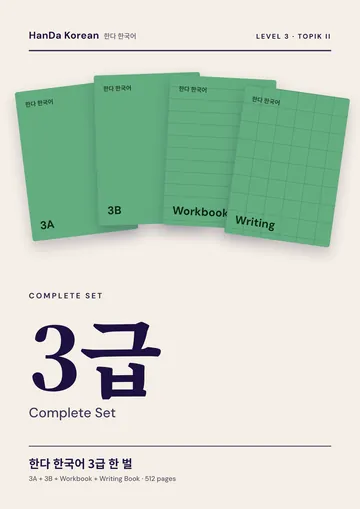 HanDa Korean Level 3 — Complete Set
Complete level 3 — student books, workbook and writing book · 512 pages
$10
HanDa Korean Level 3 — Complete Set
Complete level 3 — student books, workbook and writing book · 512 pages
$10
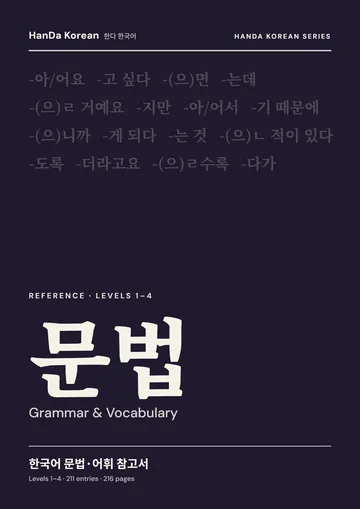 Korean Grammar & Vocabulary Reference
Every pattern from level 1 to 6 in one book · 216 pages
$8
Korean Grammar & Vocabulary Reference
Every pattern from level 1 to 6 in one book · 216 pages
$8
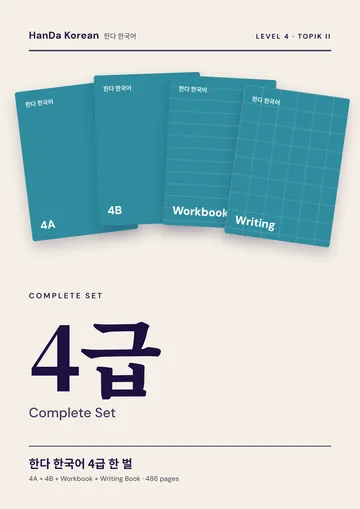 HanDa Korean Level 4 — Complete Set
Complete level 4 — student books, workbook and writing book · 486 pages
$10
HanDa Korean Level 4 — Complete Set
Complete level 4 — student books, workbook and writing book · 486 pages
$10