How to Talk About the Weather in Korean: 덥다, 춥다, 비가 오다
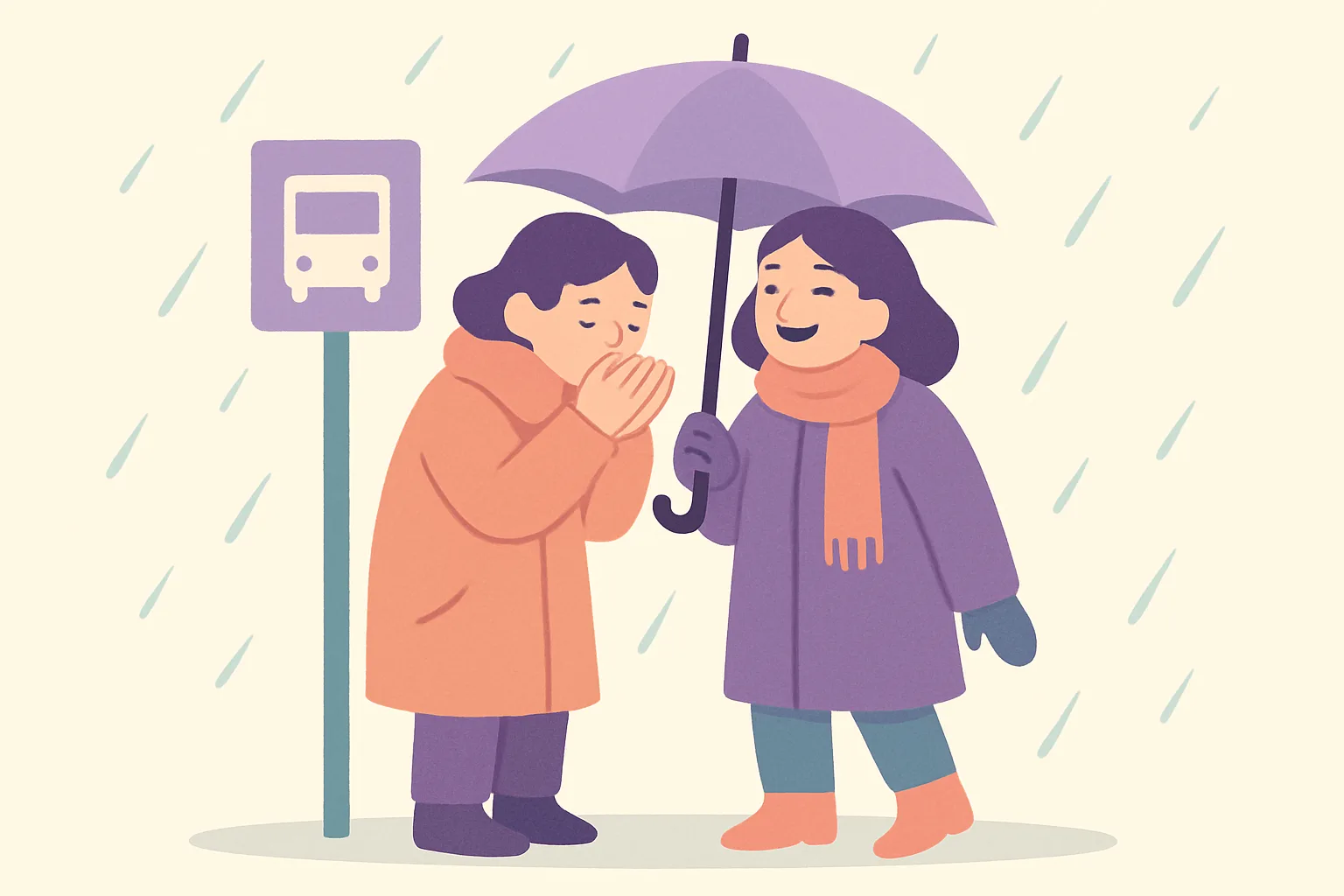
Quick answer: To say it's hot, say 더워요 (deowoyo), from 덥다. To say it's cold, say 추워요 (chuwoyo), from 춥다. To say it's raining, say 비가 와요 — literally "rain comes." All three are 해요체, the polite everyday style you can use with almost anyone.
That's the fast version. But here's the one thing that trips up almost every English speaker, and it's worth two minutes of your attention:
Korean has two sets of hot/cold words. One set is for air — the weather, a room, how your body feels in it. The other set is for things you touch. Mixing them up is the single most common weather mistake learners make.
덥다/춥다 (the air) vs 뜨겁다/차갑다 (things)
| Korean | 해요체 | Use it for |
|---|---|---|
| 덥다 | 더워요 | hot weather, a hot room, feeling hot |
| 춥다 | 추워요 | cold weather, a cold room, feeling cold |
| 뜨겁다 | 뜨거워요 | hot coffee, hot soup, a hot pan |
| 차갑다 | 차가워요 | cold water, cold hands, a cold drink |
All four are ㅂ-irregular: the ㅂ turns into 워 in the polite form. 덥다 → 더워요. 춥다 → 추워요. 뜨겁다 → 뜨거워요. 차갑다 → 차가워요. Learn them as a set and the pattern sticks.
In use:
- 오늘 진짜 더워요. — It's really hot today.
- 국이 너무 뜨거워요. 조심하세요. — The soup is too hot. Be careful.
- 밖에 추워요? 코트 입을까요? — Is it cold outside? Should I wear a coat?
- 물이 차가워요. — The water is cold.
If you say 커피가 더워요, a Korean will understand you, but it lands the way "the coffee is cold-weather" would land in English — clearly non-native. And the reverse, 오늘 뜨거워요 for a hot day, sounds like today itself will burn your hand.
One exception that isn't really an exception: people take the air words. 저 추워요 ("I'm cold") and 더워 죽겠어요 ("I'm dying of the heat," casual but extremely common) are both completely natural. 저 차가워요 would mean you're a cold-hearted person.
For someone else, Koreans usually add 보이다: 추워 보여요. — "You look cold."
비가 오다: in Korean, rain comes
English makes rain a verb. Korean makes it a noun that arrives.
- 비가 와요. — It's raining.
- 비가 많이 와요. — It's raining hard.
- 눈이 와요. — It's snowing.
- 비가 올 것 같아요. — It looks like it's going to rain.
- 비 그쳤어요. — The rain has stopped.
In speech, people often drop the 가: 비 와요, 눈 와요. Both are fine.
You'll also see 비가 내리다. It means the same thing, but it belongs to weather forecasts, song lyrics and writing. If you say 비가 내려요 to a friend at the bus stop, it sounds a touch literary — not wrong, just dressed up. Stick with 와요 in conversation.
And the sentence you'll hear most often on a rainy morning:
- 우산 챙기세요. — Take an umbrella (literally "pack/bring an umbrella").
The in-between words
Most days aren't 덥다 or 춥다. These five cover the rest of the year:
- 따뜻하다 — warm, pleasantly. 오늘은 좀 따뜻해요. (It's a bit warm today.) Also for a drink: 따뜻한 커피 주세요.
- 시원하다 — cool, refreshing. 바람이 시원해요. (The breeze is nice and cool.) Note that Koreans also say 시원하다 about piping-hot soup, meaning it clears your head — one of those words that doesn't map neatly, like several of the words Koreans use for taste and texture.
- 쌀쌀하다 — chilly. Not winter-cold, but jacket-cold. 아침에 좀 쌀쌀해요.
- 습하다 — humid. Korean summers live here. 오늘 너무 습해요.
- 흐리다 — cloudy, overcast. 날씨가 흐려요.
And two verbs you need: 바람이 불어요 (the wind is blowing / it's windy) and 해가 났어요 (the sun came out).
The small talk, which is the real point
Weather talk in Korea works like weather talk anywhere: nobody needs the information. It's a way to open a conversation or fill a lift ride. What's useful is that it follows a script, so you can join in without inventing anything.
Opening line — notice something:
- 오늘 날씨 정말 좋네요. — The weather's really nice today.
- 갑자기 추워졌네요. — It's suddenly gotten cold.
- 비가 계속 오네요. — The rain just keeps coming.
-아/어졌다 means "has become," and it's everywhere in weather talk: 추워졌어요, 더워졌어요, 따뜻해졌어요.
Reply — agree, don't inform:
- 그러게요. — Right? / Tell me about it. This is the standard reply. Learn it today.
- 그러니까요. — Exactly.
- 네, 어제보다 더 추운 것 같아요. — Yes, it feels colder than yesterday.
A Korean almost never answers a weather comment with a correction or a fact. Agreement is the whole point. If you reply to 춥네요 with "실제로는 어제가 더 추웠어요" (actually yesterday was colder), it's grammatical and slightly cold-blooded.
Closing line — care:
- 감기 조심하세요. — Take care not to catch a cold.
- 따뜻하게 입으세요. — Dress warmly.
- 조심히 들어가세요. — Get home safely.
That three-beat shape — notice, agree, wish well — is the whole conversation. It works at the office, with a neighbour, with a shop owner. If you're still collecting ready-made lines, it pairs naturally with the first phrases every beginner needs.
반말 and the shout-it-out form
With friends, drop the 요: 야, 진짜 덥다. (Man, it's hot.) Notice that this is the dictionary form 덥다 itself, not 더워. Korean uses the plain form as a spoken exclamation — something you blurt out to the air rather than say to a person. 아, 춥다. walking out of a building. 와, 시원하다. stepping into air conditioning. It's one of the most natural-sounding things a learner can pick up, and it's the same plain style explained in what 한다 means in Korean.
With a boss or an older stranger, keep the 요: 오늘 좀 덥네요. You don't need 합쇼체 for weather — 해요체 is right in almost every situation.
FAQ
How do you say "it's hot" in Korean?
오늘 더워요 — "It's hot today." The base word is 덥다, and it becomes 더워요 in polite speech because it's a ㅂ-irregular verb. Among friends you can say 덥다 or 더워. Use 더워요 only about the weather, a room or how your body feels — not about food or drinks.
What's the difference between 덥다 and 뜨겁다?
덥다 is hot air: the weather, a stuffy room, your own body in that heat. 뜨겁다 is a hot object: coffee, soup, a stove, bathwater. So 오늘 더워요 (it's hot today) but 커피가 뜨거워요 (the coffee is hot). The cold pair works the same way — 추워요 for weather, 차가워요 for things.
How do you say "it's raining" in Korean?
비가 와요, literally "rain comes." In casual speech people often drop the particle and just say 비 와요. For snow, swap the noun: 눈이 와요. 비가 내려요 means the same but sounds like a forecast or a song, so keep 와요 for conversation.
Practice
Fill in the blank with the right word.
- 조심하세요. 국이 아주 ______. (The soup is very hot.)
- 갑자기 ______. (It's suddenly gotten cold — use -아/어졌어요.)
- A: 오늘 날씨 좋네요. B: ______. (Agree with one word.)
- 우산 챙기세요. 오후에 ______ 것 같아요. (It looks like it'll rain this afternoon.)
- Your friend walks in shivering. Say "You look cold."
Answers
- 뜨거워요 — a thing you touch, so 뜨겁다, not 덥다.
- 추워졌어요 — 춥다 + -아/어지다 (to become).
- 그러게요. (그러니까요 also works.)
- 비가 올 — 비가 올 것 같아요.
- 추워 보여요. (Casual: 추워 보인다 / 춥겠다.)
Learn this properly, not just once
Blog posts teach one thing at a time. The HanDa books teach level 1 in order — every lesson built to be spoken, with a workbook and writing book beside it.
 HanDa Korean Level 1 — Complete Set
Everything for level 1 — books, workbook and writing book · 511 pages
$10
 Korean Grammar & Vocabulary Reference
Every pattern in one place · 216 pages
$8
Practice this with an AI tutor
HanDa corrects every sentence you write or say — in real conversation, not flashcards.