전하, 마마, 아니 되옵니다: The Korean of 사극 K-Dramas
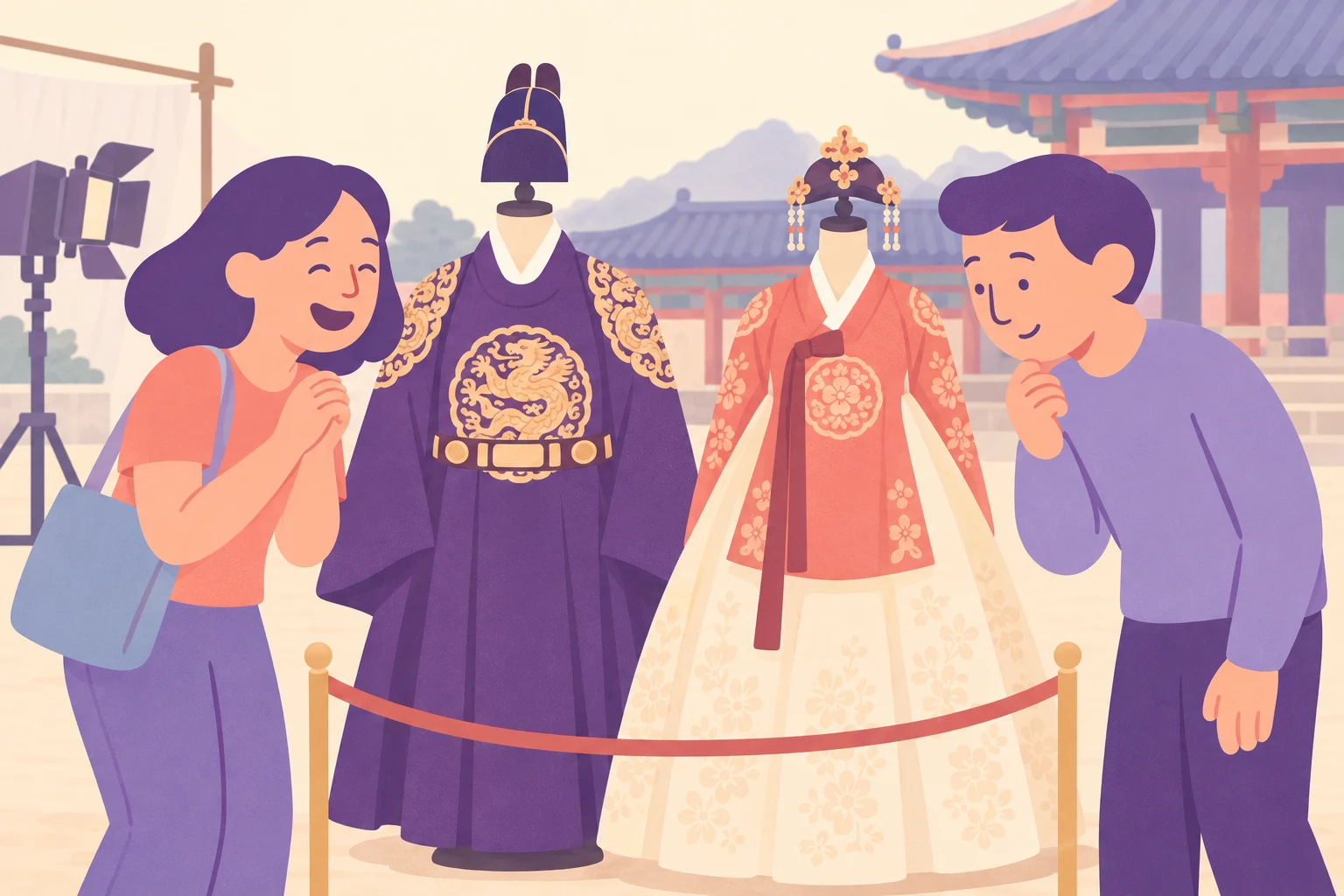
You turn on a 사극 (historical drama) and suddenly the Korean you've been studying is gone. Everyone is saying 전하 and 마마, sentences end in -옵니다 and -소서, and the subtitles just say "Your Majesty" and "Yes, sir."
Here's the one idea to take away: in 사극, the endings are the power map. Modern Korean marks politeness too, but historical drama Korean marks rank — precisely, in every single sentence. Once you can hear it, you know who outranks whom before anyone explains anything. You will never need to speak this register. But hearing it doubles what you understand.
The titles: who gets called what
These are address terms, used instead of names. Calling someone by their name in these scenes would be shocking.
| Title | Who it's for | Rough English |
|---|---|---|
| 폐하 | an emperor | Your Imperial Majesty |
| 전하 | the king | Your Majesty |
| 저하 | the crown prince (세자) | Your Highness |
| 마마 | attached to royal women's titles: 중전마마 (queen), 대비마마 (queen dowager) | Your Highness / My Lady |
| 대감 | a high-ranking minister | My Lord |
| 나으리 | any official, said by a commoner | Sir / My Lord |
| 마님 | the lady of a noble house | Madam |
| 도련님 / 아씨 | the young master / young lady of the house | Young Master / Young Miss |
One thing that trips English speakers up every time: 마마 is not "mama." It has nothing to do with mother. It's an honorific suffix for royalty. What does mean mother here is 어마마마 — what a prince or princess calls the queen. The father is 아바마마.
어마마마, 소녀 문안 인사 올리옵니다. Royal Mother, your daughter greets you.
Notice 소녀 — "this girl." That's the second half of the system.
The pronouns: you shrink yourself, or you don't
In 사극, people almost never say 저 or 나. They say a word that states their rank relative to the listener.
- 소인 — "this lowly person." A commoner, a servant, a merchant.
- 소신 — "this humble subject." An official speaking to the king.
- 소녀 — a young woman to her elders.
- 과인 — "a person of little virtue." This is the king talking about himself. It sounds humble but only a king can use it, which makes it the grandest word in the room.
소인은 아무것도 모르옵니다. This lowly one knows nothing.
소신이 다녀오겠사옵니다. Your humble subject will go, Your Majesty.
과인이 직접 가겠다. I will go myself.
Look at the third one. The king ends in plain -다, no politeness at all — because there is no one above him. That flat ending is the status marker.
The endings you hear a hundred times an episode
-옵니다 / -사옵니다 — speaking upward
That little -옵- is an extra humble layer stuffed into the normal formal ending. 하옵니다 is 합니다 with the volume of deference turned up.
전하, 아뢰올 말씀이 있사옵니다. Your Majesty, there is something I must report.
아뢰다 is "to report to a superior" — the word itself only goes upward.
성은이 망극하옵니다. Your grace is boundless. (What you say when the king grants you something.)
아니 되옵니다, 전하. You must not, Your Majesty.
That last one is the sound of a whole court kneeling in a row. In modern Korean it's just 안 됩니다.
-소서 — the pleading request
This is the old request ending, stronger and more formal than 주세요.
통촉하여 주시옵소서. Please consider it deeply / I beg you to reconsider.
You'll hear it right after 아니 되옵니다, usually from someone whose head is on the floor.
하오체 — equals, with distance
Sentences ending in -오 / -소. Used between adults of similar standing: two ministers, a husband and wife in a yangban household.
무슨 일이오? — What is it? 그만하시오. — Stop it. 어서 오시오. — Come in, please.
To a modern Korean ear this is instantly "period drama" or "very old-fashioned novel." Nobody talks like this at work.
하게체 — downward, but respectful
Endings in -네, -는가, -게, plus the pronoun 자네 ("you," from an elder to a grown younger person).
자네, 무슨 일인가? What is it, my friend?
어서 오게. Come in.
A professor to an adult student, a father-in-law to a son-in-law — 하게체 still exists in modern Korean but it's rare and skews old and male.
해라체 and commands — downward, no cushion
물러가라. — Withdraw. 그리 하거라. — Do so. 그것이 세상 이치니라. — That is the way of the world.
-니라 is the sage-voice ending. A king, a teacher, a grandmother delivering a verdict.
Sageuk line → modern Korean
This is the part that's actually useful for your speaking. Every ornate line has a plain modern twin:
| 사극 | Modern Korean | English |
|---|---|---|
| 아니 되옵니다 | 안 됩니다 | You can't / It mustn't be |
| 아뢰옵니다 | 말씀드립니다 | I'm telling you (respectfully) |
| 그러하옵니다 | 그렇습니다 | That's correct |
| 송구하옵니다 | 죄송합니다 | I'm sorry |
| 분부대로 하겠사옵니다 | 말씀하신 대로 하겠습니다 | I'll do as you said |
| 어서 오시오 | 어서 오세요 | Welcome / Come in |
| 무슨 일이오? | 무슨 일이에요? | What's going on? |
What the subtitles lose is exactly this gap. "Yes, Your Majesty" is the translation for 예, 전하 and for 그러하옵니다, 전하 and for a silent bow — three very different amounts of fear.
Can you ever use any of this?
As real speech, no. Say 통촉하여 주시옵소서 to your boss and you are doing a bit, not being polite. But that's the point — Koreans do use these lines as jokes, and now you can too, sparingly, in text with friends:
A: 내가 커피 살게. — I'll buy the coffee. B: 성은이 망극하옵니다. — Your grace is boundless.
It's the Korean equivalent of replying "I am forever in your debt, my liege." Funny once. Very unfunny if you can't also produce the normal version, which is 고마워 or 감사합니다.
So: watch 사극 for the map. Listen for who gets 전하, who says 소인, who ends flat in -다. Then say 감사합니다 like a normal person.
Practice
- Who would say this, and to whom? 소신이 다녀오겠사옵니다.
- Put this into modern polite Korean (합쇼체): 아니 되옵니다.
- A princess addresses the queen. What two words does she use for "mother" and for "I"?
- Which is the crown prince's title: 전하, 저하, or 마마?
- Modernize this 하오체 line: 무슨 일이오?
Answers
- A government official speaking to the king. 소신 = "your humble subject," and -사옵니다 marks speech going upward to the throne. A commoner would say 소인.
- 안 됩니다. (Or 안 돼요 in 해요체.)
- 어마마마 for "Royal Mother," and 소녀 ("this girl") for "I."
- 저하. 전하 is the king; 마마 attaches to royal women's titles such as 중전마마 and 대비마마.
- 무슨 일이에요? (or 무슨 일입니까? in 합쇼체)
Practice this with an AI tutor
HanDa corrects every sentence you write or say — in real conversation, not flashcards.