Paying by the Hour in Korean: 노래방, PC방, 찜질방
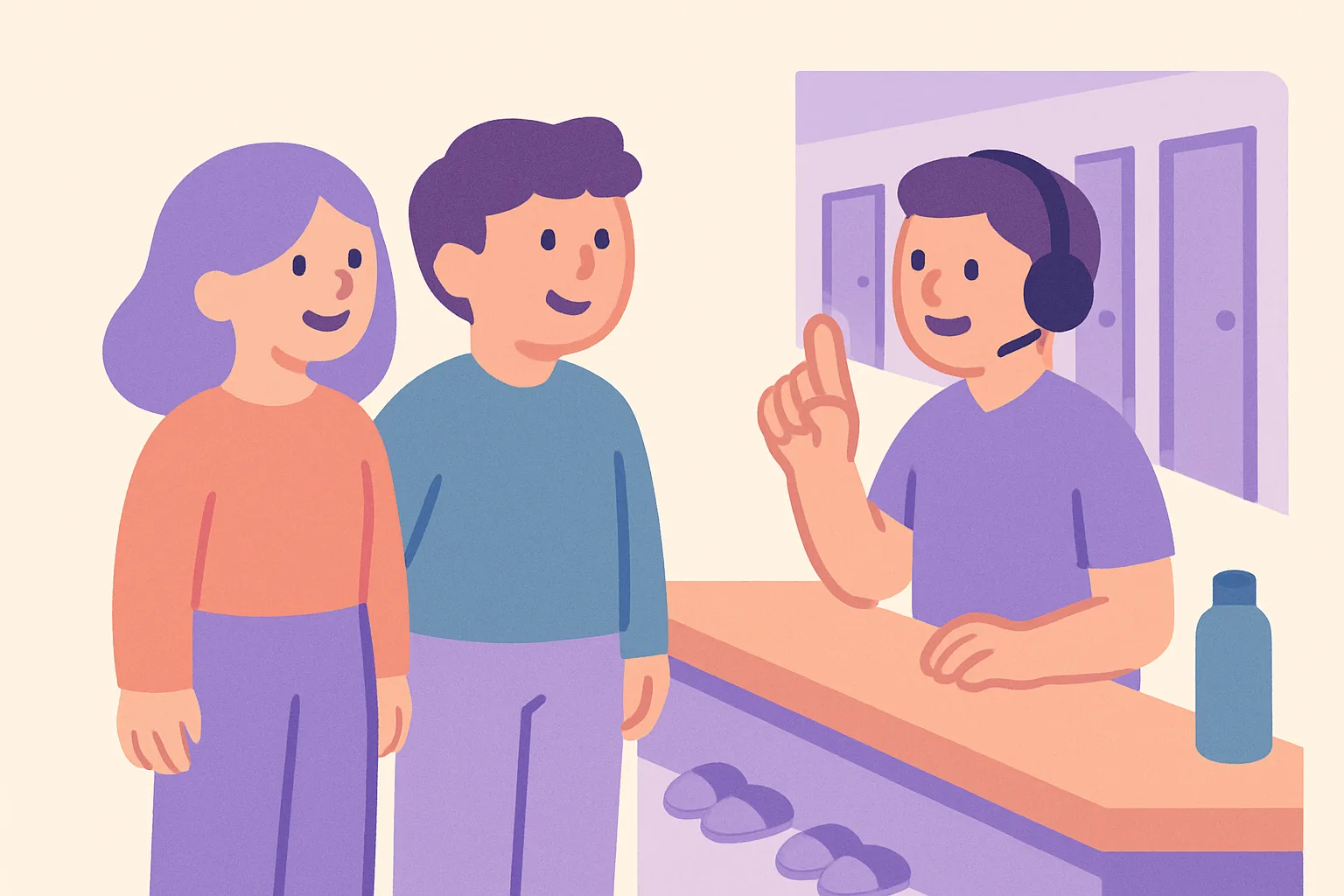
Here is the one thing that makes the counter at a 노래방, PC방 or 찜질방 feel different from a café: you are not buying a product. You are buying time.
That sounds obvious until you're standing at the desk and the staff says something in four syllables and looks at you. In a café you name a thing (아메리카노 하나 주세요) and you're done. In a 방, the conversation is about how many hours, is it paid before or after, and do you want more time. Different nouns, different verbs, and one verb in particular that English speakers almost never guess.
If you want the room-by-room tour first — what each place is, what's inside, what to expect — read the guide to 방 culture. This article is just the money-and-time part, done properly.
The verb is 하다, not 사다
In English you'd say "I'd like to buy an hour." In Korean, 사다 sounds wrong here — 사다 is for objects that go in a bag. Time gets 하다 (do) or 끊다 (literally "cut," used for buying tickets and blocks of time).
한 시간 할게요. We'll do one hour.
두 시간 끊을게요. I'll take two hours.
Both are completely normal at a counter. 할게요 is the softer, more common one; 끊을게요 sounds slightly more decisive, the way a regular says it. And the shortest version, which you'll hear constantly:
한 시간이요. One hour, please.
That little -이요 tag turns a bare noun into a polite answer. When the staff asks how long, you don't need a verb at all. Beginners often over-build the sentence — 한 시간을 하고 싶어요 is grammatical but sounds like you're explaining a wish rather than ordering. At a counter, short is natural.
Counting the time correctly
This trips up almost everyone: hours take native Korean numbers, minutes take Sino-Korean numbers. In the same breath.
| Written | Said | English |
|---|---|---|
| 30분 | 삼십 분 | 30 minutes |
| 1시간 | 한 시간 | 1 hour |
| 1시간 30분 | 한 시간 삼십 분 | 1.5 hours |
| 2시간 | 두 시간 | 2 hours |
| 3시간 | 세 시간 | 3 hours |
Saying 일 시간 instead of 한 시간 is the single most common slip, and it does sound off — like saying "one-th hour." Practice just the first four rows out loud; that covers 95% of what you'll ever order.
선불 or 후불
Two words worth memorizing as a pair:
- 선불 — pay first (prepaid)
- 후불 — pay after
Many PC방 work on a prepaid balance: you put money on an account and the clock counts down. 찜질방 usually take an entrance fee at the door, then anything you eat inside goes on your locker key and gets settled on the way out. 노래방 vary. So the useful move is to ask:
선불이에요? Do I pay now?
And the answer you'll hear:
계산은 나갈 때 하시면 돼요. You can pay on the way out.
하시면 돼요 ("you can just ~") is the workhorse phrase of Korean service language. Once you recognize it, half of what staff say to you becomes clear.
At a PC방, topping up sounds like this:
만 원 충전해 주세요. Ten thousand won on my account, please.
충전하다 is "to charge/top up" — the same verb for a phone battery, a transit card, or PC방 time. Very useful word.
Asking for more time
When the hour runs out and nobody wants to leave, you need one of these. Both are normal; pick either.
시간 연장할게요. I'll extend the time.
한 시간 추가할게요. I'll add another hour.
30분만 더 할게요. Just 30 more minutes.
That -만 더 ("just ~ more") is worth stealing. 조금만 더 = just a little more. It softens the request and sounds friendly rather than demanding.
And the freebie: 서비스 in Korean doesn't mean "service." It means on the house. If someone puts extra minutes on your 노래방 machine, they might say:
서비스로 10분 더 드릴게요. I'll give you 10 extra minutes, on the house.
This is one of those loanwords that has quietly changed meaning in Korean — there are a lot more like it once you start noticing.
The question that confuses everyone: 몇 분이세요?
Korean has two 분. One means minute. The other is the polite counter for person. So:
몇 분이세요? How many people are you?
몇 분 하실 거예요? How many minutes will you do?
Same syllable, totally different question. Context decides it, and honestly, the first one is far more common at a door. If someone greets you with 몇 분이세요?, they're counting heads — answer 두 명이요 (two people) or 세 명이요 (three people). Use 명 for yourself; 분 is the honorific counter, so applying it to your own group sounds odd.
Other lines you'll actually hear:
몇 시간 하실 거예요? How many hours would you like?
자리 있어요? Do you have a seat free? (you ask this at a PC방)
신발은 신발장에 넣어 주세요. Please put your shoes in the shoe locker. (찜질방, at the entrance)
시간 다 됐습니다. Your time is up.
That last one is 합쇼체, the formal announcement style — machines, intercoms and signs use it. Everything you say back can stay in 해요체. You don't need to match the formality of a loudspeaker.
One warning about 괜찮아요
When the staff offers you something — extra time, a towel, a top-up — the reflex answer 괜찮아요 is no thank you, not yes please. Koreans read it as a polite refusal in that situation. If you want the thing, say 네, 주세요. If you don't, 괜찮아요 with a small hand gesture is perfect. (The full story of this beautifully slippery word is here.)
Putting it together
A whole 노래방 counter exchange, start to finish:
직원: 몇 분이세요? — How many people? 나: 두 명이요. — Two. 직원: 몇 시간 하실 거예요? — How long? 나: 한 시간 할게요. 선불이에요? — One hour. Do I pay now? 직원: 네, 선불이에요. 5번 방으로 들어가세요. — Yes, prepaid. Go into room 5.
Five short lines and you're in. Notice there isn't a single complicated sentence in there — no relative clauses, no fancy endings. Counter Korean is short by design, which is exactly why it's a great place for a beginner to speak.
If the place takes bookings and you'd rather sort it out before you arrive, the same time vocabulary carries straight over to making a reservation by phone.
Practice
Say these out loud before you check.
- You're at a 노래방 with a friend. Answer the door question, then order one hour.
- You want 30 more minutes in your PC방 seat. What do you say?
- Ask whether you pay in advance.
- Put 10,000 won on your PC방 account.
- The staff asks 몇 분이세요? — what are they asking, and what's wrong with answering 한 시간이요?
Answers
- 두 명이요. / 한 시간 할게요. (or 한 시간이요.)
- 30분만 더 할게요. — or 시간 연장할게요.
- 선불이에요?
- 만 원 충전해 주세요.
- They're asking how many people are in your group — 분 here is the polite counter for people, not "minutes." Answer with 명: 두 명이요. Saying 한 시간이요 answers a question nobody asked, which is exactly the kind of small mismatch that makes a conversation stall.
Practice this with an AI tutor
HanDa corrects every sentence you write or say — in real conversation, not flashcards.